Can Nepal show the way in climate leadership?
This is a fundamental question for a country confronting growing climate risks despite contributing only a small share of global greenhouse gas emissions.
This is a multifaceted challenge that must be tackled on multiple fronts.
First, Nepal needs a total reset of its diplomatic engagement.
Attracting foreign investment will remain a top priority as Nepal seeks to meet the ambitious economic growth targets set by the Balen Shah administration, particularly the goal of building a $100 billion economy within the next seven to ten years.
At the same time, climate action should play a much greater role and be mainstreamed across all aspects of foreign policy.
In this regard, it is a positive development that Foreign Minister Shishir Khanal traveled to the South Pacific to attend the pre-COP31 meeting in Tuvalu, one of the frontline countries in the fight against climate change.
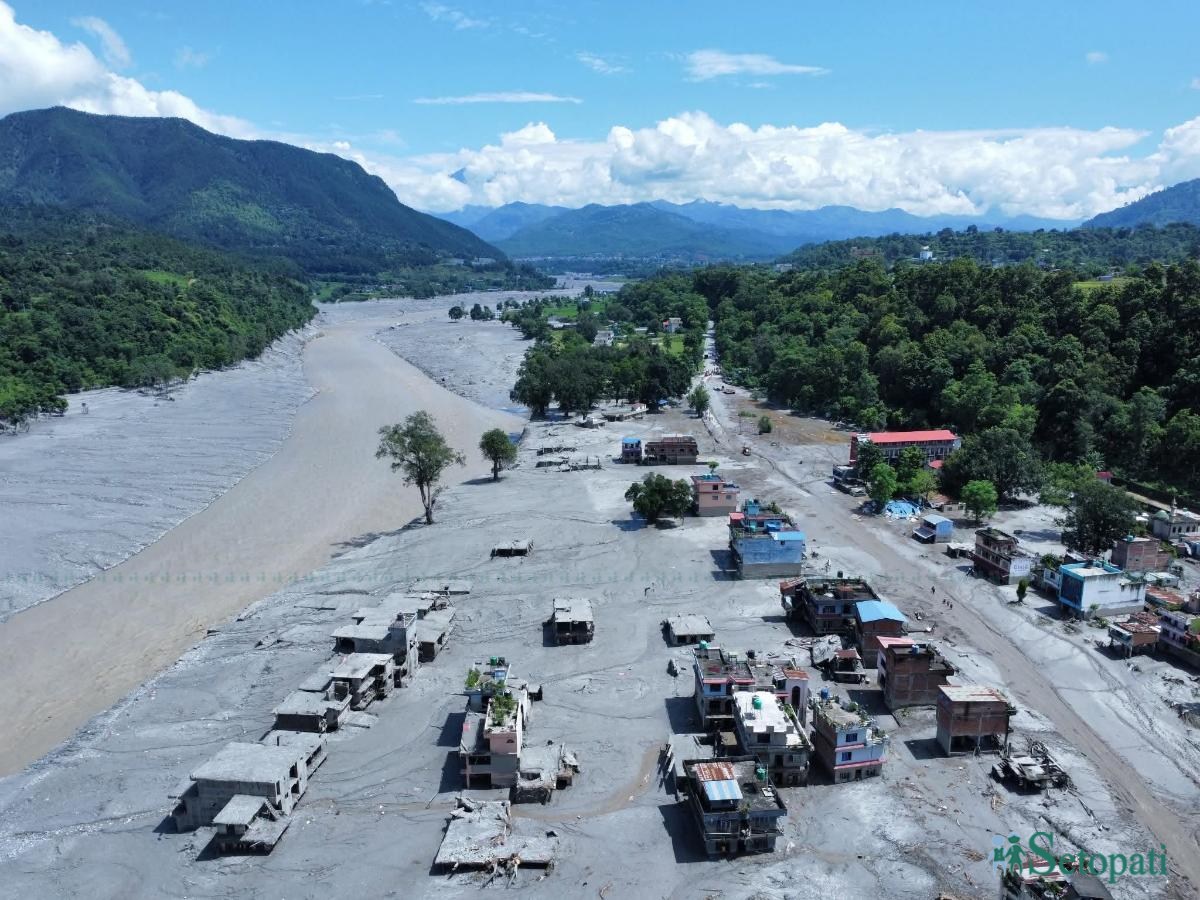
Had Nepal not been hit by the recent, tragic Bhotekoshi flood, the trip might never have taken place.
The visit sends an important signal to the international community that Nepal is serious about climate diplomacy and wants to make its mark at the upcoming negotiations in Antalya, where the COP31 will be held.
Foreign Minister Khanal did the right thing by making the long journey to the Pacific and is showing the way.
Yet this enormous battle against climate change requires Nepal to do more than merely show the way.
The country also has a great deal of work to do at home.
State institutions, at all levels, cannot fight this battle alone. It is easy to overlook the role of non-state actors but a strong, multilayered coalition is essential for tackling climate change.
The new generation is a key constituent in what should become an alliance of politicians, civil servants, civil society members, private sector representatives working together.
Can it really happen? Can different stakeholders, each with a different mandate and unique perspective, come together?
The country’s youths are ready not only to support this society-wide effort but also to lead it.
The recently concluded Kathmandu Climate Week showed that youths are more than ready to take on this responsibility head-on.
Held over three days, from October 2 to 4, the initiative showed that the youths of the nation are well equipped to make a difference. And based on my observations during the sessions I attended, I can say that the initiative was genuine and not just a tokenistic exercise.
Inspired by the well-known and well-funded London Climate Week and the similar NYC Climate Week, KTM Climate Week aimed to send a strong message to society at large and beyond.
In London and New York, hundreds of events are typically organized where heads of states and governments sit together with executives from major companies, mayors, governors, and civil society members to discuss climate action. KTM Climate Week was much smaller in scale.
Nevertheless, it shared the same vision and ambition as its more famed counterparts in the West.
With more than 20 sessions held at different venues across the Kathmandu Valley, KTM Climate Week was able to capture the imagination of hundreds of citizens, mostly youths, who wanted to deepen their understanding of the most intricate climate policies.
With topics ranging from climate finance, loss and damage, mitigation, and adaptation to issues related to climate vulnerability, carbon markets, and the role of indigenous peoples, the attendees had ample opportunities to interact and explore new views and insights into the multiple and interrelated areas of climate action.
Remarkably, the event did not have just one organizer.
Instead, organizations, groups, and individuals acting in their personal capacities came together organically and in a true spirit of partnership, managed to accomplish what might otherwise have been an impossible mission.
Despite very limited time and extremely scarce resources, the organizers successfully put together a great show.
I wanted to know more about the behind-the-scenes efforts, so I contacted Dikshit Thapa Magar, the youngest member of the organizing team.
Dikshit is also the executive director of the Institute for Rural Development, a promising initiative that works to empower and guide local leaders and communities to lay the foundations for sustainable rural development rooted in Nepal's ethos.
Dikshit, a social entrepreneur, researcher, tech geek, and brilliant musician, was quick to emphasize that she was just one member of the team.
In her own words: “The whole KTM Climate week was possible because of the collaborative approach that was adopted. There were many organizations and even some individuals not affiliated to an organization who worked really hard to make it happen. And as one of the younger people in the room, I hope I can carry a small part of that responsibility forward.”
She shared with me further reflections by email for this article, which I believe deserve to be published in full.
“Being part of Kathmandu Climate Week 2026, and being the youngest member of the organizing team, gave me a perspective I did not expect to have. For three days, I listened to conversations that were very different from one another. We spoke about loss and damage, climate finance, energy, agriculture, Indigenous Peoples, media, fashion, war, research, and local communities. What stayed with me most was that climate justice cannot be understood from one perspective. A researcher may see the changing cryosphere. A farmer may see a changing monsoon. An Indigenous community may see a threat to their land and way of life. A young person may see a future that feels increasingly uncertain. A policymaker may see the challenge of turning all of this into action. All of these experiences are part of the same climate story. As a young person on the organizing team, I also want to say something clearly: young people do not only want to be invited into climate conversations; we want to be meaningfully engaged in the work that follows.
We have different ways of seeing the problems around us, and we also have a responsibility to help build what comes next. But meaningful youth participation should go beyond putting young people on a panel, giving them a microphone, or asking them to take a photograph at an event. It means giving young people space to research, organize, question, design, implement, and help make decisions.
I hope Kathmandu Climate Week can be remembered not simply as three days of conversations, but as a beginning of continued work. I came into Kathmandu Climate Week thinking about climate mostly through the lens of young people and the future. I leave with a broader understanding: climate justice is also about the people who are living with the consequences today, the communities whose knowledge has often been overlooked, and the generations who have protected these places long before climate change became a global conversation.
Maybe that is what meaningful climate action should look like: not one voice becoming louder than another, but many different voices being heard and turning that understanding into action.
I am grateful to have been part of the team, to have listened, learned, contributed, and worked alongside people from so many different backgrounds. And I hope this is not the end of the conversation.”
One of the most important outcomes of the initiative was the Kathmandu Call. As the youngest member of the organizing team, Dikshit was entrusted with reading it at the closing plenary.
She did that with determination and confidence, but I also found her approach grounded and shaped by the humility that characterizes her.
It is important to highlight some aspects of the Kathmandu Call. First, it is ambitious in its rhetoric but also operational and action-oriented. Its first point provides for the fundamental goal of any type of action that Nepal wants to pursue in the field of climate action: climate justice must remain central to the country’s climate response.
Achieving this requires directly linking vulnerability, resilience, inclusive community participation, and equitable development.
With the first point laying the foundations for climate justice, point 2 of the Call sates: “Nepal should initiate the formulation of a dedicated Climate Justice Act to establish a comprehensive legal framework for equitable climate action.”
Point 3 is also ambitious. It states that “the drafting of the Nepal Climate Change Policy, 2083, must ensure the meaningful participation of local and provincial governments, provincial and federal parliaments, frontline communities, and civil society organizations.”
Point 15 makes another important demand with the “call for the formation of a Permanent Parliamentary Committee on Climate Justice that shall operate with a mandate focused on legislative oversight, policy integration, and international advocacy for climate justice.”
Overall, the Call sets out an ambitious policy agenda that the coalition behind KTM Climate Week seeks to pursue in the months ahead.
Another remarkable fact is that the Call also strongly advocates a new "Mountains to Sea" narrative to “establish global leadership and forge strategic alliances with mountain nations, Pacific nations, and Small Island Developing States.”
I believe there are also practical ways to engage citizens, especially by establishing climate citizens’ deliberative forums across the country.
Nepal could also consider establishing a statutory National Council comprising experts to serve as an independent watchdog and provide science-based analysis and recommendations.
Moreover, the country needs climate-centric state institutions. This requires rethinking national and local governance from a perspective of how institutions can be better equipped to tackle climate change and its consequences.
At the same time, the Call represents an important effort to make the climate movement more inclusive and diverse.
More youths from historically marginalized communities should be supported in developing the skills and knowledge required to become climate justice activists. Why should they not also become climate negotiators one day?
There is no better way to conclude this article than by reproducing Dikshit’s final words in full.
These words are inspiring and encouraging and convince me that Nepal is on the right path to addressing the challenge of climate justice.
The reason is simple.
Youths like Dikshit and her colleagues, together with the organizations, volunteers, and community representatives who worked behind the scenes to make KTM Climate Week a reality, not only offer hope for the future but also show that the country’s new generation has what it takes to make a difference.
“The Call asks for stronger research, fairer climate finance, meaningful participation, stronger local governments, protection of Indigenous and marginalized communities, and better climate institutions. The Kathmandu Call for Climate Justice brought many of these voices into one place. For me, that was perhaps the most meaningful part of Kathmandu Climate Week. It reminded me that climate action should not only be about speaking for people, but also about making enough space for people to speak for themselves. The Kathmandu Call is a call for action. I hope my generation will be there not only to answer it, but to help carry it forward.”