Over the last few months, there has been a persistent, almost relentless effort at pushing back against one of the most enduring myths of Nepal’s journey towards becoming an inclusive nation.
Thanks to a series of legal victories in the courts affirming the rights of citizens in the LGBTQ+ community, a narrative has been set.
And over the years, it has become more and more consolidated, according to which the country has become a beacon for the inclusion of sexual minorities.
Unfortunately, this is far from the truth.
As a damning report recently published by the Blue Diamond Society shows, there is still a long way to go before citizens identifying as LGBTQ+ can truly enjoy their rights, especially in terms of their identities being fully recognized by state authorities, starting from local levels.
But isn’t it also important to contextualize the struggle of this community within the broader and more diverse landscape of inclusiveness and equity that characterizes Nepal these days?
In other words, isn’t it relevant, while talking about the inalienable and yet daily infringed rights of citizens belonging to sexual minority groups, also to step back a moment and reflect on the larger struggle that those fighting for gender equality have been facing?
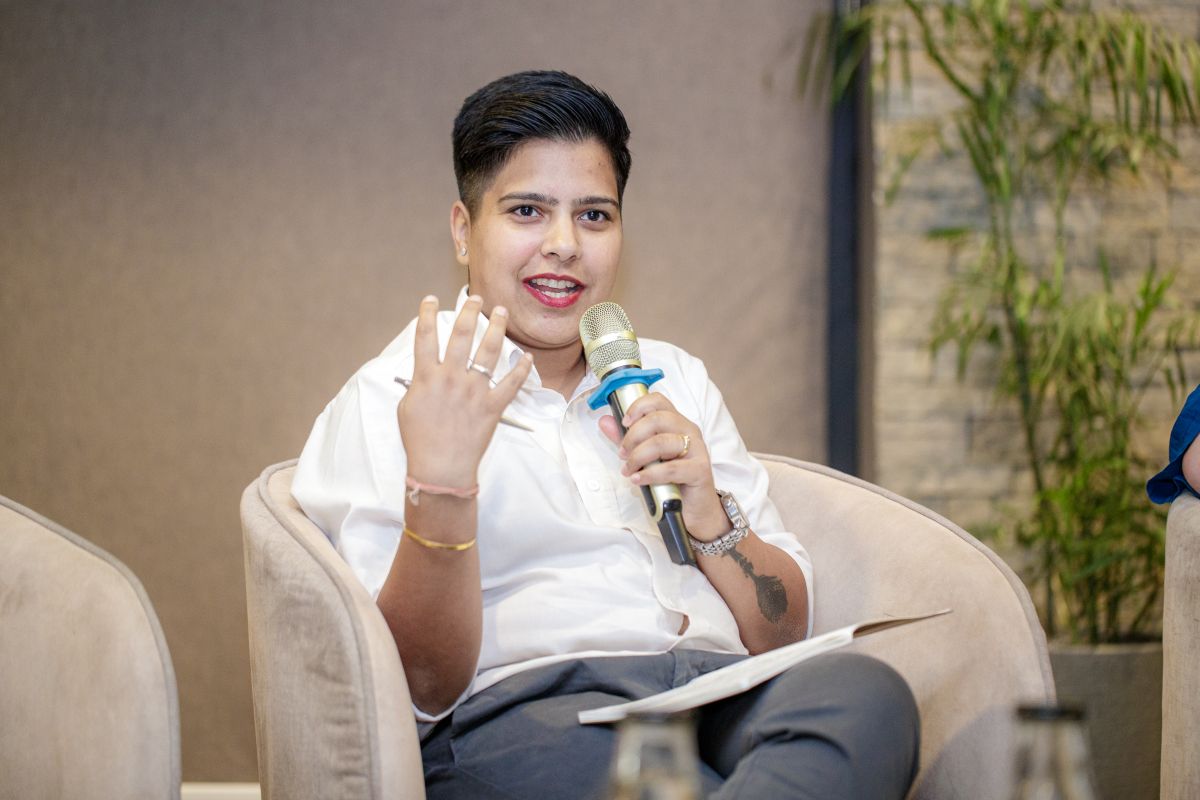
In a recent event organized by the Nepal Office of the Friedrich Ebert Stiftung focused on feminism, I had the opportunity to listen to Shailee Chaudhary, who identified as a Madheshi Marwari Queer person.
I had known her since her earlier work on caste discrimination while she was associated with Dalit Lives Matter Global Alliance, the campaigning initiative of Pradip Pariyar, and Shailee has been holistically advocating and campaigning for gender justice over the last 10 years.
As a panelist at that event, I was struck by Shailee’s broad perspective and capacity to link social justice issues that, despite being naturally connected to each other, unfortunately end up being cast through separate lenses.
Her broad latitude in thinking and connecting dots in the discourse on gender equality is currently instrumental in her work in the migration sector, where she now leads Global Migrant Workers Network, a global initiative focused on migrants’ rights.
The reader knows what I am talking about: the so-called “silos approach.”
Topics that should seamlessly weave into each other through a real amalgamation centered on social justice are artificially set apart.
In a follow-up conversation I had with her, I wanted to further understand Shailee’s views and perspectives.
Starting from the foundations, she asked herself: “What does gender justice mean in Nepal?”
We might feel tempted to take for granted this question and avoid answering it.
But, in reality, to go to the bottom of the persistent barriers to gender inclusion in Nepal, we have to deal with it; it is unavoidable.
“What does gender justice mean for a Muslim woman or a Dalit woman or members of the LGBTQ+ community?” Shailee asked.
“For example,” she further explained, “the 33% women representation in politics is real, but which women do fill these seats? What about women from minority groups?”
The present status of representation of women is an example of what Shailee calls “intersectional exclusion.”
“Women are a box. Madheshis are a box. Dalit is a box. And there is a systematic but invisible mechanism here, a single-axis logic that recognizes identities one at a time and erases the people who carry more than one,” Shailee further explains.
“Madheshi Dalit women, they do not generally get represented through quotas; how many of them are currently in positions of power?”
The LGBTQ+ are categorized under the “others” marker, boxing a diverse category of citizens representing different identities.
This is artificial, and it creates more vulnerabilities.
A similar instance happens when we talk about gender responsive allocation of resources, according to Shailee.
“Also, when we talk about gender responsive budget, what often happens in practice is just a tagging exercise. As a consequence, money gets labeled gender responsive without asking or thinking which women will benefit from it”.
Then Shailee touched on a sensitive issue: a remedial tool that is often misunderstood, also because of the wrong ways it is used: affirmative provisions.
“The way quotas are being implemented is also problematic”.
“Positive discrimination can be a powerful and indispensable tool, but at the same time, quotas have frozen different dimensions of gender identities in a way that diversity inside the women category has been effectively erased”.
“Moreover, non-binary people do not fit in the box”, she further told me.
“Unfortunately, binary is the core, the assumption of efforts of including women, and this is problematic and it is the main cause of all the issues that LGBTQ+ members have to face to be recognized for who they are by the state apparatus.”
Indeed, despite some legal wins, including the 2007 Supreme Court ruling that directs the state to recognize sexual and gender minorities, there are still immense obstacles across the whole bureaucratic system that keep ignoring the rights of citizens with a gender identity that, historically and culturally, is not recognized as “mainstream.”
What should be a simple administrative procedure instead can become a nightmare that lasts for years.
Here we are reaching a key issue.
This is what, according to Shailee, is truly the “elephant in the room” that is too often conveniently ignored.
“Binary discrimination is not happening by chance. It all starts with the country being founded on a binary perspective.”
This is the starting point of a reflection that challenges the traditionally narrow approach of dealing with gender issues because the binary approach erases identities not immediately categorized according to traditional terms.
“The National Civil (Code) Act 2017 is by design and intent binary, and this is the most fundamental problem facing the nation,” she further explained.
“Nepal might look ready and progressive on paper, but this actually, in reality, does not guarantee freedom.”
“It is problematic the fact that international recognition of Nepal’s stances towards LGBTQ has created a narrative that actually is not justified.”
This is a constant refrain you continue to hear from LGBTQ+ activists, but perhaps this collective pushback from the community, challenging the narrative of Nepal being a “paradise” for sexual minorities, is starting to pay off.
The cracks in this generalized (and convenient) image of the country, a stereotype if you think about it, are slowly emerging, and they are visible.
What we need, according to Shailee, are holistic and comprehensive solutions, new provisions that can set aside all the hurdles and inconveniences that the members of the LGBTQ+ communities face on a daily basis that actually are flagrant examples of discrimination.
“Let’s go for a new Marriage Equality Act as a way to break the current impasse and go beyond the existing Marriage Act that is very narrowly binary.”
“A completely new Marriage Act would be transformative because it would cover substantive rights, including adoption, inheritance, pensions, etc.”
A lot will depend on how the stance that the Supreme Court will take in following up on its landmark interim ruling in 2023 that, by directing the government to set up a separate register for same sex couples willing to marry, effectively temporarily legalized same-sex marriage.
So far, even this temporary ruling did not prove to be very effective in fending off sheer discriminatory attitudes by officials in government offices.
Finally, I discussed with Shailee about the September 2025 Uprising, as I was wondering to know her opinion about the levels of inclusiveness of the Gen Z movement in the aftermath of the incidents.
“After the uprising, the conversations held online and offline have not been inclusive enough, not only for citizens from the LGBTQ+ community but also from the Madheshi community and Dalit citizens”.
“How many youths from the LGBTQ+ were leading the Gen Z movement?”
At the end of the day, unfortunately, the Gen Z movement has been a faithful mirror of the broader society with its division, segregation and ultimately, discrimination.
Wrapping up our conversation, Shailee wants to remain positive and hopeful.
“At a formal level, we need strong, bold policy interventions, including overarching new pieces of legislation that must be based on and shaped by disaggregated data and intersectional co-design.”
“But we also need to shift from representation, formal representation to substantive power over the national agenda and budget,” she told me.
“The everyday self-organizing of marginalized communities and solidarity among them is giving me hope.”
“But at the end of the day, social justice centered on the diversity and respect of women from minority ethnic and religious groups and from the LGBTQ+ community will only happen when there is a redistribution of power. Let’s not forget that, ultimately, gender equality and equity are all about power.”