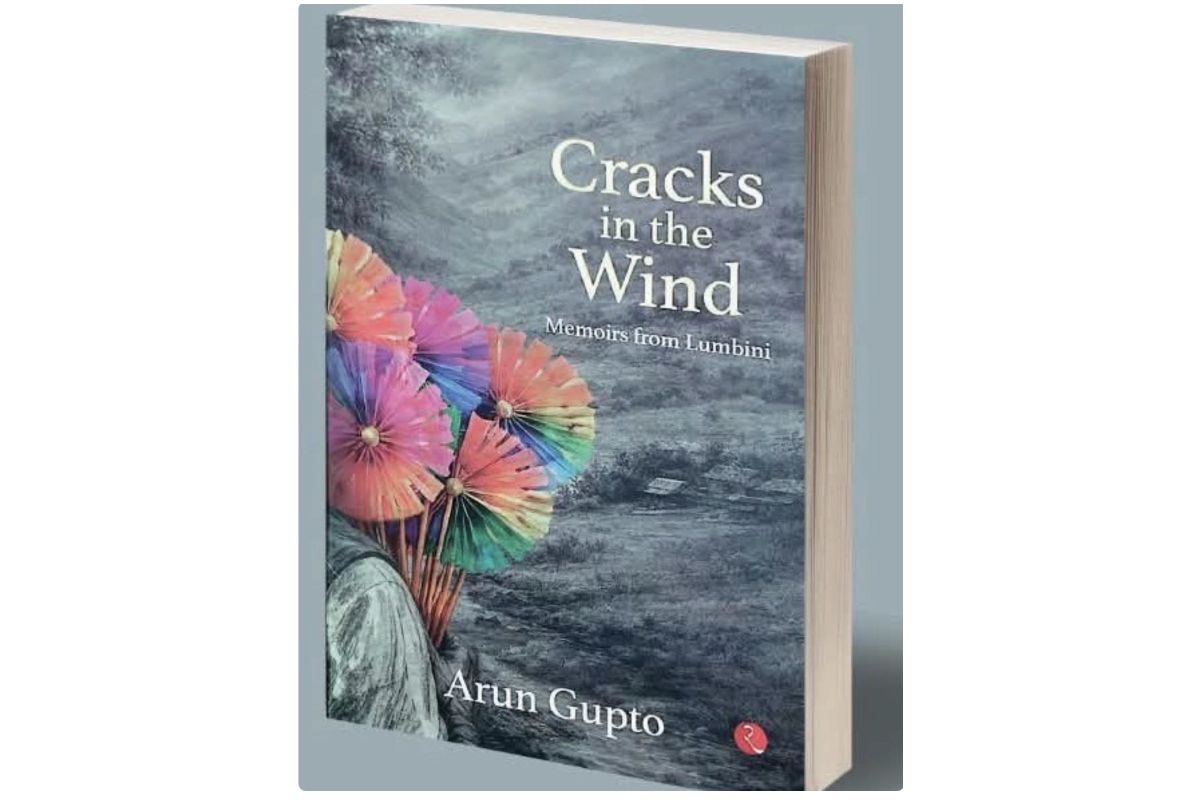
The wind - How does it crack?
Or asked more aptly, what makes the wind crack?
Or asked more relentlessly, what begets a crack in the wind?
Dr Arun Gupto’s book titled “Cracks in the wind” runs right into these inescapable queries. First, by investigating and categorically taking the readers through some uncharted meanderings where they can easily get lost in life’s unfolding.
Second, by taking them into life’s labyrinth but eventually (and inevitably) rescuing them with a ladder where a way out clears up so the readers can walk along the path where the wind has untenably fractured.
The whole journey of going back and forth, trying to frame and reframe the saga of what the author has tried to sculpt through his characters become even clearer as readers eventually get to hear toward the very beginning of the book when his grandmother whispers to herself,
“When the modest fall, the wind cracks.”
Gupto doesn’t know what she means so he ruminates, “…often, on chillier nights, when I search of the courage of my own nature, I find myself kneeling before the quiet, unsung deeds of others, learning how to carry their stories forward, now with so many gone, the tales of our village and family feel both distance and aching. Still, years have gone by and yet the cracks continue to drift on the face I loved reminding me of what endures and what is lost…………. Whenever I felt adrift, my grandmother's words would console.”
She then says, “We are what the wind has scattered. The wind scatters all.”
Those words eventually turn out to be the soul of Gupto’s book. They make the bloodline, the fiber that bound up and sustain the matrix of his world.
Grandma’s words also become the heartbeat of every page, every character and their stream of consciousness and even for a sliver of time, none can escape the sanctity of her utterance.
To understand why she thinks the wind scatters all requires us not to look anywhere else but within our inner gaze and our inner routes, the forms that give us the criteria of onlooking and define to us our world and show how we’ve agreed to live next with ourselves.
A wind is a force that drifts along and in nature comes to us in many ways. A breeze, for instance, runs through our face. We cannot hold it or wish it differently. It is formless, has no structure, no contours, chorus or rhyme.
It instantiates in randomness and passes in a drift.
We just happen to be bystanders when it arrives and it leaves in a wisp as though it never was there, having us stand in awe, combed by it, mediated by it and inherited in its embrace. And that is how we know we’ve passed through it.
And the cracks?
Grandma says, the cracks are what is left behind in us.
Our experience, our human understanding of the world, the stories – the ones we tell others and also ourselves, our way of life and the meaning we give and derive from it. Those all come from the cracks in the wind.
In other words, the wind is the movement of time and what it leaves behind for us are its bequeaths.
Dr. Gupto just didn’t write this book.
He just didn’t reminisce, or make an expression of an ontology catering to an epistemology.
None of them are here… Readers will find none.
What readers will find instead, in the midst and in their total bewilderment, is that their ethos have suddenly been wayfaring into the dialectics of human soul where sensemaking is composed by the gaze provided by the author’s stream of consciousness, who at first sight, seems to be telling a saga of his childhood, but in fact is insisting every reader to stare at the inner quells of their disquietudes and into those deep cracks of, as Hannah Arendt would say, life’s Vita Activa.
We find his narratives holding onto the brittle moorings of time and amidst the ebb and flow of his grandmother’s passing winds.
The characters delve back and forth, up and down, here and there and at the very end readers subtly realize that they indeed have not been reading this book. Instead, the book has been reading them all along…