The journey of a thousand miles begins with a single step (Lao Tzu). For a poor country like Nepal, this journey is not defined by its pace, but by the direction it follows. For a low‑income country like Nepal with limited budget and high public expectations, this direction must be capable of meeting those expectations. It should avoid duplication, tokenistic performances, and symbolic reform. Rather, it must be able to tell citizens not only what should be developed, but why, how, and for whom.
Following the Rastriya Swatantra Party's landslide victory in the March 5 election, a new government was formed under the leadership of its senior leader, Balendra Shah, with a cabinet that has a median age of just thirty-six. This is a rare and powerful moment of hope for youth engaging in politics, not only in Nepal but around the globe. Soon after taking office, the cabinet announced a working guideline, “Governance Agenda,” structured around twelve thematic sections containing one hundred policy points. These agendas are aimed at reforming entire sectors in governance and development. Many of these initiatives focus on improving transparency, accountability, and service delivery. They are considered the enduring pathways in a long journey to confront clientelism, mismanagement, and the institutional inertia created by the old political guard.
Nepal has seen gradual progress over the years, but this progress has continually been hindered by significant ill-governance issues. Development programs thus have repeatedly fallen into a vicious cycle of red‑tape, procedural delays, and bureaucratic risk aversion. They have not only created hindrances to progress but also generated widespread frustration among citizens. Dissecting the one hundred policy points, this article focuses on the reforms related to public procurement and improvements in environmental impact assessments in infrastructure development.
Firstly, regarding public procurement in Nepal, it is governed by the Public Procurement Act, 2007, and the Public Procurement Rules, 2007. The Act was designed to promote efficiency, transparency, competitiveness, and accountability in the procurement process. Over time, it has also been effective in strengthening procedural control and limiting discretionary decision-making. However, the Act relies on the lowest-bidder principle, which has made infrastructure delivery increasingly difficult and, in many cases, counterproductive. Such a bidding mechanism satisfies short-term fiscal optics and budgetary constraints and shallow understanding of public expenditure on long-term cost-benefits. However, it systematically externalizes long-term costs through compromised quality, implementation delays, frequent variations, and high operation and maintenance burdens. Despite the low bidding issue, the current Procurement Act also bears numerous shortcomings arising from institutional, governance, procedural, and economic factors (ref Figure).
Though the procurement process is interlinked between contractors and government oversight bodies with equal responsibilities, there is a clear hierarchy between these sectors and government authorities, thus creating institutional imbalances. Similarly, there are contradictory legal frameworks, dispute-resolution mechanisms (courts or adjudicators), creating multiple legal loopholes for both parties. The procurement planning and contract management are mostly unilateral and top-down. The cost ceiling and project qualifications are under the authority of bureaucratic mechanisms, thus limiting market competition. These overall results in projects that appear cost-effective during the bidding phase (project preparation phase) often become financially, socially, and environmentally costly over their lifespan. These limitations have two repercussions. First, they treat infrastructure more as a technocratic entity focused on procedural compliance. Second, the collaboration among all stakeholders remains weak, fragmented, and mostly symbolic.
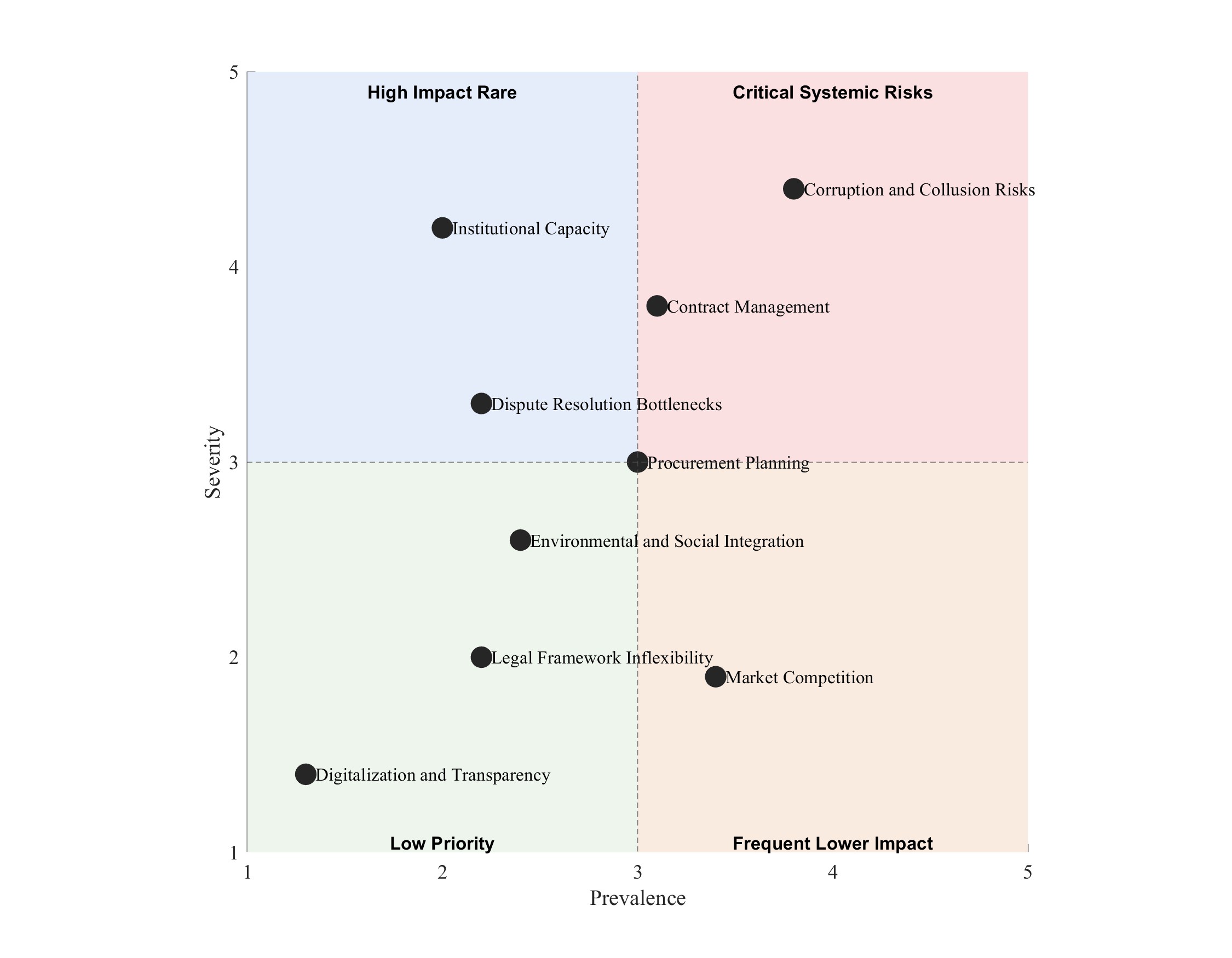
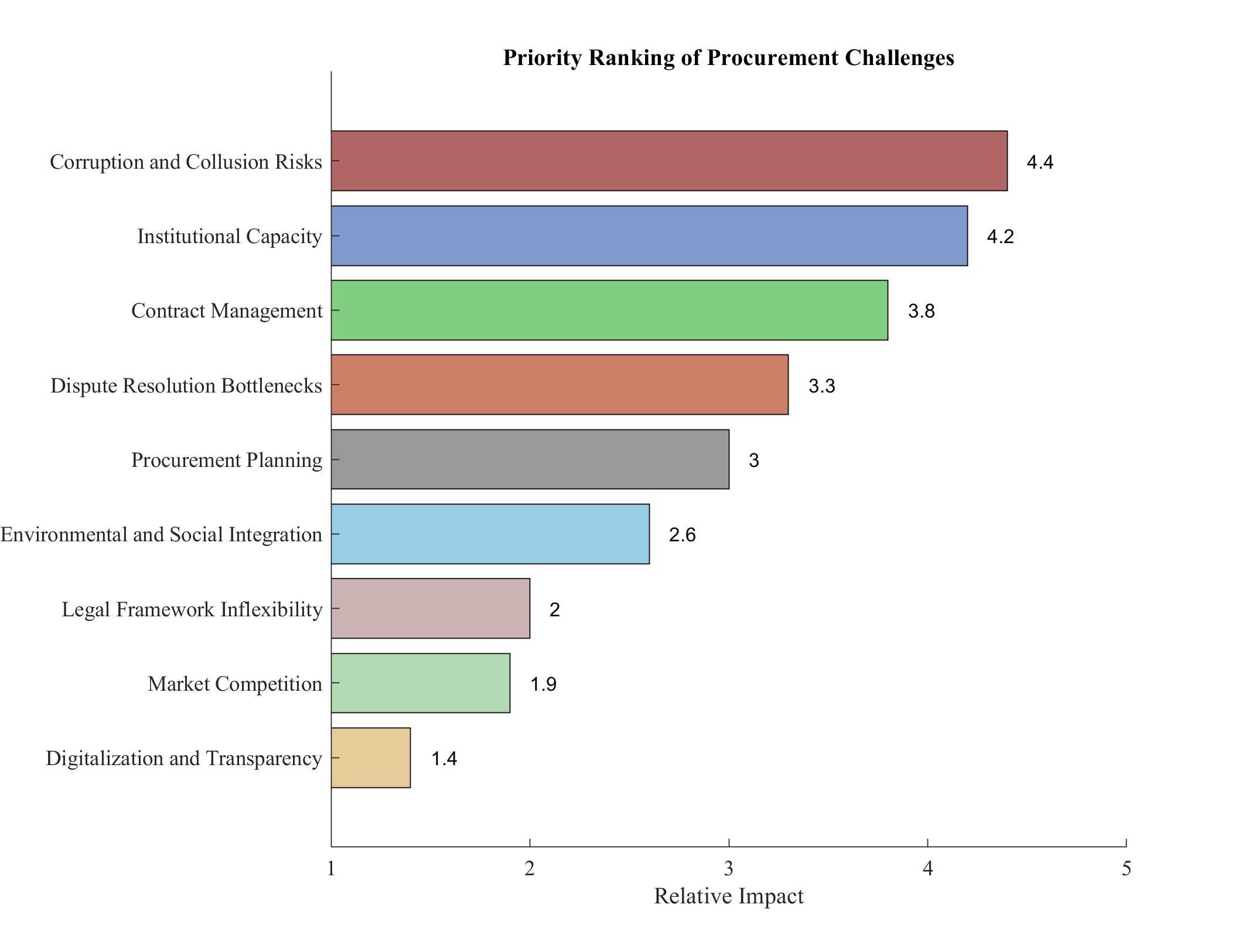 Figure: Prevalence, severity, and impact of Nepal’s public procurement system. Prevalence reflects how commonly a procurement‑related weakness is observed across institutions and projects. Severity captures the magnitude of its adverse impacts on procurement performance, governance, and outcomes. Both dimensions are assessed on a five‑point ordinal scale (1 = very low, 5 = very high).
To confront these systematic challenges, the reform agenda has focused on employing Life‑Cycle Costing (LCC), Value for Money (VfM), and performance‑based criteria for procurement evaluation. These reforms mark a progressive shift in the evaluation process for public procurements, moving away from the current, highly regulated, and bureaucracy-centric procurement mechanisms. However, these reforms come with technical complexity demanding professional expertise that goes well beyond conventional administrative skill sets. It therefore requires practitioners who can simultaneously navigate engineering complexity, economic valuation, contractual design, and risk management within Nepal’s specific governance constraints. In the absence of such capacity, these concepts risk remaining generic, oxymoronic, and rhetorical rather than transformative.
Furthermore, the tools also need to be contextualized based on a context‑sensitive procurement framework calibrated to Nepal’s institutional capacity, market structure, and socio‑economic realities. Such a framework can bridge the gap between regulatory intent and operational feasibility, for sustainable infrastructure delivery rather than remaining confined to procedural bottlenecks. Moreover, the procurement reform should have a mechanism that incorporates all the relevant stakeholders in the process of fair and transparent bidding. This stakeholder inclusion minimizes the potential future delays through consensus and trust-building.
A second major constraint on infrastructure development is the complexity associated with obtaining environmental clearances, governed by the Environmental Impact Assessment (EIA) system. The fundamental purpose of EIA is to evaluate how a proposed project may affect land, water, air, biodiversity, and local communities. It also ensures that development does not come at the cost of irreversible ecological damage. By identifying risks early, EIA allows projects to be redesigned, mitigated, or managed responsibly. However, our practice under current legislation is embedded with lengthy approval cycles and rigid procedural layers that have made it a major hurdle to timely project implementation.
EIA in Nepal is often perceived not as a planning instrument, but as an obstacle to development. “In Nepal, it is easier to chop off people than to cut trees; such laws must be changed."-Ex-minister Kulman Ghising (Nepal Connects Nov. 2026). This reveals the frustration that development workers feel toward environmental authorities. The government, in its reform agenda, has addressed this by stating that it will revisit the current procedure to keep pace with the project requirements. Currently, Nepal’s EIA system remains reactive, focusing primarily on biophysical impacts while giving limited attention to cumulative effects, climate risks, social equity, and governance dimensions.
In contrast, many high‑income countries, including OECD countries, have strengthened (not abandoned) EIA. They have supplemented it with broader and more strategic tools. These tools include Strategic Environmental Assessment (SEA), Sustainability Assessment (SA), and Environmental and Social Impact Assessment (ESIA). These approaches shift assessment upstream to policies and programs, apply multidimensional sustainability indicators, and explicitly integrate social and governance concerns, particularly for major infrastructure.
In reforming Nepal’s environmental governance framework, the EIA procedure must also evolve beyond its current project‑centric, compliance‑driven orientation. A gradual transition toward a hybrid SEA-SA-ESIA model in Nepal would enable earlier strategic decision‑making, improve stakeholder engagement, and enhance coherence between development planning and environmental governance. Without such reform, simply upgrading the clauses of the current EIA framework risks remaining a procedural requirement rather than an effective instrument for sustainable and inclusive development.
Collectively, these sectoral and incremental reforms in development sectors are insufficient to generate transformative change the current government envisions as they remain confined to symptomatic adjustments. Nepal’s development path is mostly fragmented, rooted in rigid bureaucratic regulations and rigid procedural tools. Reform and transformation tools, however advanced, cannot operate strategically if upstream planning remains fragmented, siloed, and conceptually outdated. More broadly, governance and economic reforms in Nepal, on paper, are bottom-up. However, in practice, they are guided by a top-down model architecture by the epistemic community of the National Planning Commission (NPC). It is an institution whose conceptual foundations are influenced by post-war centralized planning paradigms. The NPC model has become increasingly obsolete as it tends to be top‑down, bureaucratic, slow to adapt, and weak in implementation and monitoring. Moreover, the planning remains heavily dominated by economists, often to the exclusion of other critical experts in the development sectors. While economic analysis is indispensable, economists alone cannot serve as comprehensive planners in a complex development context.
For national planning institutions to remain relevant, there must be reforms in two stages: first, the incorporation of multidisciplinary experts, and second, the implementation of a bottom-up approach in practice (not in demand and prioritization). The institution requires experts in development studies with genuinely multi/transdisciplinary perspectives capable of bridging economics, governance, social sciences, environmental systems, and institutional realities. Second, instead of centralized collection of projects, the NPC must be capable of identifying the needs of people and the socio-economic feasibility of infrastructure to prioritize them based on demand and sustainability assessments. Without this reform at the national planning level, improvements in procurement systems, environmental assessment, and infrastructure governance will stay incremental and fragmented. In such a context, planning risks becoming technically sound but socially disconnected, environmentally blind, and institutionally weak, undermining the goals of inclusive and sustainable development. This institutional reform must be accompanied by a comprehensive, transformative infrastructure policy that serves as an umbrella framework for all sectoral infrastructure development.
At present, Nepal’s policy landscape remains piecemeal, with individual ministries formulating and implementing infrastructure policies independently. This has resulted in fragmented mandates and weak intersectoral coordination, often resulting in duplication. This fragmentation leads to policy incoherence, investment duplication, and conflicting environmental and social standards. To align planning, financing, regulation, and sustainability goals across sectors, a unified transformative infrastructure policy serves as a guiding framework for integrated development.
(Bishal Dahal and Supriya KC are doctoral researchers at the University of Oulu, Finland.)