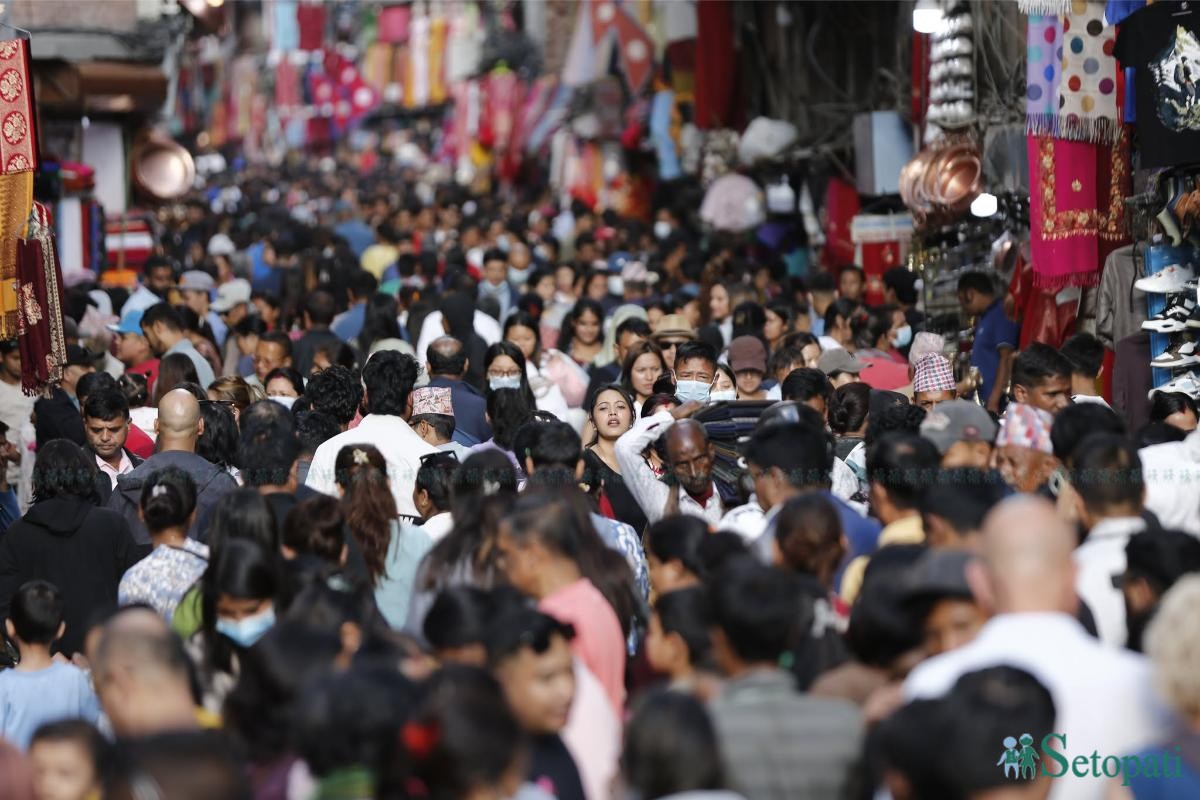
Nepal has changed faster than our population thinking.
For decades, the state taught families to have fewer children. Women grew up hearing the slogans, jingles, posters, and public-health messages of family planning. The message was clear: small family, better future. That campaign worked. In fact, it may have worked more deeply than the state itself expected.
According to the Demographic and Health Survey, Nepal's total fertility rate declined from about 4.6 children per woman in 1996 to about 2.1 in 2022. Census 2021 estimates put fertility even lower, at 1.94 children per woman. Under the medium scenario used in Nepal's population projection work, fertility is expected to fall further, to about 1.87 by 2030 and 1.71 by 2050. This may even be conservative if women's education, paid work, mobility, domestic migration, and international labor migration continue to expand.
Replacement-level fertility is usually understood as about 2.1 children per woman. In simple terms, this means around 21 children for every 10 women, so that roughly 10 daughters survive through reproductive age and replace the previous generation. Nepal is already below this level. The old state goal of lowering fertility has largely been achieved.
That is a major national achievement. But it also raises a new question: what does the government think now? Is continuing fertility decline still a success? Or has very low fertility become a new demographic, social, and economic concern?
This question matters because Nepal's population issue now has two sides. On one side, national fertility is below replacement level and may continue to decline. On the other side, research by Dhurba Raj Ghimire and Samir KC shows that some social groups still have relatively higher fertility. These two facts must be understood together. They are two sides of a sharp policy knife.
The first side asks whether Nepal is prepared for low fertility, aging, labor-force change, shrinking school-age cohorts, migration, and local depopulation. The second side asks whether higher fertility among some groups reflects free and informed choice, or whether it reflects constrained choice: early marriage, lack of information, poor counseling, weak access to contraception, family pressure, low literacy, poverty, distance, social norms, or limited reproductive autonomy.
If some women and couples want larger families freely, that is their right. A rights-based state should respect that choice. But if some women are having more children because they cannot make informed and voluntary decisions about pregnancy, spacing, and contraception, then this is not a cultural fact to be observed from a distance. It is a policy failure.
This is where equality and equity must be separated. Equality means giving everyone the same message or service. Equity means asking whether different groups face different barriers and need different forms of support. A woman in a remote area, a woman with low literacy, a woman facing family pressure, a poor adolescent girl, a woman with disability, or a woman from a marginalized caste, ethnic, religious, linguistic, or regional community may not experience "choice" in the same way as an educated urban woman with access to information and services.
The National Population Policy 2082 recognizes reproductive health rights, gender equality, social inclusion, vulnerable groups, and evidence-based population management. That is welcome. It also speaks of maintaining a "balance between fertility and population." But what does this balance mean?
Does it mean returning fertility to replacement level? Avoiding very low fertility? Supporting women and families so that desired fertility and actual fertility are closer? Balancing aging, labor force, migration, regional depopulation, and the cost of raising children? Or does it still mean lowering fertility among groups where fertility remains relatively higher?
A modern population policy cannot mean pressuring one group to have fewer children and another group to have more children. It must protect reproductive rights and informed choice, while planning responsibly for the demographic consequences of those choices.
This leads to a larger question: what counts as a population issue in Nepal today?
In the past, Nepal's population issue was often framed around rapid population growth, high fertility, poverty, mortality, pressure on land and resources, migration, urbanization, and uneven population distribution. Spatially, population debates also involved hill-to-Tarai movement, Tarai settlement, open-border social and labor ties with India, and later internal and international labor migration.
The Population Perspective Plan 2010-2031 reflected that older transition. It recognized high population growth as a development challenge and also noted the shift from fertility control toward broader population management.
But Nepal's population reality has changed. The new population agenda includes below-replacement fertility, possible faster future decline, uneven fertility by social group, youth out-migration, absentee population, aging, shrinking school-age cohorts in some places, labor shortages and care needs in others, rapid growth pressure in urban and Tarai corridors, and depopulation in many mountain and hill districts.
These are not only health issues. They are education issues, labor issues, migration issues, housing issues, social protection issues, food and land issues, environmental issues, federal planning issues, and well-being issues.
This is where Nepal needs a wider planning lens. Population is not a separate subject sitting outside development; it is the basic evidence underneath almost every public service.
Health systems need to know how many births, pregnancies, infants, adolescents, reproductive-age women, older persons, people with disabilities, and people with chronic diseases they must serve.
Education systems need to anticipate births, school-age cohorts, migration, retention, dropout, and transitions to higher education or work. Labor planning needs age structure, education, skills, migration, and labor-force participation. Food, housing, transport, social protection, climate adaptation, and local infrastructure all depend on who lives where, how old they are, how they move, and what they need.
So yes, one could say that every ministry works on population. Health works with population.
Education works with population. Labor works with population. Urban development, agriculture, social protection, and local governments all work with population.
But this answer is incomplete. If every sector uses population but no institution is responsible for integrating population evidence, the result is fragmentation. Each ministry may use its own denominator, its own projection, its own definition of target groups, and its own understanding of vulnerability. Then population becomes everyone's issue in theory and no one's responsibility in practice.
This is why the institutional question matters. Population used to have a more visible place in national planning and public administration, including through the health-and-population portfolio and earlier population planning structures. If population is now administratively diluted, does that mean Nepal's population issues have disappeared? Or does it mean that population has been absorbed into many sectors without clear accountability?
The answer is not necessarily to bring back an old-style population ministry. The old model may not fit the new demographic era. But Nepal does need a strong population spine: a visible institutional mechanism, a common data system, analytical capacity, scenario tools, and a budget process that connects population dynamics to health, education, labor, migration, aging, housing, social protection, environment, and local development.
Otherwise, Nepal will continue to treat population as a narrow family-planning subject, even as population change reshapes almost every part of national life.
This is where the new generation of political leaders faces a real test. A young government with new faces may still carry old population thinking. If population is still understood only as high fertility and population control, then the government is not thinking beyond the older generation's diagnosis.
It is simply old population thinking in a young government.
The new question is not only: how do we reduce fertility?
The new question is: how do we plan for the well-being of a changing population?
That means asking difficult but necessary questions.
What does the government now consider Nepal's main population issue: high fertility, low fertility, unequal fertility, aging, absentee population, internal migration, international migration, urban concentration, local depopulation, labor-force change, or well-being?
When the National Population Policy says "balance between fertility and population," what exactly is being balanced?
For groups with relatively higher fertility, does the government know whether this reflects free choice or constrained choice?
For a country already below replacement-level fertility, does the government see continued fertility decline as success, concern, or both?
Do health, education, labor, and local governments use the same population projections and planning assumptions?
Who is responsible for connecting population evidence across ministries?
Population is not only about how many people Nepal has. It is about who those people are, where they live, how they move, what they need, what choices they have, and whether policy improves their well-being.
If population has become everyone's issue in theory, has it become no one's responsibility in practice?
That is the population question Nepal must now answer.
Note
I am not necessarily arguing for bringing back a separate old-style Ministry of Population. I am arguing that population must not disappear administratively. Whether through a ministry, commission, national planning mechanism, statistical system, or another planning platform, Nepal needs a clear institutional home for population evidence, projections, cross-sector planning, and accountability.