The executive committee of the National Disaster Risk Reduction and Management Authority (NDRRMA) has approved the National Action Plan for Monsoon Preparedness and Response for this year.
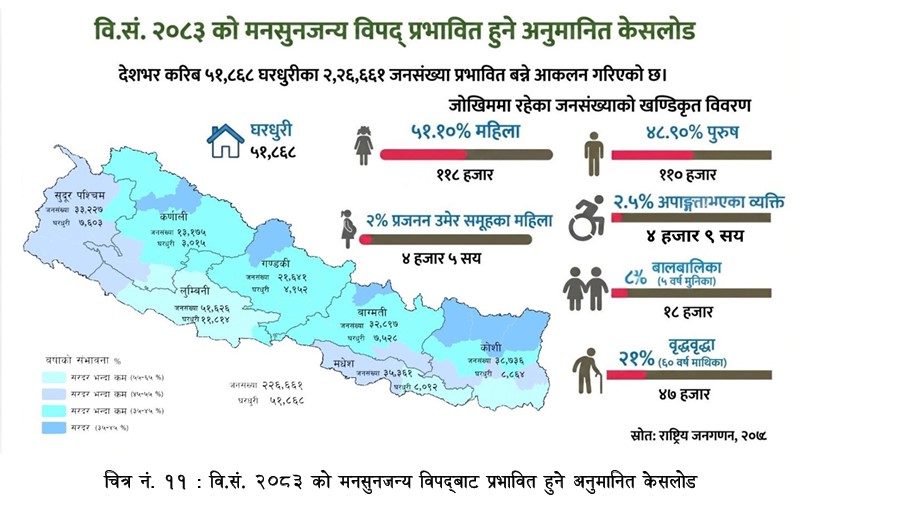
According to the action plan approved by the committee’s meeting held on Thursday, it is estimated that approximately 226,661 people from 51,868 households across the country will be affected this year.
Among those projected to be affected, women outnumber men. The action plan estimates that 51.1 percent of those impacted by monsoon-induced disasters this year will be women, while 48.9 percent will be men.
Furthermore, 4,500 women of reproductive age, 4,900 people with disabilities, 18,000 children under the age of five, and 47,000 senior citizens have been categorized as vulnerable to impact in the action plan.
Lumbini is projected to be the hardest-hit province during this year's monsoon. It is estimated that 51,626 individuals from 11,814 households in the province will be affected.
Among the 12 districts of Lumbini, Dang is expected to see the highest impact with 7,771 affected people, while Rukum East will see the lowest, with an estimated population of only 206 being affected.
Following Lumbini, Koshi province appears to be the next most vulnerable, with an estimated 38,736 individuals from 8,863 households expected to be affected. Koshi’s Sunsari district tops the list of potentially hard-hit districts this year, with an estimated 9,224 people affected. Ilam is expected to be the least affected district in the province, with an estimated population of 369 impacted.
Madhesh province ranks next in terms of potential monsoon disaster impact. Around 35,361 members of 8,092 households are projected to be affected in the province. Rautahat is expected to be the worst-affected district in Madhesh with 9,128 people impacted, while Bara district is projected to have the lowest impact with a caseload of just 150.
Sudur Paschim province follows Madhesh on the vulnerability list, with 33,227 people projected to be affected. Within the province, Kanchanpur is the most vulnerable district with 7,132 people expected to be affected, while Darchula has the lowest impact with 1,467 affected people.
Bagmati province ranks fifth on the list, with 32,897 individuals from 7,528 households expected to be affected. Among the districts, Dolakha leads the vulnerability list with 5,582 people projected to be affected, while Bhaktapur has the lowest estimate at just 103 people.
Gandaki province is sixth on the list. This year’s monsoon disasters are expected to affect 21,641 individuals from 4,952 households in the province. Nawalpur is projected to be the hardest-hit district in Gandaki with 8,583 people affected, while Mustang has the lowest estimate at 51 people.
Karnali is projected to be the least-affected province, where the monsoon is expected to affect 13,175 individuals from 3,015 households. Surkhet is expected to face the highest impact in Karnali with 3,177 people affected, while Humla has the lowest projection at 81 people.
Generally, the monsoon enters Nepal on June 13 and lasts until October 2.
For this year, forecasts predict below-average rainfall and higher temperatures. Because of the lower rainfall projection, the estimated disaster caseload is also relatively lower compared to previous years.