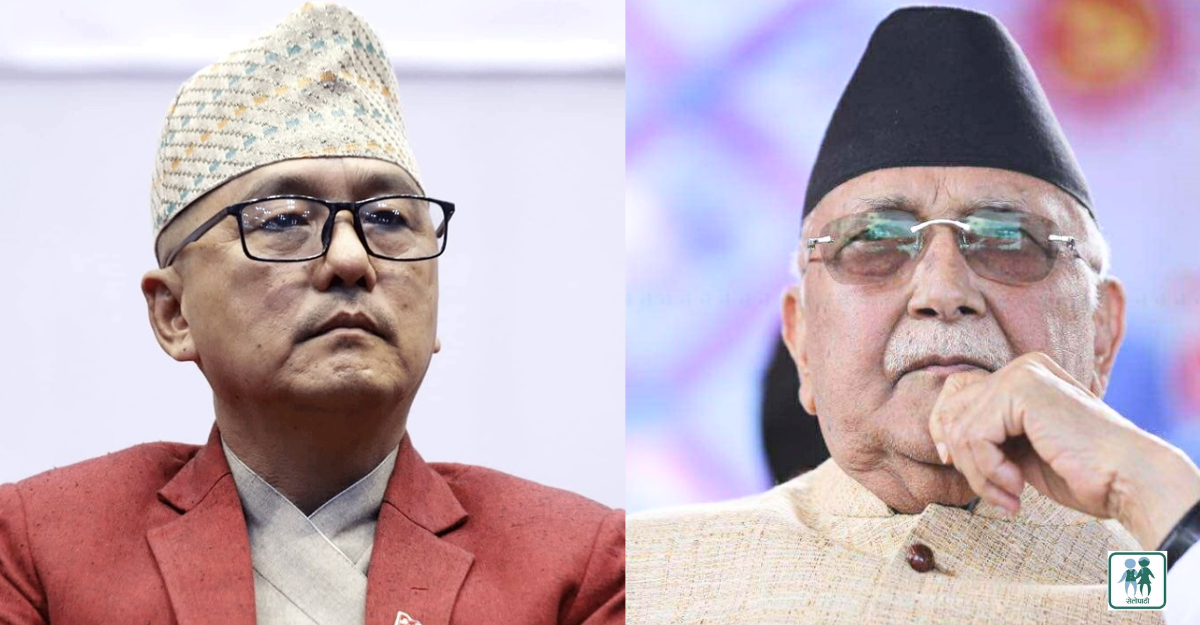
A recent topic of speculation within the Rastriya Prajatantra Party (RPP) is that CPN-UML Chairman and former prime minister KP Sharma Oli has been meddling in their party.
Oli recently reached an agreement with Nepali Communist Party (NCP) Coordinator Pushpa Kamal Dahal to form new governments in the provinces.
However, despite forming an alliance, the UML and NCP do not have enough lawmakers to secure a majority and form governments in Bagmati and Gandaki provinces. Therefore, they are seeking the RPP's support.
RPP leaders learned that instead of discussing the matter with RPP Chairman Rajendra Lingden, UML Chairman Oli has begun inviting RPP lawmakers to his residence for talks, leading to speculation that the UML is playing politics within the RPP.
The RPP leadership has information that Oli has repeatedly held late-night discussions with some RPP lawmakers at his residence in Gundu, Bhaktapur. However, it has emerged that the RPP lawmakers have not informed their own party about these meetings.
The UML and NCP need the support of two more lawmakers to form a government in Bagmati province, where the RPP has 12 seats.
The RPP leadership is currently not in favor of joining any provincial government. Oli, who is aware of this, has intensified talks with some provincial lawmakers from the RPP in Bagmati instead of discussing the matter with Lingden. The RPP has interpreted this move as Oli meddling in their party.
Under the power-sharing agreement between the UML and NCP, the UML is slated to lead the Bagmati government.
According to UML lawmakers, Oli is planning to put forward Bhaktapur lawmaker Kiran Thapa as the chief minister.
The current leader of the UML Bagmati parliamentary party is Jagannath Thapaliya, who is also a contender for chief minister.
Some UML lawmakers claim that Oli is preparing to replace Thapaliya with Thapa as parliamentary party leader and even make Thapa the chief minister.
Amid uncertainty within the UML itself over who will become chief minister, Oli is accused of meddling within the RPP to secure a majority.
"Listening to Secretary Mahesh Basnet, Chairman KP Oli is trying to advance Kiran Thapa of Bhaktapur as the chief minister of Bagmati. The UML and NCP alone do not have a majority; they need two more lawmakers," an RPP leader told Setopati. "To secure a majority, Oli apparently invites two or four of our lawmakers to Gundu late at night for discussions, promising to make them ministers. We have that information."
The leader says that if the RPP's support is required for the provincial government, the straightforward path for Oli would be to talk to Chairman Lingden, but he has been inviting some lawmakers to his residence and promising them ministerial portfolios.
"Oli spoke with Chairman Lingden on the phone once regarding the formation of the provincial government, after which nothing progressed further. The RPP does not wish to join the provincial government either," the RPP leader said. "We have information that, perhaps seeing that he won't get the RPP leadership's support or acting under someone's advice, he has been inviting RPP lawmakers and meeting them at his residence. Why does he have to meddle in our party?"
Amid talks of Oli’s meddling within the Bagmati RPP, the RPP central executive committee meeting held on Wednesday decided not to join the provincial governments for the time being.
According to Chairman Lingden, the RPP wants the Nepali Congress, UML, and NCP to form the provincial governments together.
"The central executive committee has decided to give the authority to the chairman to make an appropriate decision at an appropriate time if a different situation arises somewhere," he said.
According to spokesperson Mohan Shrestha, the RPP will not join the provincial governments at this time.
"We will not join the provincial governments. This has been decided by the central executive committee and a circular has already been sent to inform all provincial parliamentary party leaders," he said.
Some RPP lawmakers in Bagmati appear willing to join the provincial government. However, the party has urged lawmakers not to join the provincial government without consulting and securing a decision from the main leadership.
Previously, RPP lawmaker Kanchan Bichchha had joined the Madhesh government as a minister without informing the party. The RPP took disciplinary action against her and subsequently revoked her position as a lawmaker. She was a proportional representation lawmaker.
Pointing to such precedents, the RPP has instructed its lawmakers to remain in the opposition in the provincial governments.
With the RPP refusing to join the government, forming a new government in Bagmati has become challenging for the UML and NCP.
During a recent discussion with UML lawmakers in Gundu, Chairman Oli said, "Whoever can secure the RPP's support will become the chief minister." Upon hearing this, Kiran Thapa said that he would have the support of some RPP lawmakers.
Currently, Nepali Congress parliamentary party leader Indra Bahadur Baniya is the chief minister in Bagmati.
Due to infighting within the UML over changing its parliamentary party leader and the lack of a majority, forming a new government in Bagmati immediately is difficult. According to some UML lawmakers, some RPP lawmakers have promised support if a government is formed under UML leadership in Bagmati, which is why meetings were held with Chairman Oli.
On July 22, the UML withdrew its support to the Baniya-led government. The chief minister must take a vote of confidence by August 22.
The Bagmati Provincial Assembly currently has 104 members, and 53 votes are required for a majority.
The Nepali Congress is the largest party with 36 seats, the NCP is second with 26 seats, and the UML is third with 25 lawmakers. The RPP has 12 seats.
The Nepal Workers and Peasants Party (NWPP) has 3 seats, while the Hamro Nepali Party has 2 seats. The Hamro Nepali Party recently joined the Baniya-led government.