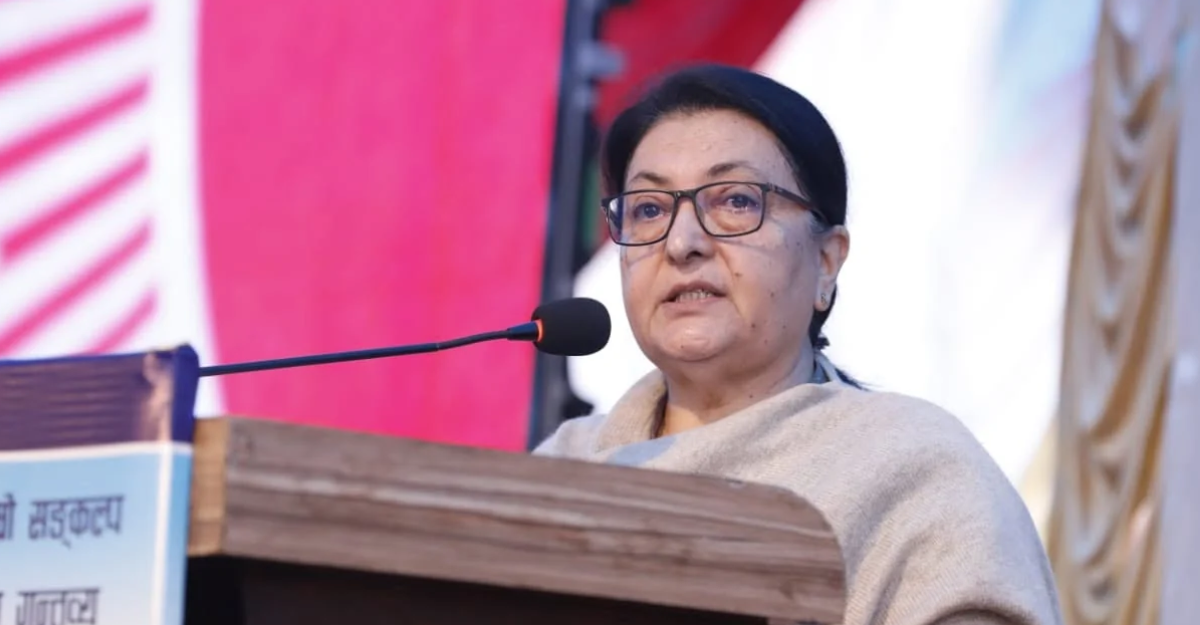
CPN-UML Senior Leader and former president Bidya Devi Bhandari has proposed changing the working style of the party at all levels, from its leadership to grassroots cadres.
She said that party committees should be developed as structures for carrying out responsibilities rather than platforms for enhancing the prestige of office-bearers and members.
Presenting a report on Thursday at the UML’s national cadre gathering, which began in Kathmandu on Wednesday, Bhandari emphasized the need to foster a culture of criticism and self-criticism within the party, improve relations between party leaders and cadres, and make the organization result-oriented.
“Rather than being formed based on actual needs, committees are increasingly being made larger and cumbersome based on demands, with a growing tendency to accommodate more people in them. In reality, party committees at various levels are not honorary bodies; they are functional bodies,” she said in her report.
She argued that party organization should not be confined to the formalities of holding meetings, making decisions, and preparing reports. Instead, structures ranging from the central committee to ward and neighborhood levels should actively work to implement decisions, expand the organization, mobilize cadres, and strengthen ties with the public, she added.
Bhandari's report comes amid ongoing debates within the UML over the leadership’s working style, organization’s operation, and internal democracy.
Rather than limiting the review of the party's weaknesses to its electoral defeat, she has sought to examine them in relation to the party's organizational practices and the conduct of its leaders and cadres.
“Healthy criticism within the party is not intended to put an end to anyone, and self-criticism is not synonymous with an inferiority complex,” she said. “In this regard, we can draw inspiration from the lives of people's leader Madan Bhandari and Jibaraj Ashrit, particularly their simplicity, integrity, tolerance, discipline, studiousness, and close relationship with the people.”
She also stressed the need for consistency between the party's ideological commitments and its actual conduct. According to her, the tendency of political parties to speak about people's rights, good governance, and accountability without translating those principles into practice undermines their credibility.
Bhandari described the events of September 8 and 9, 2025, and the UML's defeat in the March 5, 2026, elections as serious setbacks for the party. However, she maintained that the defeat in a single election does not determine the future of a political movement.
“An electoral defeat does not determine the future of a political movement. However, it is our duty to learn the right lessons from the defeat, correct our weaknesses, and move forward,” she said.
Bhandari said that the conclusions drawn from the review of the electoral defeat must be implemented sincerely at every level, from the leadership to grassroots cadres.
Her report also highlights the need for a proper division of responsibilities among party leaders and cadres, an assessment of their contributions and capabilities, and an environment that enables all levels of the party to work toward a common objective.
She proposes improving the lifestyles of party leaders and cadres and their relationships with the public as part of efforts to revitalize the organization. She reminded party members that politics is not a means of acquiring personal privileges and prestige but a responsibility to serve the people.
In this way, Bhandari has argued that responsibility for the party's electoral defeat should not be placed solely on one individual or the leadership, but should instead prompt a broader overhaul of the organization's practices.
Bhandari also raised questions about the activities of the incumbent government. She said that recent political developments and certain government actions had raised concerns about the Constitution, democratic values, and the functioning of the parliamentary system.
She noted that the balance of power among the executive, judiciary, and legislature had been adversely affected and that the country's international image was also beginning to suffer.
She accused the government of engaging in targeted actions against political leaders, individuals active in public life, and the media.
“Practices such as taking retaliatory action without following due legal procedures, targeting individuals for their political differences and placing them in police custody, or restricting media freedom are not compatible with democratic norms,” she said.
She maintained that any alleged violation of the law should be addressed through impartial investigation and judicial proceedings, rather than turning the law into an instrument of political retaliation.
Bhandari said that national consensus is necessary for constitutional amendments.
She argued that although the Constitution could be amended in response to changing times and needs, amendments should not undermine its fundamental principles, preamble, or democratic character.
In her report, Bhandari also explained her decision to return to active party politics.
Noting that she rejoined the party after completing her tenure as President, Bhandari said that her return was not motivated by personal ambitions for a position, privileges, or opportunities.
“I am now almost indifferent to any position because I have already held the country's highest office – that of president,” she said.
She said that she had returned to active politics to contribute to the party's ideological development, organizational strengthening, socioeconomic transformation, and national responsibilities.
Bhandari also proposed developing people's multiparty democracy, the UML's guiding political doctrine, as a living guiding principle capable of addressing contemporary challenges and shaping the future.
She said that the party's mass organizations should become more active in research, entrepreneurship, debate, and constructive campaigns to address growing frustration, unemployment, and the increasing trend of young people leaving the country.