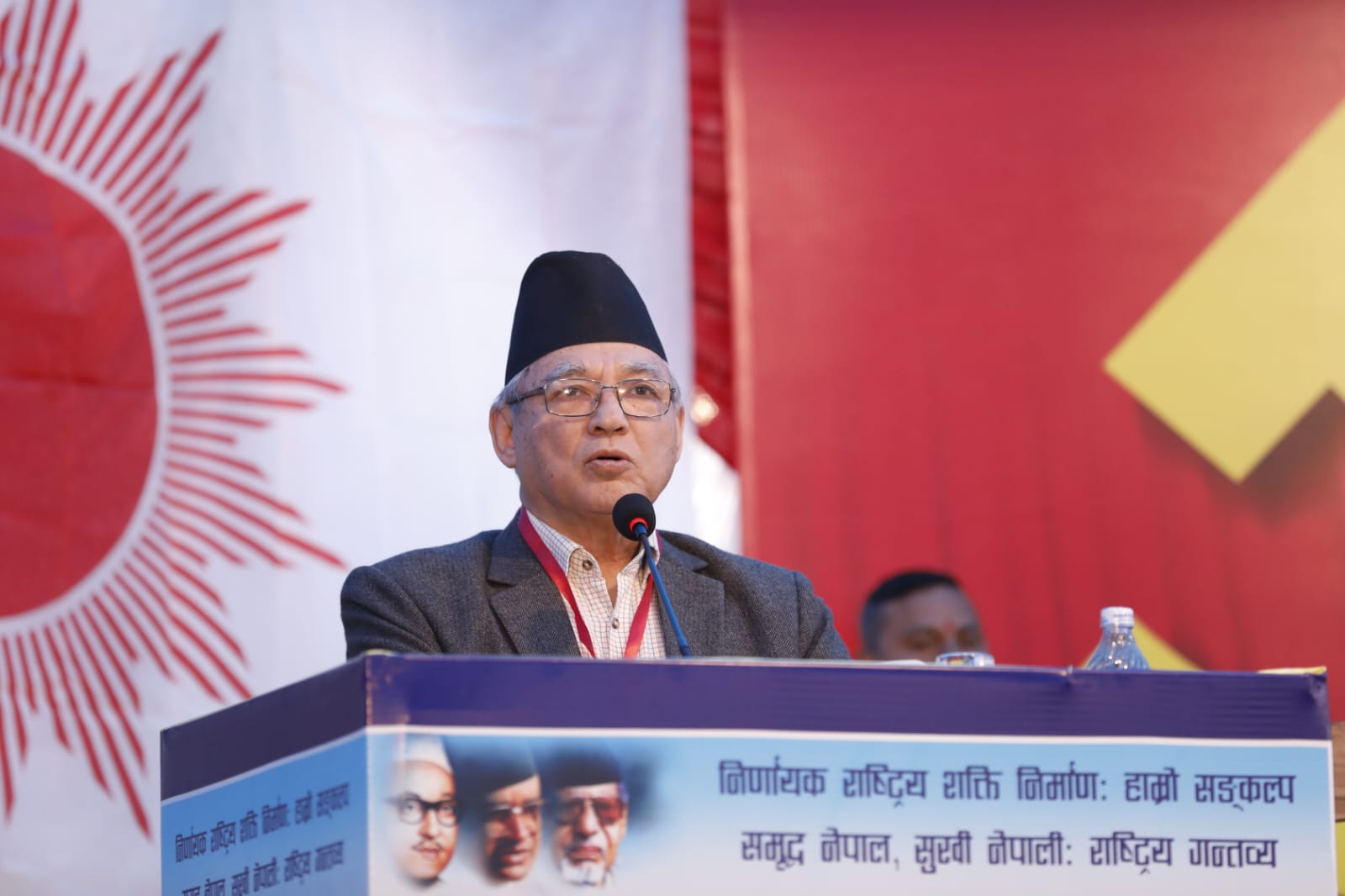
CPN-UML Vice-chairman Ram Bahadur Thapa has urged party cadres to rally around the leadership of party Chairman KP Sharma Oli while reviewing the party’s electoral defeat.
Presenting a report at the UML’s ongoing national cadre gathering in Kathmandu on Thursday, Thapa described party unity and confidence in the leadership as key factors for securing victory in the upcoming elections.
“Whenever we have rallied around the leadership, we have prevailed. Whenever we have stood against the leadership, both of us have lost,” he said in his report.
His remarks are being viewed as a political message in support of Oli’s leadership amid growing questions and dissatisfaction within the party over its leadership.
Thapa has consistently been a supporter of Oli. Although he did not explicitly defend Oli by mentioning the chairman by name in his report, he emphasized the need for party members to unite in support of the leadership.
Reviewing the defeat of the UML and other democratic forces in the election held in March, Thapa identified weak internal unity, failure to recognize the main political rival, and an inability to establish direct connections with the people as the major reasons behind the loss.
“We failed to identify our principal rival. We failed to understand our weaknesses. We failed to cooperate with one another against our main rival. We failed to maintain internal unity. We failed to establish direct connections with the people,” he said.
He noted that the party had won elections in the past when it cooperated with competing political forces against common rivals and maintained direct connections with the public.
Thapa concluded that the party had grown stronger whenever it remained united behind its leadership.
Describing the next election as a contest between populist and democratic forces, Thapa said that the UML must begin preparations for it immediately.
“Whether March will be repeated or there will be a break from that trend is the central question today,” he said.
Noting that local-level, provincial assembly, and National Assembly elections are scheduled for the coming year, Thapa said that they should not be treated as ordinary electoral contests.
His report states that the outcome of the upcoming elections could also affect constitutional amendments and the balance of political power at the national level. Since constitutional amendments can be passed with a two-thirds majority in both the House of Representatives and the National Assembly, he expressed concern that populist forces could seek to secure such a majority to pursue constitutional changes.
He therefore stressed the need to maintain the dominance of the democratic and nationalist forces currently in power at the local and provincial levels.
Thapa said that the UML must prioritize organizational restructuring, preparations for political movements and elections, legal struggles to defend the Constitution, and direct engagement with the public to re-establish itself as a decisive national political force.
Calling for the implementation of the conclusions reached by the central committee following its review of the recent electoral defeat, Thapa also emphasized the need to strengthen internal unity.
The UML's national cadre gathering has reportedly been organized to review the party's defeat in the March election, rebuild the organizational, and determine its future political direction.