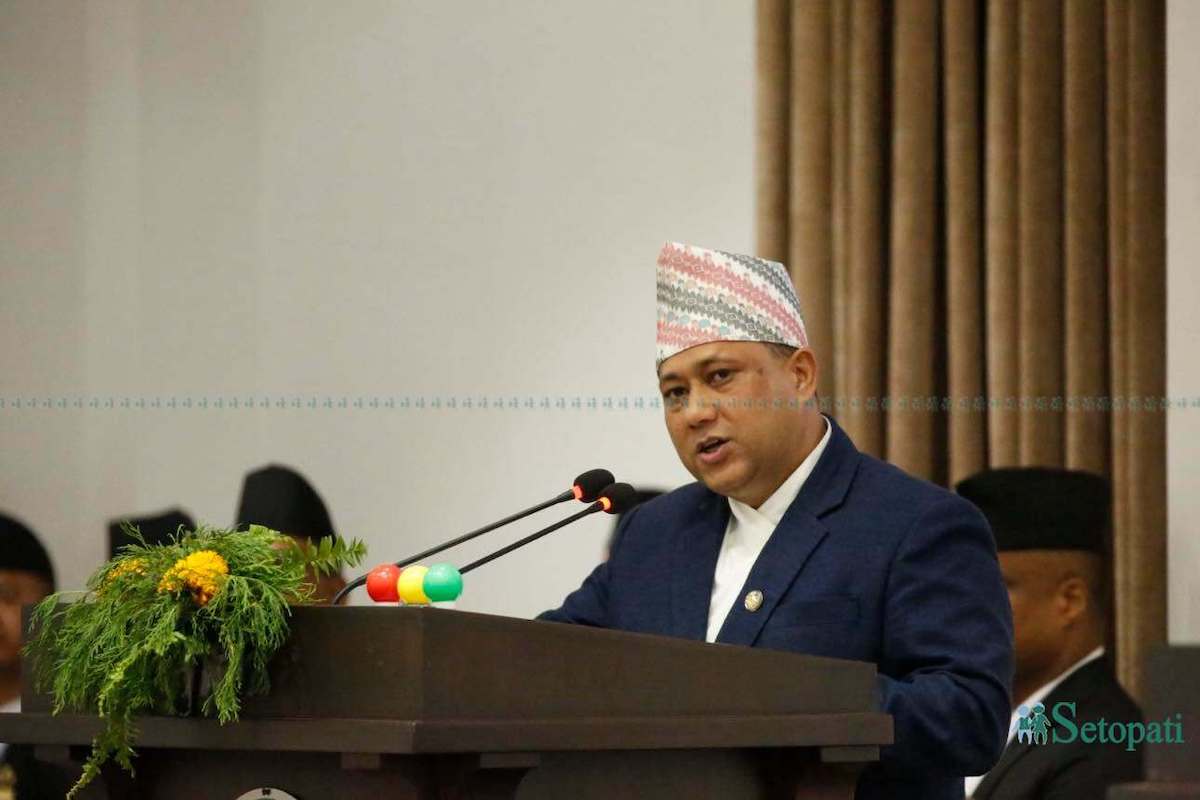
Foreign Minister Shishir Khanal on Wednesday provided clarifications in Parliament regarding two controversial remarks made by Prime Minister Balendra (Balen) Shah during the House of Representatives meeting on May 31.
The clarification came after opposition lawmakers repeatedly obstructed parliamentary proceedings in protest against Shah's statement that "Nepal has also encroached on Indian territory." Khanal also addressed another controversial remark made by the prime minister that "the United Kingdom should also have a stake in the border dispute with India."
Opposition lawmakers had been demanding that the prime minister personally appear in Parliament to answer questions on both issues. However, PM Shah refused to attend the House despite the opposition’s continued protests, following which Foreign Minister Khanal responded on his behalf.
Meanwhile, lawmakers from the Shram Sanskriti Party said that the explanation was not acceptable to them. Party lawmaker Harka Rai said that the person who made the mistake must come and rectify it.
In his clarification, Khanal said that the prime minister's remarks on the border issue were primarily related to encroachments in the no-man's land area and cases of cross-border occupation.
"Since the Fixed Boundary Principle was adopted in riverine border areas during the demarcation of the Nepal-India border, a situation of cross-border occupation exists, where citizens of one country cultivate and reside on land that falls within the territory of the other country," he said. “Border-related mechanisms and technical teams from both countries are actively working to map the long Nepal-India border systematically and scientifically, constructing and repairing border pillars, and collecting data on encroachments in no-man’s-land areas and instances of cross-border occupation.”
He said that the work of the technical committee, which had been stalled for a long time, is currently active, and the process of joint data collection is underway.
Khanal further informed Parliament that bilateral border-related task forces and other mechanisms are mapping locations where no-man’s-land encroachment and cross-border occupation may have occurred. He added that detailed findings are expected later.
“Studies by the technical committee have shown that in some places, land currently being used and occupied by Nepal may fall within India, and land currently being used and occupied by India may fall within Nepal. Both sides claim land they have occupied or used. The context of the statement made by the honorable prime minister in Parliament is connected to this technical reality and cross-border occupation," Khanal said.
Khanal emphasized that the key issue is how border-related matters should be resolved, adding, “We are always committed to resolving this issue through diplomatic dialogue on the basis of historical treaties, agreements, and maps, in line with the spirit of the close relationship between Nepal and India.”
Khanal also addressed the prime minister's remark that the United Kingdom should have a stake in the Nepal-India border dispute.
He made it clear that the government has not sought UK’s mediation in the border issue.
“While responding to questions on Nepal's border issues, the honorable prime minister referred to the friendly nation United Kingdom because Nepal's boundary demarcation is directly linked to the 1816 Treaty of Sugauli. We are not seeking third-party mediation in this matter. The prime minister was merely indicating that if there are any additional reference materials from that period, they could naturally be useful in helping resolve the issue.”
He reiterated that the Nepal-India border dispute is a bilateral matter. “Nepal is always committed to resolving this issue through diplomatic dialogue and talks on the basis of historical treaties, agreements, and maps, in line with the spirit of the close relationship between Nepal and India,” he added.