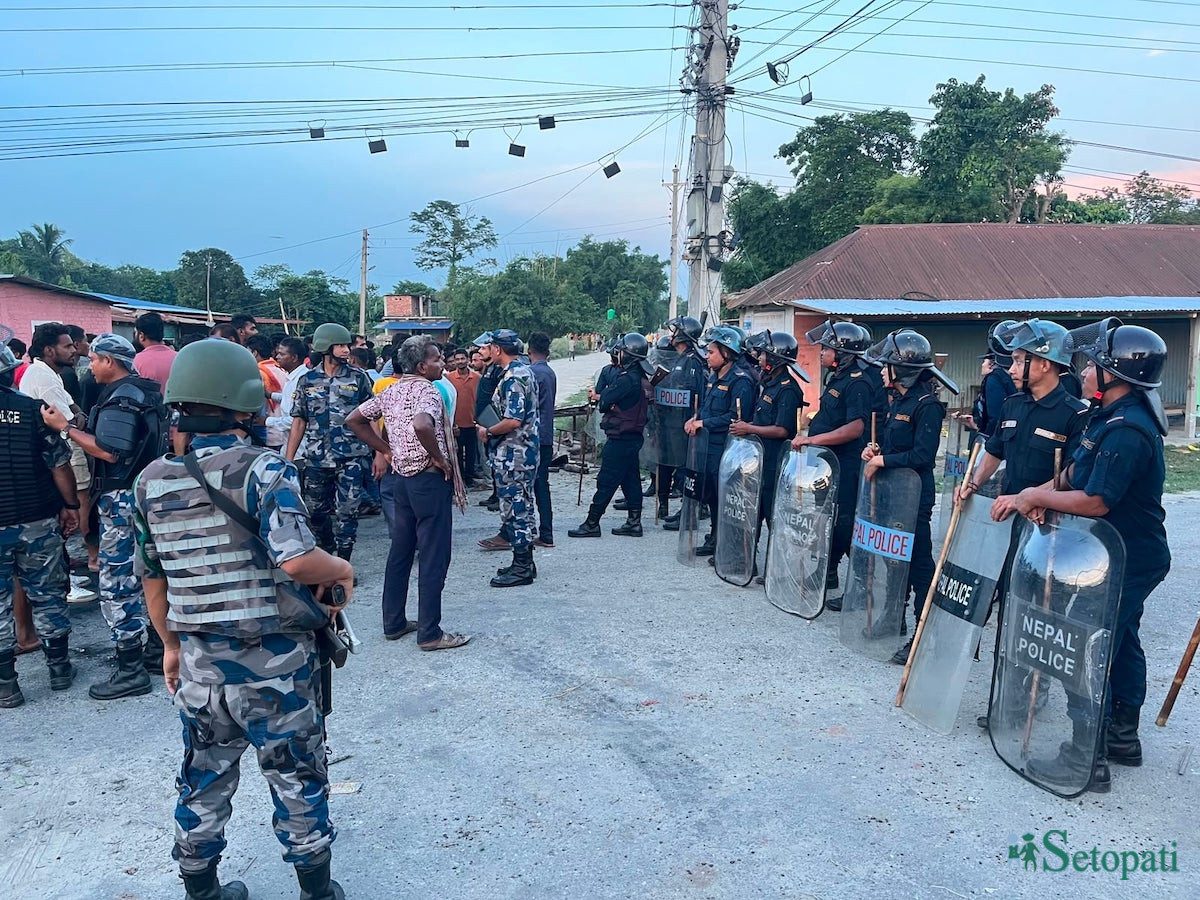
Probe committees formed to investigate the recent religious conflicts in Koshi and Madhesh provinces have submitted their reports.
During the clashes that spread across Sunsari, Siraha, and Dhanusha districts, four people lost their lives when police opened fire to control the crowd. Three individuals died at Kaptangunj in Dewangunj Rural Municipality-3, Sunsari, and one person was killed in Gol Bazar, Siraha.
The Ministry of Home Affairs had formed a committee led by Joint Secretary Bhupendra Thapa to investigate the Sunsari incident and another led by Joint Secretary Pushpa Raj Shahi for the Siraha incident. Both committees submitted their reports to Home Minister Sudan Gurung.
According to the report, Nepal Police and Armed Police Force personnel opened fire during the dispute in Kaptangunj, Sunsari. Jay Prakash Mehta, Om Prakash Mehta, and Rabindra Kumar Mehta died from police gunfire. Likewise, Ganesh Yadav died in Siraha.
The home administration had not publicly disclosed who fired the shots in these incidents. However, the probe committees concluded that the deaths in Sunsari resulted from gunfire by both Nepal Police and the APF, while the fatal shot in Siraha was fired by Nepal Police.
Joint Secretary Shahi, coordinator of the probe committee on Siraha incident, confirmed submitting the report to Home Minister Gurung on Monday. However, he said that he could not discuss the contents of the report.
"We have finished the investigation and submitted the report to the minister. We cannot disclose its contents right now," he said.
According to sources at the Home Ministry, both reports are currently being studied. After studying the reports, decisions will be taken on how to proceed with the recommended actions.
"The reports have been received and are being studied. After the study is completed, the recommended actions will be discussed," a source said.
‘Lapses by security forces'
According to a committee member, recommendations have been made to caution Siraha Chief District Officer (CDO) Surendra Paudel and Superintendent of Police (SP) Basudev Pathak. Action in accordance with the law has been recommended against other security personnel who opened fire.
“It appears that the police themselves fired the shots; pistol bullets were used. Legal action has been recommended against some of those who fired,” the source said. “There was suspicion that the shots might have been fired due to infiltration, but the study did not find such evidence.”
The source noted that the report explicitly names the police officers who opened fire and recommends action against them.
After Ganesh Yadav was killed by a gunshot in Siraha, the protests escalated further. As the situation spiraled out of control, commercial buildings, houses, mosques, and shops belonging to the Muslim community were torched and vandalized. The committee concluded that such extensive damage would not have occurred had shots not been fired.
"If firing had not taken place there, the situation would not have caused so much damage. Nor was the crowd of a nature that necessitated opening fire. However, shots were fired, which escalated incidents of arson and vandalism," the source said.
Over 50 suggestions and policy reform recommendations
The committee has provided more than 50 suggestions to prevent such incidents from recurring in the future. Specifically, it has suggested that police officers deployed for crowd control should not be given lethal weapons and should instead use rubber bullets.
"Madhesh province has only one water cannon vehicle. There is a lack of other necessary equipment, and we have pointed out those weaknesses," said a committee member. "We have recommended that lethal weapons not be used for crowd control, rubber bullets be used, and commanding officers or security personnel firing shots be required to wear body cameras."
The committee member added that due to fear of punishment, police officers initially did not admit to firing shots.
"Due to the fear of facing disciplinary action for opening fire, it appeared they did not admit to it initially. Even the spent bullet casings from the scene had been made to disappear," he said.
Additionally, according to Home Ministry sources, the committee has suggested policy reforms in the Local Administration Act, 1971.
Although this act gives the chief district officer the primary responsibility for maintaining peace and security, CDOs are often not personally deployed in the field during crowd control. This creates a gap in situational understanding between field police and the CDO, occasionally leading to situations where CDOs take no accountability for shooting incidents.
The committee emphasized policy reforms to address this practical problem.
"Providing necessary technical equipment to security personnel, monitoring via drones, identifying the guilty, and amending the Local Administration Act are among the matters covered in the report," the source said.
What does Nepal Police say?
When asked about the committees’ conclusion that police themselves opened fire, Nepal Police central spokesperson and Deputy Inspector General (DIG) Abi Narayan Kafle said that the committees’ reports had not yet been officially received.
"It is difficult to immediately ascertain and state what transpired during crowd control situations. Police are deployed from various units. Reports had come in that warning shots were fired into the air to take the situation under control. However, it is difficult to immediately ascertain whether someone was hit by bullets in the midst of that," he said.
He said that no confirmation had been made immediately since speaking prematurely without verifying facts in such sensitive incidents would send a wrong message.
He also noted that while it was initially claimed a police officer was also shot during the incident, subsequent investigations revealed that only spent casings were found.