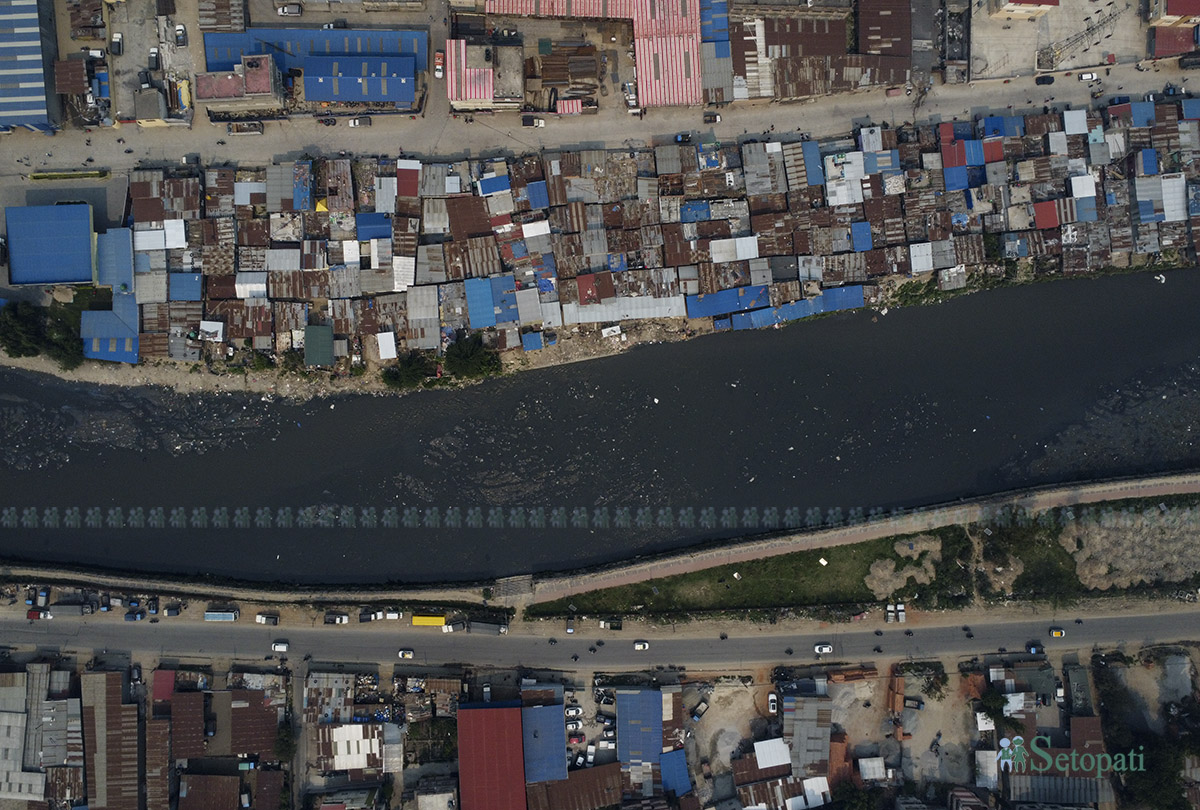
After the government evicted landless squatters and unorganized settlers living along the riverbanks in the Kathmandu Valley, the impact has spread nationwide.
Under the direction of Prime Minister Balen Shah, bulldozers were deployed last Saturday and Sunday to clear settlements along the riverbanks in Thapathali, Sinamangal, Gairigaun, Shantinagar, and Manohara areas.
It is estimated that nearly 10,000 squatters and unorganized settlers have been displaced by this drive. Among them, over 5,000 have already come into contact with the government. According to 2022 government data, around 1,800 families lived in the Kathmandu settlements where the demolition took place.
The District Administration Office, Kathmandu, has already issued a notice to bulldoze additional settlements starting this Friday.
After seeing the government's rapid removal of Kathmandu's squatter settlements using massive police force, landless squatters and unorganized settlers across the country are in a state of panic. Letters sent by the Ministry of Home Affairs to local governments through various District Administration Offices have exacerbated this fear.
Letters received by local levels, such as Damak and Mechinagar Municipalities, instruct them to "make necessary arrangements to protect government and public land and control encroachment, and immediately move forward with the removal of encroachments."
The letters also mention that "if security arrangements are required while removing encroachments, appropriate security should be provided."
Heads of local governments say this indicates the government is intent on evicting landless squatters and unorganized settlers even if it requires using force.
While some mayors have objected, claiming that the district administration’s letters – citing the Home Ministry’s order – undermine the spirit of the Constitution and federalism, the federal government is pushing this forward as its policy. Consequently, fear has spread nationwide that sooner or later, the bulldozers will arrive.
Another cause for alarm is the proactive stance taken by police offices in some districts based on these letters.
In Dang, the chief district officer called a meeting of all local heads in the district and decided to clear encroached public land. Local squatters and unorganized settlers protested against the decision, chanting slogans against the federal government and arguing that they cannot be removed without being provided an alternative.
In Rupandehi, locals fear that the campaign to demolish structures encroaching on roads will expand into a full-scale removal of squatter settlements.
Meanwhile, the Nepal Army has faced criticism for requesting details of squatters from local levels in Bardiya.
"It is well known that security personnel were deployed on April 25 and 26 to remove squatter settlements encroaching on riverbanks and public land in the Kathmandu Valley. As updated details regarding unorganized squatter settlements in Bardiya are required, we request you to provide the following details to the battalion by April 27, 2026," reads a letter sent by the Nepal Army’s Bajradal Battalion in Banke to eight local levels in Bardiya.
According to studies, Kailali has the highest number of landless squatters in the country. Government records show nearly 132,094 individuals occupying forest areas and public land there. This figure includes 6,778 landless Dalits, 13,114 landless squatters, and 112,202 unorganized settlers.
In Kathmandu district, the number of landless Dalits, squatters, and unorganized settlers stands at 125,236. Government records also show significant numbers in Kanchanpur (73,799), Jhapa (59,888), Banke (46,552), Bardiya (45,608), Dang (70,389), Rupandehi (76,657), Udayapur (48,609), Chitwan (41,279), and Morang (65,136).
The Land Problem Resolution Commission has signed agreements with 750 local levels to collect data through ward offices. According to data collected as of August last year, 98,756 applications were received from landless Dalits and 168,441 from landless squatters. However, unorganized settlers make up the largest group with 932,050 applications.
These figures do not include Kathmandu Metropolitan City, which has not yet collected data despite signing an agreement with the commission.
Meanwhile, the land commission was dissolved by the previous government led by Sushila Karki. The Supreme Court later overturned that decision and reinstated the officials. However, they have yet to finalize the investigation of the 1,211,612 applications received by the commission. It is a lengthy process involving verification of applications, handling objections, land measurement, and distribution of temporary certificates.
The government's recent decision has effectively bypassed the commission’s jurisdiction. The commission, formed under the Land Act of 1964, has not been involved in the screening of unorganized settlers in Kathmandu.
Hari Prasad Rijal, chairman of the commission, expressed deep dissatisfaction, accusing the current government of attempting to rule with an "authoritarian style."
He said that the government is moving forward in a "military fashion" violating the land rights of citizens and their fundamental constitutional rights, urging the government to retreat from this path.
According to Rijal, the act of collecting data by using security personnel, trampling on the system and procedures envisioned by the Constitution and prevailing laws of the country, and depriving citizens of their rights through the use of force cannot be accepted as democratic under any circumstances.
"The Constitution was not made on a whim; it was built on the sacrifices of tens of thousands of citizens. Based on that, the Land Act was amended to include some provisions. It is the state's duty to provide land to the landless Dalits, landless squatters, and unorganized settlers," he told Setopati. "The government's current attitude has deprived citizens of their rights guaranteed by the Constitution."
Rijal added that the government has not only encroached on the commission's jurisdiction but also excluded them from the process, resulting in a duplication of data collection.
"We have already taken the necessary applications. If allowed to work unhindered, we could even process the 86,400 land ownership certificates that have been distributed but are missing from the records. But this government is not letting us work," he said.
Meanwhile, by Wednesday, about 1,200 families (approximately 5,000 people) displaced from Kathmandu’s settlements have contacted the government. They registered their names and details at a screening center at Dasharath Stadium. Many of them have found their own rented rooms.
About 150 families with nowhere else to go remain under government care. Among them, about 50 families are kept at a holding center set up at the Radhaswami Satsang Bhawan in Kirtipur. The rest are housed in hotels and lodges in Balaju, New Bus Park, and Machha Pokhari areas.