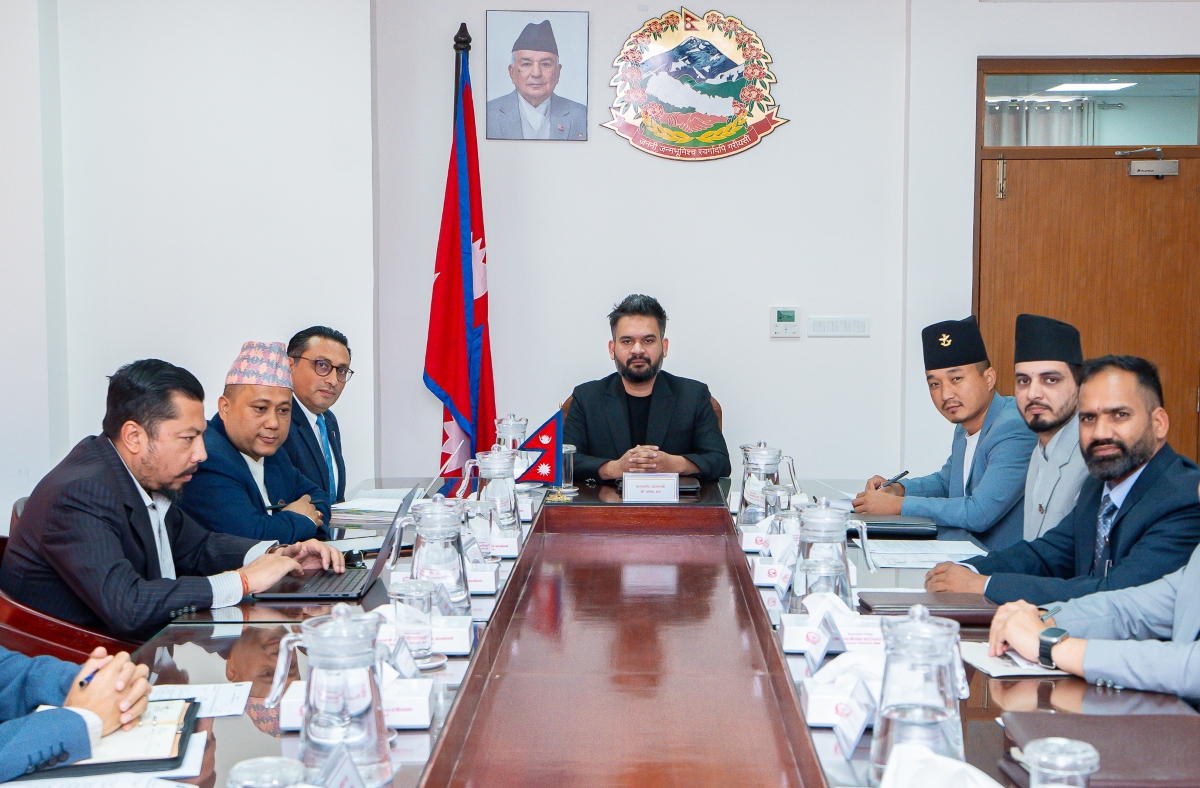
The government led by Prime Minister Balen Shah has missed its own deadline to form a powerful committee to investigate the assets of political leaders and high-ranking officials.
Under the 100-point governance reform agenda approved by the Cabinet in its first meeting, the government pledged to form a powerful committee within 15 days to investigate the assets of political figures and high-ranking officials who have held public office since 1991.
However, that self-imposed deadline expired Friday. As of Monday, the government is yet to form such a probe committee.
When contacted, spokesperson for the Office of the Prime Minister and Council of Ministers, Hemraj Aryal, said that discussions on forming the committee are ongoing.
“The asset investigation committee has not yet been formed, but we are holding discussions on it,” he said.
When asked whether the size of the committee had been decided, he replied that although discussions have begun, no decision has been made on how many members it would have.
Asked whether any names have been discussed for leadership of the committee, he said: “If a name for leadership had been decided, the committee would already have been formed.”
He added that discussions are ongoing about whether the committee should be led by a sitting or former judge of the Supreme Court or a high court, aiming for impartial and capable leadership.
He also clarified that no specific names have been discussed yet for either the coordinator or members of the committee.
“I’m not aware of any specific names being discussed,” he said.
From the spokesperson’s remarks, it appears that even after the deadline has passed, concrete progress on forming the committee has not been made. Discussions remain at a preliminary stage, with key aspects such as the committee’s size, leadership, and mandate yet to be finalized.
Point 43 of the 100-point governance reform agenda approved by the first Cabinet meeting mentions the formation of such a committee.
The provision states that the probe committee will be formed with the aim of ending widespread corruption, hiding of assets, and impunity.
In the first phase, the committee will collect, verify, and investigate asset details of key political office-bearers and high-ranking officials who held public office between 2006 and 2026.
In the second phase, it will investigate the assets of those who held public office between 1991 and 2006.
Point 43 states that arrangements will be made to ensure the investigation process is conducted based on legal standards, evidence, and impartiality, and mechanisms will be put in place to implement the committee’s reports and recommendations through relevant bodies.
According to the agenda, the committee will operate under the Office of the Prime Minister and Council of Ministers and will include experts in law, economics, revenue, and investigation, along with representatives from relevant agencies.
The committee will also be given authority to collect documents, records, and data, analyze them, and make recommendations.
The government has included this in the 100-point agenda under the heading, “Good governance, transparency, and corruption control.”
Additionally, the government has committed to preparing and implementing a restructuring plan for the National Vigilance Center within 30 days to promote good governance, control corruption, and enhance transparency and accountability in public service delivery.
To systematize anti-corruption efforts, Nepal Rastra Bank is tasked with establishing a digital asset registry within 100 days, covering bank accounts, digital wallets, share investments, and other financial activities. It will also implement a risk-based indicator system and enable automatic detection of suspicious transactions for investigation.
The 100-point agenda states that the government will issue a second national action plan against corruption in line with the United Nations Convention against Corruption within 15 days.
Similarly, it plans to introduce a National Integrity Policy within 30 days to promote ethical conduct, protect whistleblowers, and manage conflicts of interest, along with drafting or amending relevant laws.