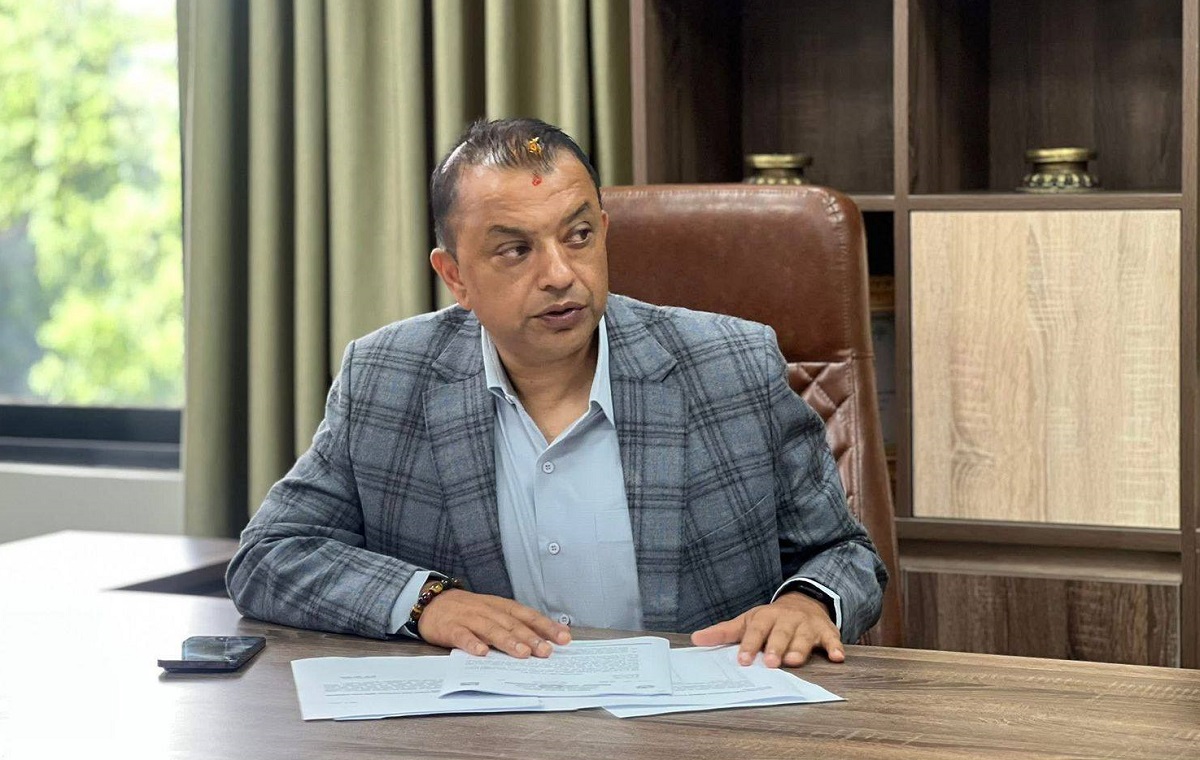
Following defeats for all party office-bearers, including himself, who contested the the House of Representatives election held on March 5, Nepali Congress President Gagan Thapa has resigned from his position, taking full responsibility for the loss.
Thapa submitted his resignation to Vice-president Bishwa Prakash Sharma on Wednesday. The resignation comes after a central committee meeting was called to review the election results.
Thapa himself was defeated in Sarlahi-4.
Immediately upon returning to Kathmandu, Thapa had expressed his intent to resign during a meeting with Vice-president Sharma. However, Sharma had advised him not to do so immediately.
Thapa eventually stepped down after completing the process of recommending 20 proportional representation (PR) candidates to the Election Commission from the list previously submitted by the party.
The Nepali Congress has called a central committee meeting for Friday at 1 p.m. to review the election.
Thapa had led the party into the election after being elected president by a special general convention on January 14, leaving him with very little time for preparation.
Candidacy registrations began just a week after he took office.
While the party fielded candidates in all 165 constituencies on January 20, it won only 18 seats in the March 5 election.
With 18 seats under the first-past-the-post system and 20 under the PR system, the NC secured a total of 38 seats, finishing second. Meanwhile, the Rastriya Swatantra Party (RSP) emerged as the largest party with nearly a two-thirds majority, winning a total of 182 seats.
The faction led by outgoing president Sher Bahadur Deuba had been demanding Thapa's resignation, arguing the party suffered defeat under his leadership. Thapa himself had been expressing his intent to resign, taking responsibility for the defeat.
The Deuba faction had boycotted the special general convention and even moved the Supreme Court against it. The case remains sub-judice.
Excerpts from Thapa’s resignation letter:
"Taking over the leadership of the party after the special general convention and leading it into the election within a very short timeframe was both an opportunity and a challenge for me.
The special general convention not only changed the leadership, but was also the beginning of multi-dimensional reforms and self-reflection within the Nepali Congress.
While the changes ignited enthusiasm among party workers, there was insufficient time to effectively communicate the message of a “transformed Congress” to the general voters.
I believe this time constraint was a major factor in the results this time.
I am clear on one thing: had we faced the election without holding the special general convention, the situation and results would have been even more unfavorable. However, since the party contested this election under my leadership, the duration of my tenure, the circumstances under which I assumed responsibility, or what would have happened if I had not done so are not important. I am absolutely clear that the accountability for the current results lies with me.
I had made up my mind to resign immediately after the election, but I am submitting my resignation now after completing other election-related essential tasks related to my responsibilities.
In the coming days, I will travel across the country and hold conversations with party colleagues and the public, understand their sentiments, and listen to their suggestions. I will remain actively involved in the journey of rebuilding and strengthening the Nepali Congress with even more energy.
I have decided to resign from the position of party president today, but I have not separated myself from the journey of party reform and rebuilding.
Therefore, this decision of mine is not an end – it is an initial step toward self-reflection, accountability, and the renaissance of the Nepali Congress."