The CPN-UML appears quiet for now. Calls for a change in leadership are no longer as audible as they once were. Even leaders who had actively sought an alternative to party Chairman KP Sharma Oli before the central committee meeting held in September have fallen silent.
Having secured the passage of his political report by the central committee, Oli appears to have concluded that dissent within the party has subsided.
Through an inter-party directive issued after the meeting, he has even warned that those who publicly criticize the party leadership will face disciplinary action.
But has discontent within the UML genuinely eased, or has the campaign to change the leadership found a new source of support?
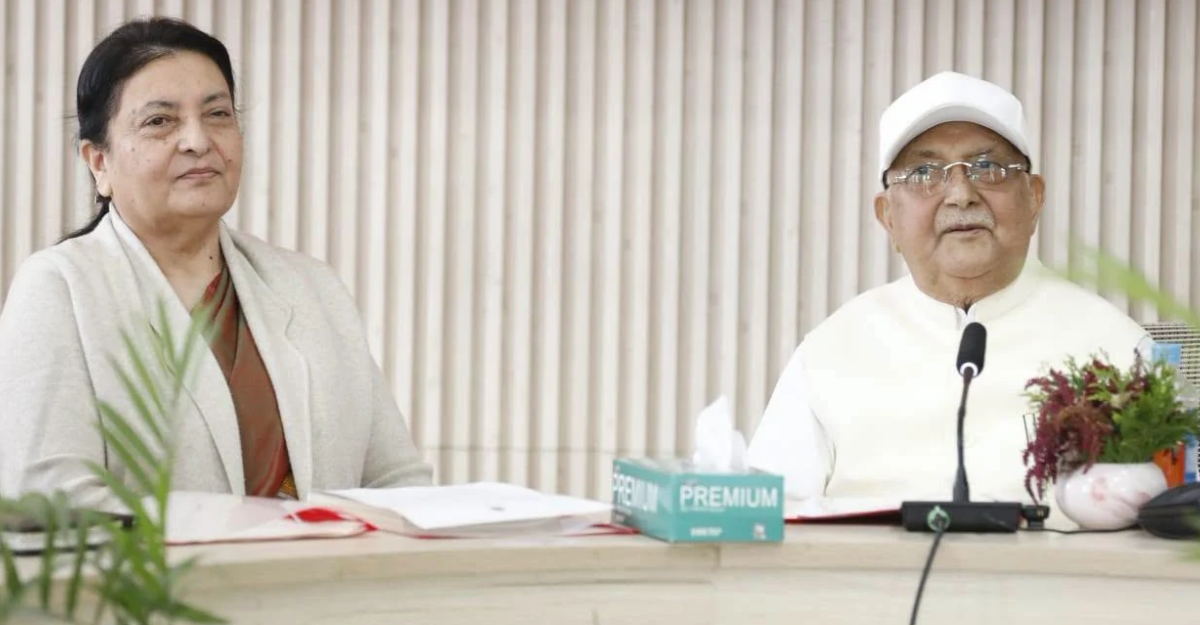
At the center of this question is former president and newly appointed UML Senior Leader Bidya Bhandari.
Oli himself appointed Bhandari senior leader when she returned to active party politics after nearly 11 years. She now ranks second in the party hierarchy, after Oli.
However, leaders aligned with Oli and those opposed to him interpret her return in completely different ways.
Oli’s supporters describe it as a move to manage internal discontent and keep the organization united. Those opposed to him, meanwhile, say it has kept the possibility of a leadership change alive.
The disgruntled faction believes Vice-chairman Bishnu Paudel and General Secretary Shankar Pokharel, who had previously been openly involved in seeking an alternative to Oli, backed down by the time of the central committee meeting. Disappointed by their retreat, some leaders have now begun looking toward Bhandari.
In other words, as Oli consolidates his grip on the party, the dissenting faction is also beginning to see a potential path toward new leadership.
The difference is that the debate over leadership change was previously public. Now, its future has become tied to the role Bhandari chooses to play.
Pokharel weaker, Bhandari stronger?
The central committee meeting held from September 21 to 24 marked a significant turning point in the UML’s internal power struggle.
Following the party’s defeat in the House of Representatives election, the question of leadership restructuring had gained momentum. Even leaders considered close confidants of Oli had questioned his leadership style. But by the time the central committee meeting took place, the campaign had failed to achieve the results its proponents had expected.
According to a leader who supports restructuring the party, had Paudel and Pokharel maintained their positions until the end, the pressure on Oli to hand over the leadership could have intensified considerably.
“If Paudel and Pokharel had stood firm, around 150 central members would have been in favor of restructuring,” the leader told Setopati. “Many people did not have much confidence in Paudel, but they believed Pokharel had political integrity. He, too, became afraid.”
According to the leader, even after Paudel and Pokharel backed down, nearly 60 central committee members spoke in favor of restructuring.
“Even if Paudel reached an understanding with Oli, Pokharel should not have surrendered like this,” the leader said. “Pokharel’s retreat could benefit Bhandari. It has also given Oli more time to consolidate his power.”
Dissident leaders point to the upcoming national gathering of party cadres, scheduled to take place in Kathmandu on November 18-19, as an example of how much Pokharel’s position has weakened.
Instead of General Secretary Pokharel, party organization department chief Bhanubhakta Dhakal is taking the lead in preparing for and coordinating the gathering.
A standing committee member sees this as a sign of Oli’s dissatisfaction with Pokharel.
“To understand how ruthless Oli can be when someone displeases him, just look at how the general secretary has been sidelined from the responsibility of organizing the national gathering of cadres,” the member said. “Such events are organized through the central office, which is headed by the party’s general secretary. Yet he [Oli] has assigned responsibility for the gathering to Bhanubhakta Dhakal. This seems to have demoralized the general secretary.”
However, there is no mandatory provision requiring the general secretary to coordinate the national gathering. Therefore, this episode should be understood as a political interpretation offered by the dissenting faction rather than definitive proof of Oli’s dissatisfaction with Pokharel.
A leader close to Oli also acknowledges that Pokharel’s political influence has weakened following the latest central committee meeting.
According to the leader, Pokharel’s attempt to remove Oli in the name of party restructuring was counterproductive.
“The chairman knows very well how to weaken those who oppose him,” the leader said.
However, the leader explained that Oli brought Bhandari back because the organization cannot be run by merely weakening the dissidents within the party.
“That does not mean the party should be weakened,” the leader said. “That is why he brought Bhandari in. Her arrival does not automatically mean she will challenge the chairman. He may simply want those dissatisfied with him to rally around her rather than leave the party.”
From this perspective, the establishment faction believes Oli is seeking to use Bhandari not as his replacement but as a means of keeping dissatisfied leaders within the party.
“A flashlight has appeared in a dark tunnel”
Leaders opposed to Oli interpret Bhandari’s arrival very differently.
According to them, after Paudel and Pokharel backed down, the campaign for leadership change was effectively left without a leader. Bhandari’s return has created the possibility of filling that vacuum.
“People outside the UML are not happy that Bidya Bhandari has returned to the party. Many of us within the party are unhappy about it, too. But the mood within the UML is different,” a leader opposed to Oli said.
The leader described Bhandari’s arrival as a source of hope for bringing the party out of its crisis.
“Oli has pushed the UML into a dark tunnel. Since Bhandari arrived, we have felt that, even if only slightly, a flashlight has been switched on,” the leader said.
According to the leader, Bhandari could help establish some balance at a time when anyone questioning Oli’s leadership style risks disciplinary action.
This expectation is also grounded in Bhandari’s formal position in the party hierarchy.
According to the central committee’s decision, Senior Leader Bhandari is entitled to participate in meetings of the secretariat, standing committee, politburo, and central committee. The inter-party directive has also assigned her the responsibility of assisting the chairman and helping guide the party toward appropriate decisions.
These arrangements give her access to the party’s major decision-making forums. However, they do not automatically grant her the authority to block Oli’s decisions or bring about a change in leadership. That will depend on the political position she chooses to adopt.
So far, she has not publicly taken a clear position in favor of changing Oli’s leadership. The hopes of the dissenting faction, therefore, should not be confused with Bhandari’s actual political plans.
Nevertheless, leaders opposed to Oli express confidence that Bhandari will gradually bring dissatisfied members together.
In their view, the earlier campaign to find an alternative to Oli was led by party office-bearers. Bhandari, who ranks immediately below Oli, could now assume that role.
In this sense, they argue, her arrival may not immediately amplify calls for rebellion, but it has introduced a potential figurehead who could lead such a movement.
Oli, meanwhile, wants to put an end to the debate over leadership change. Following the UML’s latest central committee meeting, he has sought to curb criticism of the leadership in the name of enforcing party discipline.
An inter-party directive issued on October 6 described the central committee meeting as a “cut-off meeting” for restoring discipline.
The directive said that members would not face disciplinary action based on what they had said before the meeting. However, it warned that anyone who publicly criticized or opposed the party’s policies, decisions, or leadership, or engaged in factional activities from that point onward, would be asked to explain their conduct and could face disciplinary action.
This has made it more difficult to publicly advocate a change in Oli’s leadership.
Oli’s supporters, however, describe the move as an effort to maintain discipline and unity within the party.
They claim that the central committee meeting in September settled the disputes raised in the name of restructuring. As a result, they believe the issue of an immediate leadership change is unlikely to resurface.
“At least until the local and provincial elections, this issue will not be raised again,” a leader close to Oli said.
According to the leader, new political equations concerning the UML’s leadership could emerge by the time of the upcoming 12th general convention, but it would be premature to speculate about them now.
This is where the strategies of Oli and his dissatisfied colleagues diverge.
Oli wants to shut down the debate over leadership change and focus the organization on the elections. The dissenting faction, however, argues that retaining the current leadership and its style of functioning will lead to another electoral defeat.
Could Bhandari become an interim leader?
Some leaders opposed to Oli have begun considering an even more ambitious proposal involving Bhandari.
They say the party should discuss the possibility of giving Oli an honorable exit from the leadership and appointing Bhandari as interim leader until the next general convention.
“The general understanding among party cadres is that the party has already become weak and that they can no longer move forward under Oli’s leadership,” a standing committee member said. “That is why Bidya Bhandari should be brought in to lead the party on an interim basis, while Oli is given an honorable farewell.”
For now, however, this is only an idea being floated by some leaders from the dissenting faction. Bhandari herself has given no indication that she would accept such a proposal.
Implementing this option would be difficult unless Oli himself agreed to step down.
Under the UML’s statute, a special general convention could provide a formal route to changing the leadership.
Article 72 of the party statute stipulates that the central committee must convene a special general convention within six months if a written demand, accompanied by concrete reasons and agenda, is submitted by two-thirds of district committees or a majority of the national general convention representatives’ council.
Based on the 2,263 delegates who attended the 11th general convention, at least 1,132 delegates would need to support the proposal to secure a majority.
Given Oli’s grip on the party organization and the balance of power among general convention delegates, securing that number would be a major challenge for the dissenting faction.
For this reason, leaders opposed to Oli say persuading him to agree to an honorable departure would be preferable to trying to remove him through a special general convention.
“If the UML contests the election under KP Oli’s leadership, it will suffer an even more humiliating defeat. It would be easier if he voluntarily made way,” a standing committee member said. “Removing him through a special general convention could also damage the party. But that does not mean the demand for an alternative to Oli has weakened.”
However, even the dissenting faction has no clear answer to the question of who currently has enough political leverage to persuade Oli to hand over the leadership.
With Paudel and Pokharel having failed to give the leadership-change campaign a decisive push, it remains an open question whether Bhandari can play that role.
Could Oli’s own decision create a challenge to his leadership?
There is an interesting contradiction at the heart of Bhandari’s return to the UML.
Until recently, the party was divided over whether Bhandari should be allowed to return to active politics. Even the renewal of her party membership had become a subject of controversy.
Yet at the central committee meeting held in September, Oli himself proposed appointing her as senior leader.
After the proposal was approved, Bhandari rose to the second position in the party hierarchy, immediately after Oli. She formally began participating in party meetings after taking an oath administered by Oli himself on October 8.
Leaders close to Oli describe the move as an expression of the chairman’s political magnanimity and a step taken for party unity.
The dissenting faction, however, believes that although Oli brought Bhandari into the party to ease immediate pressure, the decision could eventually create a challenge to his own leadership.
Bhandari now faces two possible paths.
She could limit herself to the role of a senior leader who assists Oli. In that case, her return could strengthen Oli’s leadership rather than provide the dissenting faction with a basis for pursuing leadership change.
Alternatively, she could lend political support to leaders who want a change in leadership. If she chooses this path, the restructuring debate, which currently appears dormant, could become active again.
It is not yet clear which path Bhandari will choose.
Therefore, the answer to the question of whether Bhandari’s return has weakened or strengthened the rebellion against Oli must, for now, be sought on two levels.
Following the central committee meeting, the campaign to replace Oli in the immediate future has weakened. Its principal proponents have retreated, and the chairman has tightened his control over the organization.
But dissatisfaction among leaders who want a change in leadership has not disappeared. They see Bhandari’s arrival as an opportunity for new power equations to emerge in the future.
In other words, the rebellion against Oli currently appears weak, but Bhandari’s return has kept open the possibility of reviving it.
Whether that possibility develops into a genuine political challenge or remains merely a hope among dissatisfied leaders will depend on the role Bhandari chooses to play.