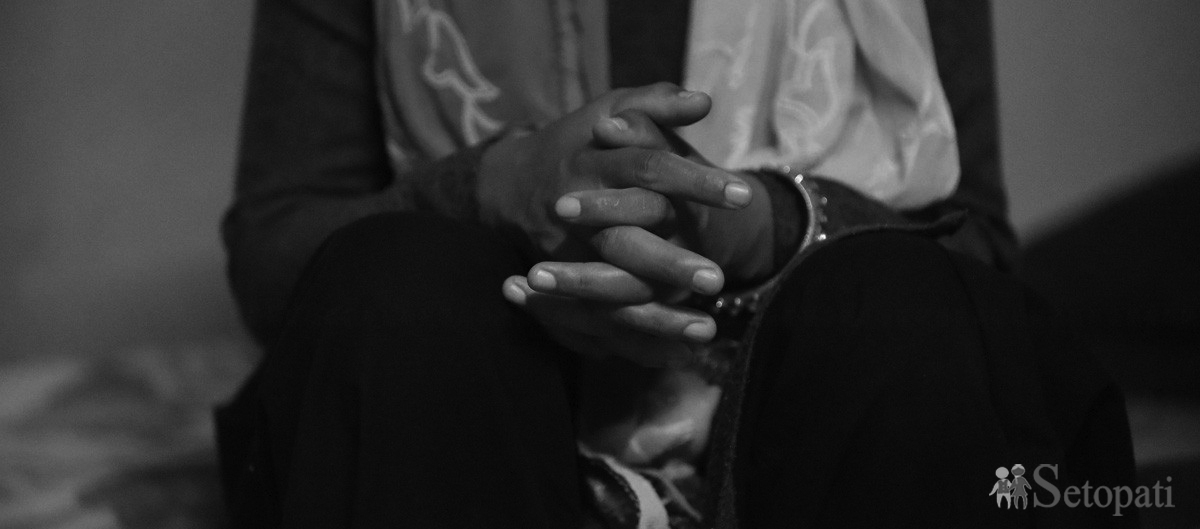
It has been seven years since Sisne Himal (name changed) ran away from her village and came to Kathmandu in search of justice.
As soon as we met her at a tea shop in Lalitpur on Tuesday, Sisne Himal pulled out a folded A4-sized file from her gray bag.
That file contained the final verdict she had been waiting for over the past 12 years.
Eleven years ago, Sisne Himal filed a complaint against five individuals, accusing them of trafficking her to Syria. Of those five, the Supreme Court has sentenced three to 12 years imprisonment each and a fine of Rs 50,000 each.
A bench of Justices Sharanga Subedi and Nripa Dhwaj Niraula handed down the sentence to Shyam Lal Dangol of Tokha, Kathmandu; Juwa Hasta Satar (Sunita Murmu) alias of Damak, Jhapa; and Gyanendra Chanara of Salyan, ruling that they trafficked Sisne Himal to Syria with the intent of selling her.
The court stated that documents included in the case file prove that these three trafficked Sisne Himal to Syria in collusion.
Although the Supreme Court delivered the verdict on June 8 last year, the full text was released only a few days ago.
"At least all three have been sentenced to 12 years in prison, that's enough," Sisne Himal told Setopati. "I suffered so much because of them! Now it's enough for me!"
According to the details in the complaint, charge sheet, and verdict, the incident began on April 14, 2014.
On that day, Gyanendra Chanara, Sunita Murmu, and Shyam Dangol brought Sisne Himal from Rukum to Kathmandu, then took her to India via Kakarbhitta. Five days later, she was taken from to Syria from Kolkata, India, via Dubai.
Among the three, Dangol had lured her with the promise of a job in a medicine manufacturing company. Chanara was the one who had introduced her to Dangol.
They colluded to take Sisne Himal to Kolkata, India, where they handed her over to Bhakte Pariyar and Topraj Adhikari.
Sisne's complaint states that these two sent her along with four other girls to Dubai from Kolkata. From there, a contact person linked to them took her to Syria.
Sisne Himal told the court that it was only upon reaching Syria that she learned she had been sold for USD 7,000.
The gang's office in Syria sent her to work in a house, where extreme exploitation began. She said in her statement that she was denied food, sexually abused, beaten, not given payment for work, and more.
After three months of work, she fell ill.
The family then returned her to the gang's office. Office staff continued to torture her daily, she said.
After two months in the Damascus office, Sisne Himal secretly contacted her family.
Her family negotiated with the Syria office to bring her back to Nepal. They agreed to send her back for Rs 200,000.
Under that condition, Rs 200,000 was paid to the gang, and Sisne Himal returned to Nepal.
After returning, she filed a complaint 11 years ago against Chanara from her village, Dangol from Kathmandu, Murmu from Jhapa, and Bhakte Pariyar and Topraj Adhikari with unknown addresses, accusing them of selling her in Syria promising to give her a job in the medical sector.
Initially, the police refused to register her complaint.
After four months of approaching various organizations for help, she succeeded in registering it with their assistance.
One year after the complaint was registered, police arrested Chanara. Later, Dangol and Murmu were also arrested.
Although police filed a case against all of them, the government attorney did not prosecute Bhakte Pariyar, Topraj Adhikari, and a person named Kalpana, citing them as absconding and with unknown addresses.
Sisne Himal said that the perpetrators tried hard to make her retract her statement in the case filed at the Kathmandu District Court,.
"They even tried to lure me with money," she said, "but I wanted justice, not money."
In that case, the Kathmandu District Court acquitted Chanara and Murmu but kept Dangol in custody.
Dissatisfied with the district court's decision, the government attorney appealed to the high court.
Sisne Himal fled Rukum with her daughter and came to Kathmandu, saying Chanara returned to the village after the acquittal and threatened to kill her.
"They couldn't get to me, so they threatened to kill my daughter, and I had to leave home," she said. "Since the case was filed in Kathmandu, I came here."
It has now been seven years since she fled to Kathmandu.
In the meantime, the high court ruled that the group of Dangol, Chanara (acquitted by district court), and Murmu had trafficked Sisne Himal to Syria and sold her there.
A bench of Judges Yagyaraj Bhatta and Tek Narayan Kunwar sentenced Dangol, Chanara, and Murmu to 20 years imprisonment and a Rs 200,000 fine each, and ordered them to pay Rs 200,000 each in compensation to the victim.
The sentence was handed under Section 15(1)(a) of the Human Trafficking and Transportation (Control) Act, which provides for up to 20 years imprisonment for human trafficking.
The high court also ordered police to again investigate Bhakte Pariyar and Topraj Adhikari, who were involved in the trafficking.
Dangol and Murmu appealed the high court's decision to the Supreme Court.
The Supreme Court, after hearing their appeal, also ruled that they took her to Syria with the intent of selling her.
The verdict states: "Although there is no clear and objective evidence that the victim was sold or bought in Syria, the file proves that she was taken there with the intent of buying/selling or exploiting her."
The Supreme Court, however, did not comment on Pariyar and Adhikari, who were involved in taking her to Syria and bringing her back to the Nepali border when she returned.
Under Section 15(1)(e) of the Human Trafficking and Transportation (Control) Act, a person faces 10 to 15 years imprisonment and a fine of Rs 50,000 to Rs 100,000 if it is proven that they took someone abroad with the intent of selling them. There is also a provision to make the perpetrators pay reasonable compensation to the victim.