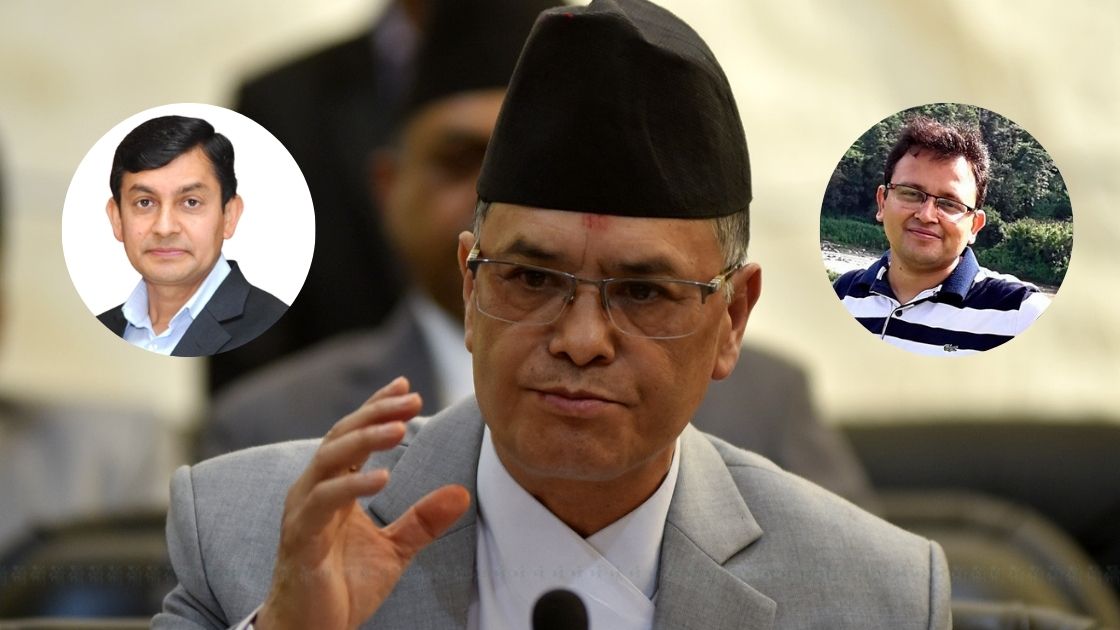
The Department of Money Laundering Investigation raided the homes of people close to former chief justice Cholendra Shumsher Rana on Wednesday.
According to sources, raids were conducted at the residences of former high court judge Nawaraj Thapaliya, former Supreme Court information technology expert Deepak Timilsina, and Nabin Basnyat.
Following the raids, interest has grown regarding who these individuals are and what their connections with Rana are. Some background on Thapaliya and Timilsina, and their links with Rana, is outlined below.
Nawaraj Thapaliya
Advocate Nawaraj Thapaliya came into the spotlight in March 2019.
Questions were raised as to how he was recommended for a high court judge position despite having no record of continuous legal practice or building a good reputation.
Thapaliya was reportedly seen more often around the chambers of Supreme Court justices, staff, and government attorneys than arguing cases in court. The process to appoint him as a high court judge was initiated by then-chief justice Cholendra Shumsher Rana.
A meeting of the Judicial Council chaired by Rana recommended Thapaliya for appointment as a high court judge. Thapaliya was appointed by Rana himself. Thapaliya is the husband of a friend of Rana’s daughter.
During Rana’s tenure as chief justice, Thapaliya was accused of collude with Rana to settle court cases and take bribes.
Less than a year after Rana left the Supreme Court following impeachment proceedings, complaints began to be filed against Thapaliya at the Judicial Council.
He faced allegations including taking Rs 6 million at a Kathmandu hotel from a woman fighting a court case and taking tens of millions of rupees to influence the outcome of a case related to the Unity scam.
After complaints were filed accusing him of acting as a middleman and taking bribes from service-seekers, he was recalled to the Supreme Court from the Jumla Bench of the Surkhet High Court.
The Judicial Council formed a committee headed by then-judge Til Prasad Shrestha to investigate the allegations against him.
The committee recommended his dismissal, concluding that allegations including his involvement as a middleman and taking bribes had been substantiated.
In February 2024, the Judicial Council recommended his dismissal to the chief justice, following which he was removed from judicial service.
The Constitution allows high court judges to be removed on grounds including competence and misconduct under Article 142(1)(c), while Article 149(6)(c) contains similar provisions concerning district judges. The council dismissed Thapaliya under these provisions.
Deepak Timilsina
Deepak Timilsina, who once worked in the Supreme Court’s information technology section, suddenly came into the spotlight in 2021. The reason behind this was once again former chief justice Rana.
It was reported at the time that then-chief justice Rana had sought his share in the Cabinet from then-prime minister Sher Bahadur Deuba. Three political sources contacted by Setopati at the time confirmed that discussions were underway to appoint either two or at least one minister on Rana’s recommendation during the Cabinet expansion.
The Constitution allows a person who is not a member of the Federal Parliament to be appointed minister for up to six months. Rana was reportedly seeking to use that provision to appoint his “own people,” and Timilsina was the person he initially put forward.
Timilsina’s association with the Supreme Court dates back nearly 15 years.
At the time, the Supreme Court had an information technology section where employees could also be hired on contract. Timilsina was appointed as an IT expert in this manner. His uncle, Ram Krishna Timilsina, was then the Supreme Court registrar.
Appointed as an expert at the Supreme Court in 2006, Timilsina later became director of the Information Technology Division.
He became embroiled in controversy while serving as director and resigned during the tenure of then-chief justice Ram Prasad Shrestha. According to sources, Shrestha had asked him to resign.
However, Timilsina’s association with the Supreme Court did not end there.
After Ram Kumar Prasad Sah became chief justice, Timilsina returned to the Supreme Court. Sah appointed him as an IT expert.
At the time, Ramesh Joshi was director of the Information Technology Division. Although Joshi headed the division, Sah had many tasks executed by Timilsina as an IT expert.
When Joshi’s contract expired, Sah did not renew it. There was speculation that Sah wanted to appoint Timilsina as director, but he was unable to do so.
After Sah left the Supreme Court, Timilsina also left.
Timilsina’s ties with the Supreme Court grew again after Rana took over as chief justice. He had close relations with Rana and some other justices.
There were allegations that when officials were being appointed to constitutional bodies during KP Sharma Oli’s tenure as prime minister, the chief justice had also sought a share in the appointments. Some political leaders say Timilsina was active on behalf of the chief justice at the time.
After Rana left the Supreme Court, Timilsina’s name was no longer frequently discussed within the judiciary.
His name resurfaced after the department raided his residence, along with those of Rana and Thapaliya, on Wednesday.
Other events linked to the investigation into Rana
Government agencies began investigating people close to former chief justice Rana after police detained him recently and examined his mobile phone.
At around 3 a.m. on September 27, police officers from the Kathmandu Valley Crime Investigation Office took Rana into custody from his residence and took him to the office. He was held at the office for about 12 hours.
On September 28, police arrested Inam Sapkota of Jhapa and began investigating him. According to sources, Sapkota also gave a statement about his relationship with Rana during questioning.
According to sources, Sapkota told police, “Cholendra used me.”
Sapkota is currently in the custody of the District Police Range, Kathmandu. A seven-day extension has been granted for his detention on the charge of indecent behavior.
Sources say Sapkota was also found to have been in contact with Deepak Bhatta, who has recently approached the Supreme Court with a habeas corpus petition.
Sources claim that after Sapkota was found to have connections with both Rana and Bhatta, investigations are underway over suspicions that attempts may have been made to tamper with legal cases.
Following Rana’s arrest, the Home Administration transferred Bhatta from Nakkhu Prison to Sindhupalchowk Prison.
Meanwhile, it has emerged that Armed Police Force Additional Inspector General (AIG) Banshi Raj Dahal was suspended based on his contacts with Rana and Sapkota.
The Home Ministry suspended Dahal on Monday evening on allegations of “leaking sensitive information” related to security.
A statement issued by Home Ministry spokesperson Ananda Kafle said that the Armed Police Force had recommended action against Dahal, alleging that he had “committed an act contrary to the code of conduct by leaking sensitive information related to security.”
The Home Ministry has not yet disclosed what information Dahal allegedly leaked, to whom, or for what purpose.
According to sources, the investigation focused on Dahal’s visit to the Kathmandu Valley Crime Investigation Office in Teku on the night Rana was arrested, as well as his subsequent contact with Sapkota.
Rana and Dahal are also relatives.
Dahal reportedly arrived at the Crime Investigation Office at around 3 a.m. on the night Rana was arrested. Sources say Nepal Police reported the incident to the Home Ministry through its headquarters.
According to sources, the investigation into Dahal moved forward after the report reached Home Minister Sudan Gurung.
Sources say police also examined Rana’s phone while he was in custody, and that information obtained from the device led investigators to Sapkota.
A few days later, a Special Bureau team took Sapkota into custody for questioning. During the investigation, Sapkota was found to have been in contact with AIG Dahal, according to sources.
Conversations and messages between Dahal and Sapkota also came under investigation. According to sources, evidence was found indicating that Dahal had provided Sapkota with sensitive security-related information.
The Armed Police Force headquarters subsequently sought an explanation from Dahal. Although he submitted his response, the headquarters recommended that the Home Ministry take action against him.