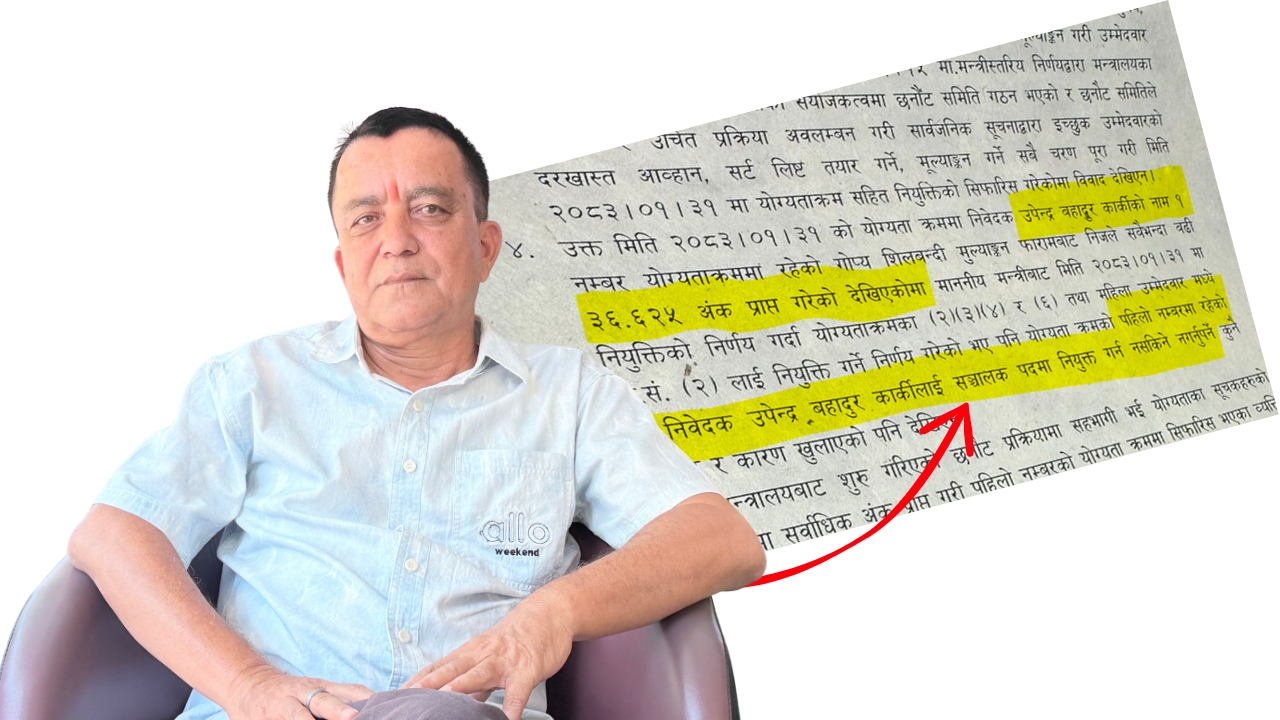
Upendra Bahadur Karki never dreamed of getting a government job or receiving a government appointment.
He used to think that having qualifications alone was not enough to get there. To secure a government appointment, he thought, one had to pay money, pull strings, and curry favor with political leaders.
That is why Karki continued working in the private sector until the age of 56.
However, he had a change of heart after the Gen Z movement.
After the government led by Balen Shah introduced a policy of meritocracy, or making appointments based on merit, Karki felt a desire to work in a government institution.
On April 25, 2026, he saw a notice in Gorkhapatra inviting applications for appointment as board members of the Nepal Airlines Corporation.
He thought that, given his qualifications and experience, he might be able to contribute to reforming a government institution.
“I applied for a government appointment for the first time in my life,” Karki told Setopati.
Karki, who is from Morang, spent his entire career in the airline industry. In 1992, he became a marketing officer at Everest Airlines, his first job in the sector. He then worked for a long time at Cosmic Air, where he eventually became a director.
After Cosmic Air shut down, he worked as a director at Simrik Airlines.
“I felt that I fit the qualifications prescribed for a member of the corporation’s board,” said Karki, who holds a master’s degree in economics.
He completed the required procedures and submitted his application for the position on May 4.
The list of applicants was published on May 8. Karki’s name was third among 27 applicants. Two days later, on May 10, he appeared for an interview and presented his professional work plan.
The results were announced on May 14.
The Ministry of Culture, Tourism and Civil Aviation published the names of five people, under a notice asking them to come and collect their appointments.
The first name on the list was Deepak Prasad Bastola of Pokhara, Kaski. The second was Prabin Bhattarai of Chitwan, followed by Maheswor Bhakta Shrestha of Lalitpur, Rupa Lamichhane of Gokarneshwar, Kathmandu, and Lila Raj Dhakal of Syangja.
Karki did not find his name on the list.
He read the ministry’s notice again.
The ministerial decision stated that the appointments had been made “on the recommendation of the selection committee following completion of the entire appointment process, including evaluation of educational qualifications and experience, assessment of professional work plans, presentations, and interviews.”
Karki found it strange that his name was missing from the list.
“Some of the people recommended for appointment had never worked in the airline sector,” Karki said. “I was even asked technical questions during the interview. I kept wondering what answers those who had never worked in the airline industry had given to make it onto the list.”
He also remembered those who had conducted the interviews. Ministry Secretary Mukunda Prasad Niraula was the coordinator. Other ministry representatives were involved, along with an associate professor who teaches psychology at Tribhuvan University. A young lecturer who teaches aeronautics at Pulchowk Engineering Campus had also participated as an expert.
“I was asked technical questions in the interview that only people familiar with the airline sector would know. Therefore, I kept wondering what questions had been asked of the others,” he said.
Karki had applied for a government appointment for the first time in his life because he believed appointments would be based on merit. The results left him with a question: Had meritocracy really been implemented?
Suspicious of the results, Karki approached the Supreme Court to put the process to the test.
“I believed in meritocracy. I applied because I thought that if I got the appointment and had the government’s support, I could do something at Nepal Airlines,” Karki said. “I had worked in the airline sector for a long time. I applied thinking that if I got the opportunity to reform Nepal Airlines, my name could be written in golden letters in history. But I had to knock on the court’s door for meritocracy.”
On June 4, the Supreme Court ordered the Ministry of Culture, Tourism, and Civil Aviation to submit, in a sealed envelope, the sheets showing the scores awarded by experts for evaluation of the professional work plans, the scores for presentations of those work plans, the interview scores, and the sheets containing the total scores.
Following the Supreme Court’s order, the ministry submitted the documents.
The Supreme Court opened the sealed envelope and examined the records. Karki had received the highest score – 36.62 – and ranked first on the merit list.
It was also found that Bhim Chand, who had ranked fifth in the merit list, had been left out of the ministerial appointment decision.
The court ruled that the Balen Shah government’s professed meritocracy amounted to “pick and choose” and overturned the decision made by Minister Khadak Raj Paudel (Ganess).
On June 12, a bench of Supreme Court Justices Tek Prasad Dhungana and Shanti Singh Thapa ruled that the appointments made on a “pick and choose” basis were opaque, not based on merit, flawed and contrary to good governance.
After the ministerial decision was overturned, Karki became a member of the Nepal Airlines Corporation’s board of directors.
While he was fighting the case, Deepak Prakash Bastola, who had been recommended for the board, became vice-chairman of the corporation.
Bastola, a retired major general of the Nepal Army, had four decades of experience as an aeronautical engineer. However, after he was not given an executive role, Bastola resigned.
Likewise, Maheswor Bhakta Shrestha, who had been recommended as a board member, was appointed executive chairman and general manager of the corporation on July 14. Karki also filed a case at the Supreme Court on July 16 challenging Shrestha’s appointment.
The law requires a person to be at least 30 years of age and no older than 65 to become the corporation’s executive head. Karki sought Shrestha’s removal after the 80-year-old Shrestha was appointed to the position.
“I had asked the court to appoint me as general manager because my name was first on the merit list,” Karki said.
A bench of Supreme Court Justices Sunil Kumar Pokharel and Bal Krishna Dhakal, acting on Karki’s petition seeking annulment, removed 80-year-old Shrestha from the position of general manager on August 21. However, the court did not order Karki’s appointment as general manager.
The court rejected that part of Karki’s claim, saying he had been appointed as a board member and that the authority to appoint the general manager rested with the Cabinet.
The government, however, is now preparing not only to deny Karki the post of general manager but also to remove him from the corporation’s board.
After Karki successfully challenged and overturned the government’s decisions twice in court, the government appears to be moving toward retaliatory action against him.
The Ministry of Tourism has already sought an explanation from him twice as part of the process to remove him.
He was asked to explain allegations of a conflict of interest on the grounds that a company in which Karki was involved had previously won a contract from Nepal Airlines and had participated in another tender as recently as two years ago.
Karki told Setopati: “The company I was involved with had previously won a tender to supply paper cups for distributing water at the airline. How does winning a tender constitute a conflict of interest? The tender was not received or awarded after I became a member of the airline’s board.”
In his written response, he argued that a company legally obtaining a contract or procurement work from a public body through an open competitive process, and a person who is a director of that company subsequently being appointed to a board position at the public institution, cannot by itself be considered a conflict of interest.
According to sources at the Tourism Ministry, Prime Minister Shah’s assistant expert on civil aviation, Suman Gautam, has lately become more influential at the ministry than the minister himself. Sources say Gautam frequently visits the ministry on behalf of the prime minister and intervenes in its affairs.
A source said that Gautam’s alleged reprimands were one of the reasons Deepak Prasad Bastola resigned as NAC vice-chairman.
Gautam had instructed board members to remain in the office full-time, according to the source. Bastola was reportedly frustrated with his working style and approach. He then told Gautam that board members were supposed to perform their duties in accordance with the Nepal Airlines Corporation Act, the source said.
Quoting remarks Bastola made to people close to him, the source said:
“They act as if they alone care about the country. They act as if they alone have come to build the country. It is difficult for a person with dignity and self-respect to work with these people.”