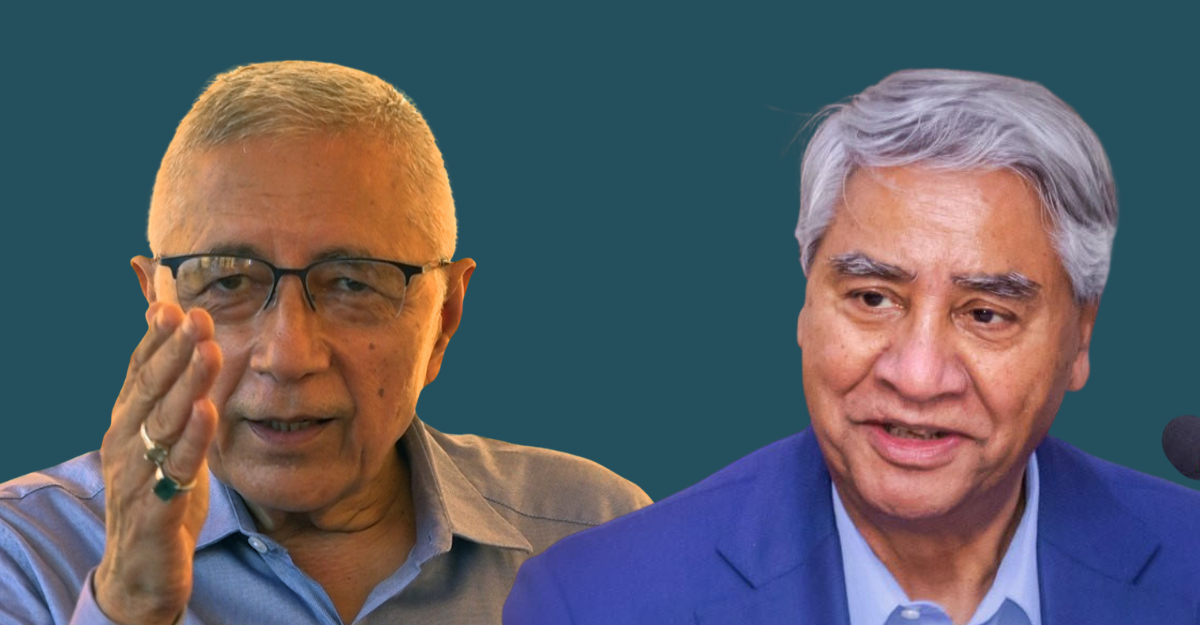
As the Nepali Congress approaches its ward conventions under the 15th general convention process, many leaders close to outgoing party president Sher Bahadur Deuba and leader Shekhar Koirala have returned to the party’s Sanepa headquarters. This has given rise to speculations both within and outside the party over how many central-level leaders still remain aligned with Deuba and Koirala.
The ward conventions are scheduled for September 19 and 20. Before that, in line with the decision of the central executive committee’s meeting of September 13, the status of central members elected by the 14th general convention was made equivalent to that of central members elected through the special general convention. Following the decision, many leaders from the Deuba camp returned to Sanepa.
In the 14th general convention held in 2021, Deuba won the presidency with the support of more than 82 percent of the central members.
None of the office-bearers from that time is now standing with Deuba. Leaders from the establishment faction claim that Umakant Chaudhary, who had presented a schedule at Chundevi for holding a separate general convention, also appears positive about joining the establishment faction. However, he has not yet publicly stated his position on the matter.
At the time of the 14th general convention, Deuba was the main point of trust for most Nepali Congress leaders. He was also prime minister at the time.
However, politics changed following the Gen Z movement in September 2025. Deuba and his wife were even physically assaulted at their residence in Budhanilkantha.
The changed political environment was also reflected within the Nepali Congress. Campaigns for transformation and generational change emerged inside the party. The number of people who trusted Deuba gradually declined. Party leaders and workers increasingly began rallying behind then-general secretaries Gagan Thapa and Bishwa Prakash Sharma.
Deuba then handed the responsibility of acting president to then-vice-president Purna Bahadur Khadka but continued to intervene in the decision-making process. As a result, meetings of the central committee remained inconclusive for a long period. Consequently, the party could not hold its regular general convention within January, and a special general convention was held following demands from general convention representatives, under the leadership of Gagan Thapa and Bishwa Prakash Sharma.
After the Election Commission recognized the special general convention, President Thapa distributed election tickets. Deuba was not given a ticket, and he subsequently left for Singapore shortly before the election, citing the need for medical treatment.
After receiving treatment in Singapore and resting in Hong Kong, Deuba returned to Nepal. When he landed at Tribhuvan International Airport after about five months on August 13, leaders and workers from his faction gave him a grand welcome.
While Deuba was abroad, leaders aligned with him had already opened a contact office in Chundevi and begun parallel activities. When Deuba returned to Nepal, some expected dialogue with the establishment faction and a resolution of the differences that had emerged following the special general convention, but that did not happen.
Deuba went directly from the airport to the Chundevi office.
“I could not be defeated by King Gyanendra; can anyone else defeat me here?” he said. Photographs then emerged of Deuba assuming his duties in a room and at a desk bearing a nameplate identifying him as president at Chundevi.
Deuba had issued an appeal saying, “I have returned not as a leader, but as a lifelong citizen of this great nation, ready to serve with humility, dedication, and love.” Yet within a short time he appeared as party president and participated the following day, August 14, in a national gathering/conference organized by his faction.
That gathering began advancing a new position that the 15th general convention should be held under Deuba’s leadership. Deuba, for his part, began saying that Gagan Thapa had held the special general convention without his knowledge and without even verifying signatures. On September 15, he issued an appeal saying he would not step back from carrying out his responsibilities until the final moments of his life.
“I have no personal desire for any post or responsibility. I no longer have any ambition to hold any position. But if the state and the Nepali Congress deem it necessary to utilize my experience, I will not hesitate to carry out my responsibilities until the final moments of my life,” Deuba said. “As the legitimately elected president of the Nepali Congress from the 14th general convention, which was duly completed by general convention representatives from across the country, it is my legal, political and moral responsibility to complete the 15th general convention and hand over the party leadership, and fulfilling that is my duty too.”
However, following Deuba’s appeal that he would not step back from his responsibilities until the end, many leaders close to him turned toward Sanepa. One factor behind this was also a decision made at the national conference on August 16. Through the decision, the Deuba faction indirectly signaled support for a Hindu state, which created a situation in which many leaders close to Deuba who had contributed to drafting the Constitution began distancing themselves.
After the Nepali Congress led by Gagan Thapa moved ahead with the general convention process, the Deuba faction repeatedly approached the Supreme Court in an attempt to stop it. However, the Supreme Court did not issue an order to halt the general convention. Some leaders from the Deuba faction argue that the general convention should not proceed because the Supreme Court has granted permission to review the special general convention verdict. At the same time, they have themselves introduced a separate general convention schedule, resulting in contradictory decisions.
Deuba has been preparing for a separate general convention by appointing former general secretary Shashank Koirala as coordinator of the 15th general convention preparation committee. However, former acting president Purna Bahadur Khadka, who had supported him in the past, and leader Shekhar Koirala, who had occasionally supported him, are not currently standing with him. Khadka and Koirala are seeking to remain in the middle. Both have been appealing for the general convention schedules to be halted and for decisive dialogue to begin. However, few leaders have remained committed to their appeal, while most have already gone to Sanepa to participate in the general convention process.
According to some leaders who have left Deuba and joined the establishment faction, the possibility of the party coming together is now low. They say that when they pressured Deuba to unite the party, he instead told leaders to clarify which faction they belonged to. They say this led even more leaders to leave his side. According to these leaders, Deuba is preparing to form a separate party, whose ideology and principles would differ from those of the Nepali Congress.
The Nepali Congress central committee elected by the 14th general convention had 168 members. Shekhar Koirala, who lost to Deuba in the presidential race, automatically became a central member. In the meantime, Ram Sharan Mahat has been ill, while Jhapa leader Kumar Budhathoki has died. Only a small number of central leaders now appear to remain with Deuba.
Some have also speculated that candidates who lose in the convention being organized by the establishment faction could subsequently go to Deuba’s convention and assume leadership roles there. For this reason, the establishment faction is making efforts to select its leadership unanimously as far as possible.
Here are the leaders who remain on Deuba’s side:
1. Sher Bahadur Deuba
2. Prakash Man Singh
3. Bimalendra Nidhi
4. Shashank Koirala
5. Krishna Prasad Sitaula
6. Prakash Sharan Mahat
7. Narayan Khadka
8. Man Bahadur Bishwakarma
9. NP Saud
10. Anand Dhungana
11. Ambika Basnet
12. Shankar Bhandari
13. Ramesh Lekhak
14. Mohan Bahadur Basnet
15. Shiva Humagain
16. Kiran Raj Sharma Paudel
17. Jit Jung Basnet
18. Guru Baral
19. Kundan Raj Kafle
20. Madan Amatya
21. Arzu Rana Deuba
22. Govinda Bahadur Shah
23. Nripa Bahadur Bada
24. Rangamati Shahi
25. Bidya Timalsina
26. Sita Devi Devkota Pandey
27. Laxmi Khatwada
28. Kalyani Rijal
All central leaders close to former acting president Purna Bahadur Khadka have already returned to Sanepa. Khadka, however, is in favor of suspending the general convention schedule and holding decisive talks.
Some leaders aligned with Shekhar Koirala remain uncertain about their position. Koirala himself is reportedly in favor of not participating in either general convention and instead traveling to villages across the country in an effort to unite the party.
However, leaders claim that, except for Koirala, the establishment faction is in dialogue with other leaders and that talks are progressing with the aim of bringing them into the establishment faction by the time of the ward conventions. Twenty-two central members were elected from Koirala’s faction in the 14th general convention.
Later, Deuba nominated Minendra Rijal, Chandra Bhandari, Kiran Yadav, and Rukmini Koirala, bringing the number of central committee members aligned with Koirala to 26.
Leaders who remain in Koirala’s camp
1. Shekhar Koirala
2. Badri Prasad Pandey
3. Sanjay Gautam
4. Sarita Prasain