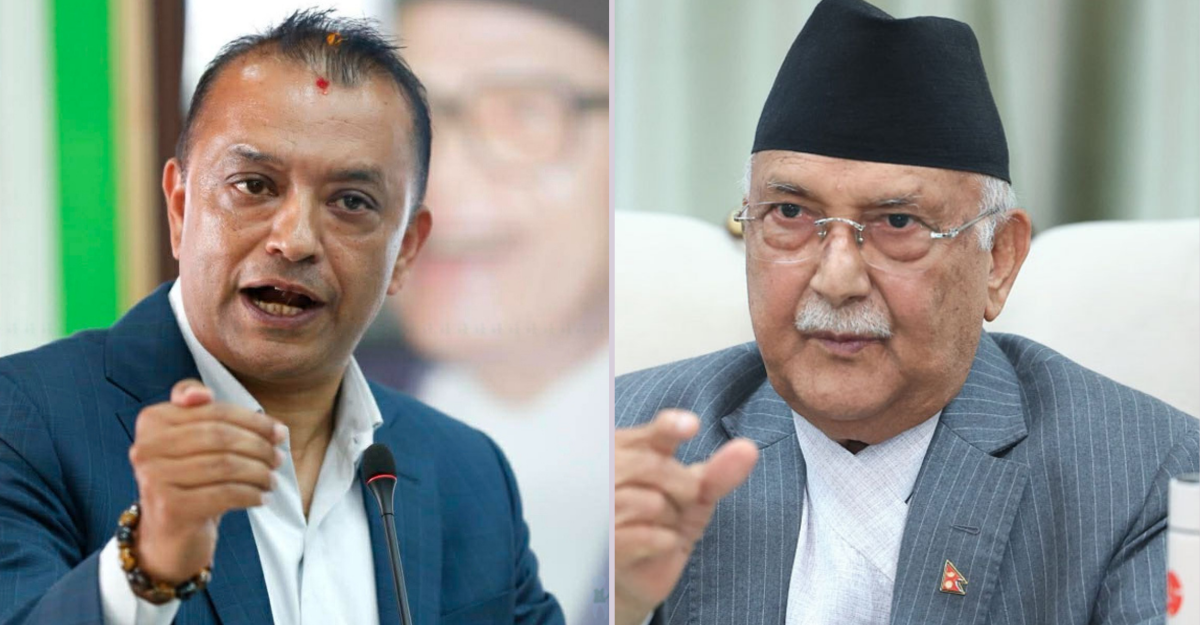
For nearly a month and a half, top leaders of the Nepali Congress (NC) and CPN-UML had been engaged in final negotiations to implement the agreement on taking turns to lead provincial governments.
NC Vice-president Bishwa Prakash Sharma and UML Chairman KP Sharma Oli had held multiple rounds of discussions on the issue.
On the evening of May 17, NC President Gagan Thapa himself met Oli at his residence in Gundu, Bhaktapur, and held a lengthy discussion on the matter.
Even after that meeting, talks between leaders of the two parties continued. However, the thread of trust between them had already begun to fray while the dialogue was ongoing.
That distrust has now reached a point where the NC leadership has concluded that it will no longer continue cooperation with the UML in provincial governments.
The party has informally prepared to recall its ministers from all provinces. It has now adopted a strategy of staying in government if a new understanding is reached with the Nepali Communist Party (NCP) led by Pushpa Kamal Dahal, or sitting in the opposition if no such alliance materializes.
NC leaders say this decision is not the result of a sudden impulse. Rather, it stems from their conclusion that while talks on changing provincial leadership were underway, UML Chairman Oli was playing a parallel political game and treating them with disrespect.
According to party sources, the situation took a new turn about two weeks ago. While discussions on alternating leadership were continuing, Oli made a strange proposal to NC Vice-president Sharma.
He proposed sabotaging both the budget presented by UML-led government under Hikmat Karki in Koshi province and the budget presented by the NC-led government under Kamal Bahadur Shah in Sudur Paschim province.
He then outlined a new political realignment.
“Let’s make Til Kumar Menyangbo chief minister in Koshi, and appoint a chief minister from your faction in Sudur Paschim,” an NC source quoted Oli as proposing to Sharma.
Sudur Paschim Chief Minister Shah is from the faction of former NC president Sher Bahadur Deuba.
The NC leadership rejected the proposal.
Vice-president Sharma discussed it with President Thapa, and both leaders concluded that destabilizing provincial governments to play new games was not appropriate.
An NC leader said, “We wanted to implement the agreement on alternating leadership. We were not in favor of toppling governments and playing new games.”
According to NC leaders, subsequent events in the provinces further deepened distrust. While top leaders were negotiating in Kathmandu, UML lawmakers in Biratnagar were actively working to sabotage their own government’s budget. Notably, leaders including Til Kumar Menyangbo – whom Oli wanted to make chief minister – were at the forefront of the campaign to block the passage of the budget unless it was amended. They were also supported by NC lawmakers who were dissatisfied with the budget.
According to NC leaders, they were also alarmed by this contradiction between what was being discussed in Kathmandu and what was happening in the provinces.
The party then gave a clear instruction Koshi parliamentary party leader Uddhav Thapa: “ The government must be saved, and the budget must be passed.”
By that time, Chief Minister Karki had already formed a budget amendment task force including leaders from the NC and UML. Stating that the task force would make amendments, the NC decided that as a party participating in the government, it should not allow the budget to fail.
After the NC stood in favor of passing the budget, UML lawmakers opposing the budget faced a moral dilemma.
A UML leader in Koshi said, “Once the Congress stood in favor of the budget, a difficult situation arose within our party. Eventually, the budget was passed.”
A similar situation unfolded in Sudur Paschim. The NC sent General Secretary Pradip Paudel to Dhangadhi to resolve the issue regarding the budget, while the UML sent Pushpa Kandel. However, while the two leaders were holding talks to reduce budget-related differences, another unexpected development took place.
According to NC leaders, they received information that while the talks were ongoing, Oli instructed Kandel over the phone not to pass the budget and even suggested scrapping the current budget and bringing a new one later.
This led to another round of top-level talks in Kathmandu. Both parties agreed to call their leaders from Sudur Paschim to Kathmandu for a final decision. The NC called Chief Minister Shah, but the UML did not call its ministers, according to NC leaders.
This incident prompted the NC to question whether the UML was genuinely seeking an agreement or merely wasting time.
Later, the NC leadership received information that while negotiating with them, Chairman Oli was simultaneously holding parallel talks with the Dahal-led NCP. This final piece of information destroyed whatever trust remained, according to a leader.
“While continuing talks with us, he was trying to form a different alliance,” the leader said. “We felt deeply disrespected and concluded that continuing cooperation in such a manner is not right.”
According to the leader, the NC leadership then reviewed Oli’s recent overall political style.
“He disrespected the people’s rebellion, disrespected the electoral mandate, and now he has disrespected his alliance partner. After seeing this pattern repeatedly, we concluded there is no justification left for this cooperation,” the leader said.
Leaders say that following this conclusion, the NC has formally begun work on forming new political alliances.
On Wednesday morning, NC President Thapa and Vice-president Sharma called Sudur Paschim Chief Minister Shah and instructed him to remove UML ministers who were working to sabotage the budget. Shah subsequently sacked three ministers and one minister of state from the UML.
Hours later, all four NC ministers in Karnali province submitted collective resignations. The NC is also preparing to hold a parliamentary party meeting in Koshi on Thursday to decide on withdrawing from the government.
An NC office-bearer said that the party’s strategy is now clear: first, recall ministers from all provinces; then, make efforts for a new power equation.
“Priority will be given to cooperation with the Prachanda-led NCP. If that is not possible, the Congress has decided to not remain in government with the UML in any province and will sit in the opposition instead,” the office-bearer said. “Now, either a new equation will be formed, or we will remain in the opposition. Difficult cooperation like the one at present holds no meaning.”
However, NC leaders have not said anything openly regarding the matter. Speaking to Setopati, Vice-president Sharma only said, “We are still in discussion. Deliberations are taking place on how to move forward now. The cooperation with the UML in the provinces had become a bit stifling.”
He declined to disclose further.
However, other NC office-bearers say that the current situation emerged because Oli disrespected the NC and played another game simultaneously while negotiating with them.
“The main issue is not the views on the Gen Z movement or any other matter,” an NC office-bearer said. “We had already worked together for 10 months after the Gen Z movement. What we are most unhappy about is Oli’s conduct regarding provincial governments. His style of saying one thing and doing something else eventually led us to the conclusion that we cannot move forward together with the UML.”