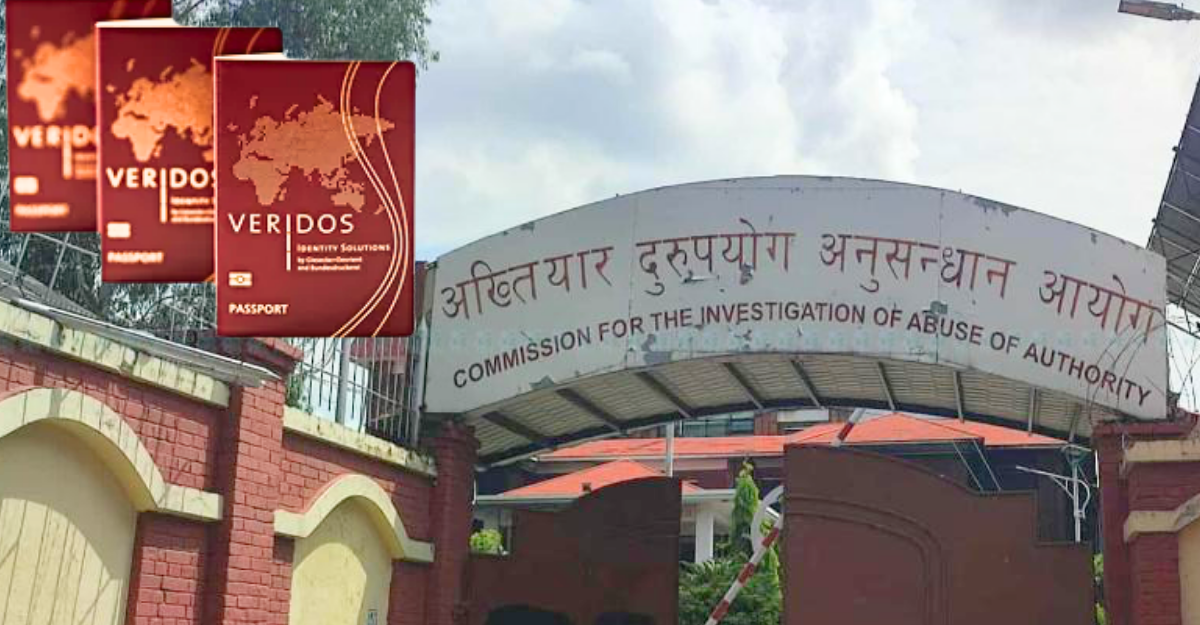
The Commission for the Investigation of Abuse of Authority (CIAA) has filed a corruption case against the German government-owned company, Veridos GmbH, without even recording statements from its representatives.
The CIAA has accused Veridos representatives Fabiola Bellersheim and Florian Pacquelin of colluding with employees of the Department of Passports to secure the contract for passport printing.
Bellersheim serves as the head of sales for Asia at Veridos and is responsible for managing sales and agreements for secure passport and identification technology projects globally.
Pacquelin is the lead representative for the company overseeing Nepal’s e-passport procurement and agreement process.
On Monday, June 15, aides to Prime Minister Balen Shah reportedly kept CIAA officials inside Singha Durbar for nearly nine hours and pressured them to file a corruption case regarding the passport contract.
The following day, the CIAA published a notice in The Rising Nepal, directing representatives from both German companies that were awarded the passport contracts to appear in Kathmandu or provide statements virtually within three days.
It also sent a formal letter to this effect to the Veridos office in Hamburg through the Nepali Embassy in Germany. Embassy staff traveled from Bonn to Hamburg to deliver the letter on June 16.
Veridos responded to the CIAA on June 17, stating that the company took the investigation seriously and would cooperate fully by presenting relevant facts.
The company, however, said that it would be difficult for its officials to travel to Nepal on such short notice and proposed holding discussions virtually.
Veridos suggested virtual meetings on either Friday, June 19, or Monday, June 22, between 9 a.m. and 12 p.m. German time.
However, the CIAA neither responded to the request, nor summoned the company representatives for questioning.
Despite initially summoning the German company for questioning, the CIAA ultimately filed charges without recording any statements, accusing Veridos of colluding to secure the contract and causing financial losses to the Nepal government.
When asked why the CIAA hurried to file charges without recording statements from Veridos, CIAA spokesperson Suresh Neupane said: "We do not always know clearly who has given statements and who has not. Investigation officers summon individuals from various bodies and issue notices for statements as necessary. Only that officer knows whether those individuals appeared or not."
Neither the German government nor Veridos has publicly responded to the serious allegations or the decision to file charges without recording statements. However, Germany's Foreign Ministry reportedly consulted with the two German companies and the German ambassador to Nepal on Monday to formulate its position on the matter.
Germany is expected to take the matter seriously, given that the company accused of corruption and collusion is partly owned by the German government.
Even before the CIAA filed charges, the German government had reportedly become concerned over how members of the prime minister's secretariat treated the companies and German Ambassador Udo Eugen Volz. Ambassador Volz has sought a meeting with Foreign Minister Shishir Khanal to discuss the matter.
The situation had already worsened after the way German Ambassador Volz and engineers from the German companies were treated at the Prime Minister's Office on June 15, and after members of the prime minister's team alleged that "your machines do not work." Now, the situation has escalated further, with the CIAA filing serious corruption charges.
While the prime minister’s aides were “questioning” CIAA officials at Singha Durbar on June 15, eight individuals including Ambassador Volz, engineers from the two German companies, and their local representatives were made to wait for hours in another room.
They had been called to discuss the progress on the installation of the passport system that day.
The team arrived at 11:30 a.m., but was made to wait in a room until 2 p.m. without meeting anyone. Eventually, the prime minister’s aides called Siddhartha Thapa, the Nepal representative for Veridos, inside.
Subash Sharma, the prime minister’s chief personal secretary, sent a message asking why the German ambassador was there, stating, "We will not meet them; they should return." However, Ambassador Volz insisted he would not leave without meeting someone from the prime minister’s team.
Subsequently, the prime minister’s IT advisor Bibek Mishra and aides Santosh Giri and Madhav Khanal entered the room.
Mishra reportedly told the ambassador, "We were surprised to see you. We did not expect your presence."
According to sources who were present in the room at the time, the ambassador then explained that he had been involved in passport-related discussions since the time of the interim government led by Sushila Karki. He said that he had held discussions at the time to ensure Nepal did not face passport-related issues, and that he had come again with the same intent.
Ambassador Volz noted that he had accompanied representatives from Veridos, which is partly owned by the German government, and another German company since they had won the international tender to supply passports in Nepal. He said that if the Nepal government had any questions or issues regarding the companies’ works, he was ready to hear them and make efforts to resolve them through discussions.
The ambassador also sought to reassure the prime minister's team about the printing of passports.
In response, Mishra said, "We have no issue with the German team. But there are issues with our team at the Department of Passports. There has been corruption in this case, and we are investigating it."
He added, "This project will not be completed on time. We do not trust the Department of Passports to print passports on time. When we visited the department a couple of days ago, the company's machines did not work."
Benjamin Gerlach, Veridos engineer and project manager for Nepal, responded, "The machines did not work when you visited because no technicians were present there. I express regret for that. But it is impossible for the German machines not to work. After hearing this, we arrived in Kathmandu this morning on very short notice. The machines work. If you come to the department tomorrow, we can show you by filling out the details and printing a passport."
When Gerlach requested the prime minister’s team to visit the Department of Passports and see the printing of passports, Mishra replied that they would visit the next day.
On June 16, PM Shah’s advisors Asim Shah, Bibek Mishra, and Madhav Khanal visited the department.
German engineers filled out Asim Shah’s form, took his photo, scanned his retina, and collected all his biometrics. They then immediately produced a sample passport in his name.
The German team thus demonstrated that everything was fully operational and that their system was ready to print passports whenever instructed by the government. Despite witnessing that the system was ready for live printing, the prime minister’s team offered no feedback. They neither thanked the German team, nor said that they were reassured.
The multinational company has already implemented identity solutions for governments and public institutions in more than 100 countries. It remains to be seen how the company has interpreted the accusation by the prime minister’s team that its machines do not work, and what steps it may take next.