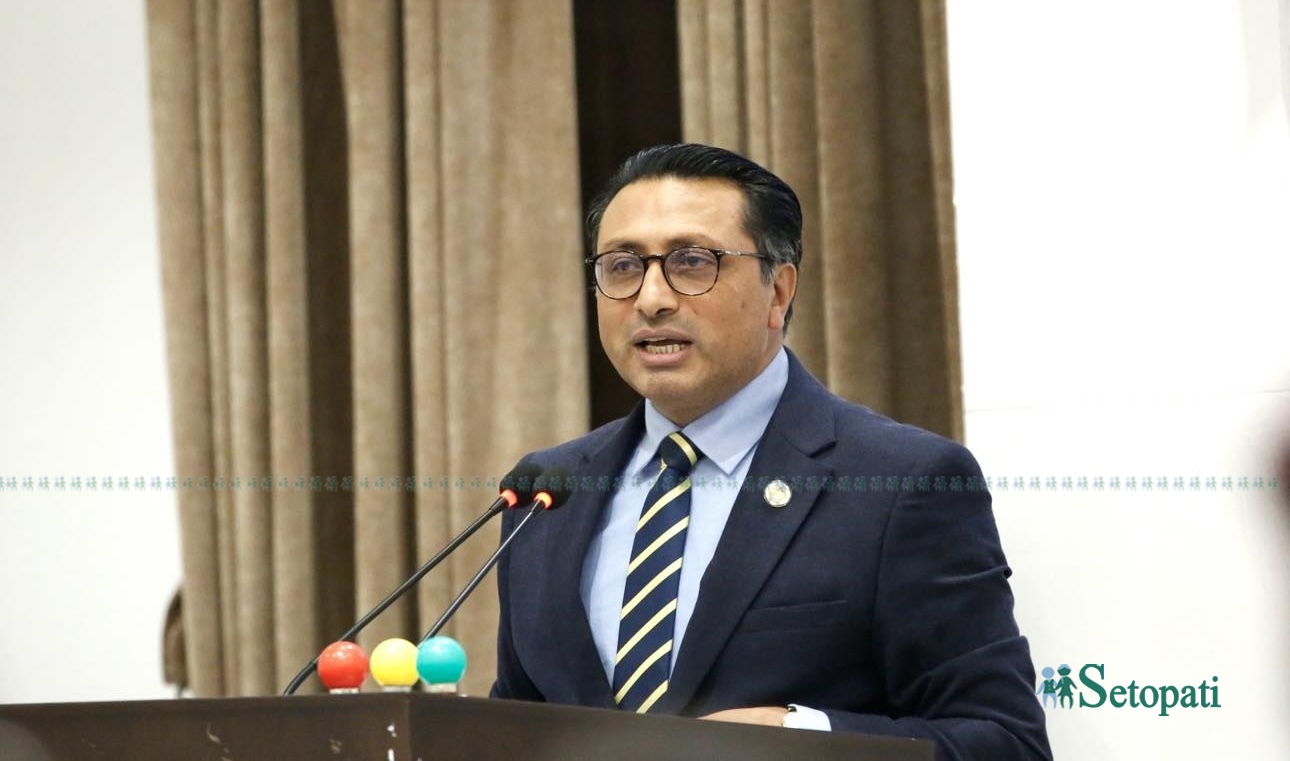
Finance Minister Swarnim Wagle has said that the government is focused on policies to increase citizens' incomes rather than merely distributing cash to reduce poverty.
Responding to questions raised regarding the budget in the House of Representatives, Wagle explained that the government has not cut existing social security programs but has, in fact, expanded them.
According to him, new programs, including nutritional meals and insurance for Dalit children, have been introduced.
Wagle said that distributing cash alone does not reduce poverty, and that the government aims to empower citizens to earn their own income rather than keeping them perpetually dependent on assistance.
To achieve this, programs related to agricultural modernization, insurance, digital economy, and startup promotion have been brought forward, he added.
While acknowledging that economic growth may not always be labor-friendly, Wagle emphasized the government's commitment to building an inclusive economy.
Citing China as an example, he mentioned that it succeeded in lifting over 800 million people out of poverty within 20-25 years through inclusive economic growth. "If we start only distributing money, we could head toward situations similar to Zimbabwe and Venezuela,” he said.
Wagle further said that the decline in poverty in Nepal over the past two decades has been driven more by remittances from foreign employment than by social transfers.
He added that evidence shows higher household incomes naturally lead to improvements in education, healthcare, nutrition, and overall living standards, reinforcing the need to prioritize income growth.