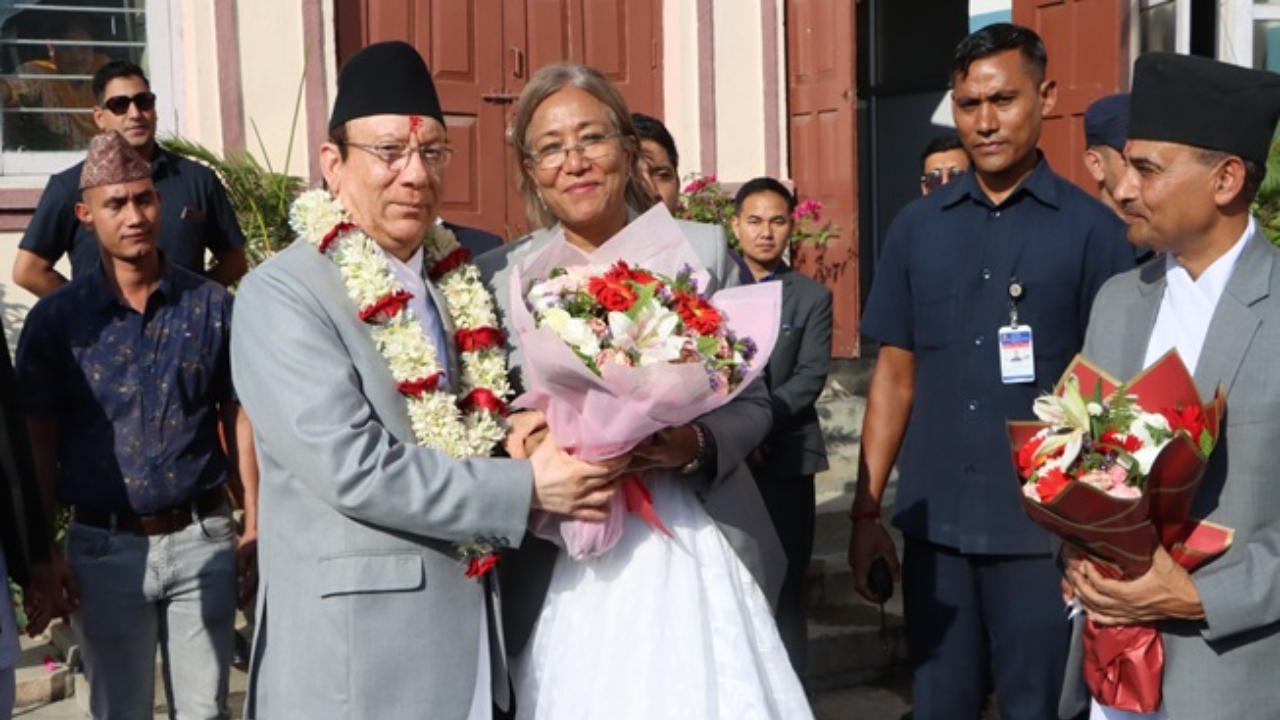
Chief Justice Prakash Man Singh Raut is going into mandatory retirement starting Tuesday.
Raut, who was appointed chief justice on October 6, 2024, is retiring upon reaching the age of 65.
According to Article 131(b) of the Constitution, the chief justice and justices must retire upon reaching 65 years of age.
Anticipating his retirement, Raut had already stopped hearing cases some time ago.
As of Raut's retirement, a new chief justice has not been appointed or recommended. Therefore, senior-most justice Sapana Pradhan Malla will serve as acting chief justice after his retirement.
As per Article 284(3) of the Constitution, the Constitutional Council must recommend a new chief justice one month before the incumbent retires. This is followed by a parliamentary hearing, and upon approval, the president appoints the chief justice.
However, one month ago, the country had an interim government. Due to the absence of key members such as Parliament officials and the leader of the opposition, the Constitutional Council was incomplete.
Because of this, the interim government led by Sushila Karki did not convene a Constitutional Council meeting, and the recommendation process could not move forward.
On March 10, the Judicial Council sent a roster of six eligible candidates for chief justice to the Constitutional Council. These names were based on seniority. The Constitution allows appointment as chief justice for those who have served at least three years as a Supreme Court justice.
Accordingly, the council recommended the names of senior-most justice Sapana Pradhan Malla, along with Kumar Regmi, Hari Prasad Phuyal, Manoj Kumar Sharma, Nahakul Subedi, and Til Prasad Shrestha.
The Constitutional Council is chaired by the prime minister and includes the chief justice, speaker of the House, deputy speaker, chairperson of the National Assembly, and the leader of the main opposition.
Currently, the Council includes Prime Minister Balen Shah, Chief Justice Raut, and National Assembly Chairman Narayan Prasad Dahal. With Raut retiring, the council must recommend a new chief justice.
Although a new government has been formed, the speaker, deputy speaker, and leader of the opposition are yet to be elected. These are all ex-officio members of the council.
Since a new chief justice cannot be appointed immediately due to these reasons, senior-most justice Malla will be designated as acting chief justice, said Supreme Court spokesperson and Joint Registrar Arjun Prasad Koirala.
“Chief Justice Raut’s term lasts until today. Tomorrow, an acting chief justice will be named,” he said.
As per constitutional provisions, in the absence of a chief justice, the senior-most justice assumes the role of acting chief justice with full authority.
Justice Pradhan was born on November 15, 1963. If appointed chief justice, her tenure would last until November 15, 2028.
She completed her bachelor’s degree in law from Nepal Law Campus in 1987, a master’s degree in comparative law from the Faculty of Law at Delhi University in 1989, and a mid-career master’s in public administration from the Harvard Kennedy School in 2014.
Pradhan became an advocate in 1987, a senior advocate in 2013, and was appointed a Supreme Court justice in August 2016.
A long-time advocate for women’s rights in Nepal, Pradhan also served as a member of the Constituent Assembly from 2008 to 2012.