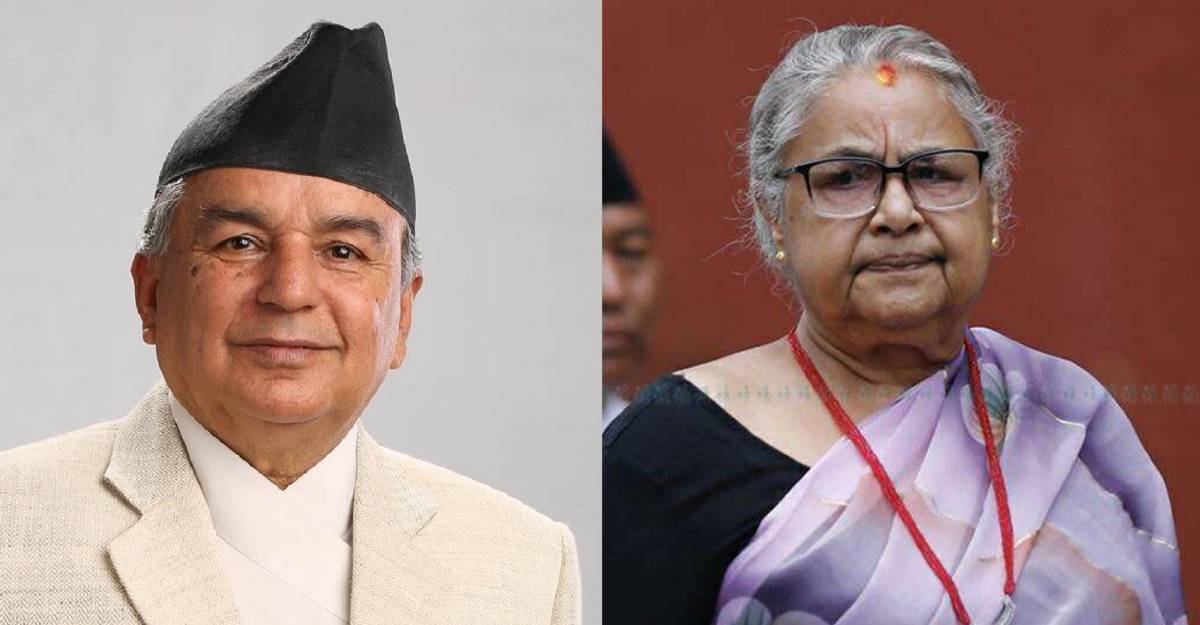
The recommendation made by the caretaker government led by Prime Minister Sushila Karki for the appointment of a member to the National Assembly, and President Ram Chandra Paudel’s decision to hold that recommendation for the past 10 days, have raised two important questions.
One question concerns traditional practices and the current government’s ethics, while the other relates to the constitutional boundaries of the president.
This government became a caretaker following the House of Representatives election on March 5. During its final days, a Cabinet meeting held on March 15 recommended appointing Home Minister Om Prakash Aryal to a vacant National Assembly seat. The decision was read out by Home Minister Aryal himself in his capacity as government spokesperson.
Prime Minister Karki made the recommendation under Article 86(2)(b) of the Constitution. However, her decision has drawn criticism for two reasons.
First, it is against ethics and established practice for a caretaker government to make appointments to positions of long-term significance.
Second, there is a clear conflict of interest when the Cabinet recommends one of its own members.
The Rastriya Swatantra Party (RSP), which secured nearly a two-thirds majority in the March 5 election, is set to form a new government within this week. Constitutional experts therefore argue that the right to recommend a name for the vacant National Assembly seat belongs exclusively to the newly mandated party.
Constitutional expert Bipin Adhikari says that a caretaker government should refrain from making any decisions that can be “waited upon,” except in truly urgent matters.
“Some matters cannot be delayed even for a single day. In such genuinely urgent cases, even a caretaker government must make recommendations or decisions,” he told Setopati. “But apart from that, all decisions that can wait should be left to the new government that has received a fresh mandate.”
He noted that in parliamentary democracies there is a well-established practice and tradition regarding what a caretaker government can and cannot do.
“There is a tradition that caretaker governments do not recommend or decide on long-term appointments. This tradition is as strong as the written provisions of the Constitution. The current government did not keep that in mind. There has been a mistake in this,” Adhikari said.
However, he added that a caretaker government may act if the party that received the new electoral mandate gives its explicit consent.
“If the newly mandated party itself agrees, then the caretaker government can make the recommendation,” Adhikari explained. “But if it acts on its own whim, then it is a mistake.”
Senior advocate Tikaram Bhattarai also believes the current government should not have made this recommendation.
“It would have been better if the present Cabinet had not made such a decision,” he said. “It would have been ideal if the party that won a fresh mandate had made the recommendation after forming the government.”
While the caretaker government’s recommendation itself is being questioned, President Paudel’s decision to sit on the recommendation for the past 10 days has also raised constitutional concerns.
Constitutional experts maintain that once the government has forwarded a recommendation for appointment, it is against the spirit of the Constitution for the president to hold it back.
Article 66(2) of the Constitution clearly states that all functions performed by the president shall be done on the recommendation of the Council of Ministers. The Constitution and the law do not grant the president the authority to stop or hold such recommendations.
“The President has no right to shelve any recommendation made by the government. He must decide immediately,” Bipin Adhikari said.
“Sometimes a recommendation made by the government may be inappropriate,” he said. “But even if the president considers it illegal or constitutionally flawed, he does not have the authority to block it.”
Since executive authority rests with the prime minister, blocking a Cabinet recommendation falls outside the president’s constitutional domain, Adhikari added.
“If the government has made a wrong decision, it will bear the consequences and be accountable for it. The president should not hold the prime minister accountable; our Constitution does not give the president that authority.”
Senior advocate Tikaram Bhattarai agrees that in cases involving serious constitutional or legal flaws, the president may at most offer advice.
“The Constitution allows the president to send a bill passed by Parliament back for reconsideration once. He must certify it the second time,” Bhattarai explained. “As far as the government’s recommendation is concerned, the president can consult experts and request the government to withdraw it. But if the government refuses, the best practice for a constitutional president is to proceed with the decision.”
He noted that this constitutional boundary has been breached by presidents in the past and said, “It is not good to violate constitutional provisions in this manner.”
A similar incident occurred eight years ago.
After the 2017 parliamentary election, then-caretaker prime minister Sher Bahadur Deuba recommended three names – Gopal Basnet, Krishna Prasad Paudel, and Chandani Joshi – for appointment as National Assembly members. Then-president Bidya Devi Bhandari held the recommendations.
At the time, the CPN-UML (which had won a majority in alliance with the Maoist Center) had asked Deuba not to make the recommendations, but he ignored it. President Bhandari also overstepped her constitutional boundary and blocked the recommendations.
Later, after KP Oli became prime minister, Deuba’s recommendations were withdrawn and Bimala Paudel, Ram Narayan Bidari, and Narayan Kaji Shrestha were appointed instead.
Constitutional experts have described the current episode as a repeat of that earlier controversy.
“This time too, it would have been better if the caretaker government had not made such a decision,” said Bhattarai. “But once the government has already made the decision, the president stopping it is not in keeping with the spirit of the Constitution.”
One-third of National Assembly members retire every two years. Of the vacant seats, three are filled by the president on the Cabinet’s recommendation.
The vacancy in question arose after Bamdev Gautam of the Nepali Communist Party (NCP) resigned as National Assembly member. His term officially ended on March 4; but he had submitted his resignation shortly before. It is this seat for which the Sushila Karki-led government recommended Home Minister Aryal.
A writ petition has also been filed in the Supreme Court challenging the Cabinet’s decision. Advocate Manish Kumar Shrestha and others have demanded that the recommendation for Aryal’s appointment be quashed. The case is scheduled for hearing on April 8.