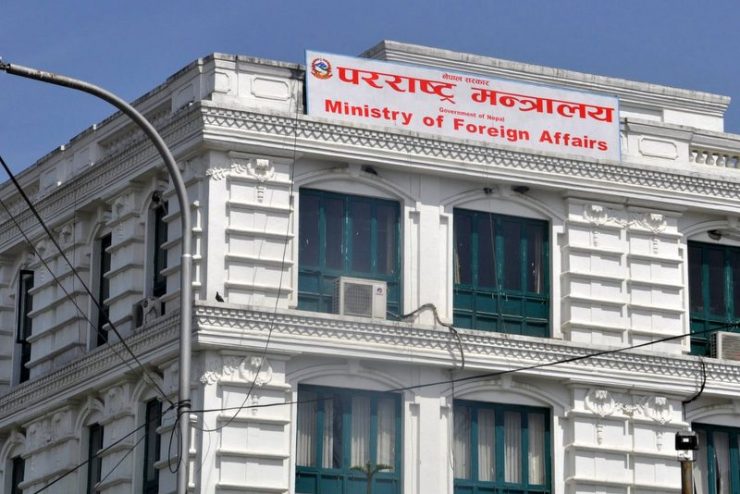
Nepal has sent diplomatic notes to India and China regarding Lipulekh.
Lok Bahadur Poudel Chhetri, spokesperson for the Ministry of Foreign Affairs, said in a press release issued on Sunday that the ministry’s attention has been drawn to queries and concerns raised by various media outlets regarding the Kailash Manasarovar Yatra, which is reportedly intended to be operated between India and China through the Nepali territory of Lipulekh.
The Nepal government is completely clear and firm on the fact that Limpiyadhura, Lipulekh, and Kalapani, located east of the Mahakali River, have been integral parts of Nepal’s territory since the 1816 Treaty of Sugauli, the ministry said.
“The Government of Nepal has once again conveyed its clear stance and concerns to both India and China through diplomatic channels regarding the Kailash Manasarovar Yatra planned via the Nepali territory of Lipulekh,” the release said.
The ministry noted that the Nepal government has consistently urged the Indian government not to carry out any activities such as road construction or expansion, border trade, or pilgrimages in the said region.
Furthermore, it clarified that China has also been officially informed that the Lipulekh region is Nepali territory.
In accordance with the essence and spirit of the close and friendly relations between Nepal and India, the Nepal government remains committed to resolving border issues through diplomatic means based on historical treaties, agreements, facts, maps, and evidence, said the foreign ministry.
India's Ministry of External Affairs has officially announced the Kailash Manasarovar Yatra for 2026 and opened applications.
A press release issued by the Ministry of External Affairs on Thursday stated that the pilgrimage will be organized in coordination with the Chinese government.
According to the ministry, the pilgrimage will take place during June to August.
For this pilgrimage, India has designated two routes: one through Uttarakhand state crossing over at Lipulekh Pass, and the other through Sikkim crossing over at Nathu La Pass.
Nepal's Lipulekh and Kalapani regions are currently under Indian control. While India has been claiming this territory as its own, Nepal has officially protested against it.
Nepal had also sent a diplomatic note in protest when India and China previously agreed to open a border point via Lipulekh.
Following the Sino-Indian War in 1962, the Indian army came and stationed itself in the Kalapani region.
King Mahendra was ruling Nepal at the time, and the country did not officially protest the Indian encroachment then.
The dispute over Lipulekh and Kalapani escalated in the 1990s after the establishment of democracy. During his visit to India in 1998, Prime Minister Girija Prasad Koirala officially raised the issue with India. Although a bilateral mechanism was subsequently formed to resolve the matter, the dispute remains unresolved.
The press release issued by the Indian Ministry of External Affairs mentions that 10 batches will be able to undertake the Kailash Manasarovar Yatra via Lipulekh and another 10 batches via Nathu La in Sikkim. With 50 pilgrims in each batch, a total of 1,000 pilgrims can participate.
Those interested in the pilgrimage can apply by visiting the yatra's official website. The deadline for submitting applications has been set for May 19.
The ministry stated that the pilgrims will be selected from among applicants through a fair, computer-generated, random and gender-balanced selection process.