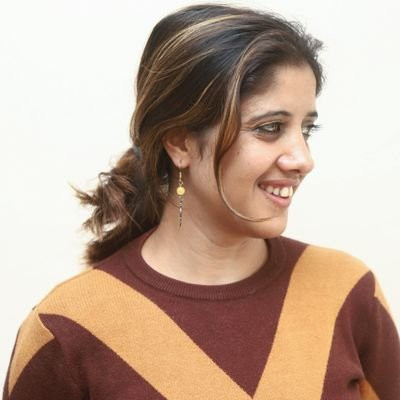
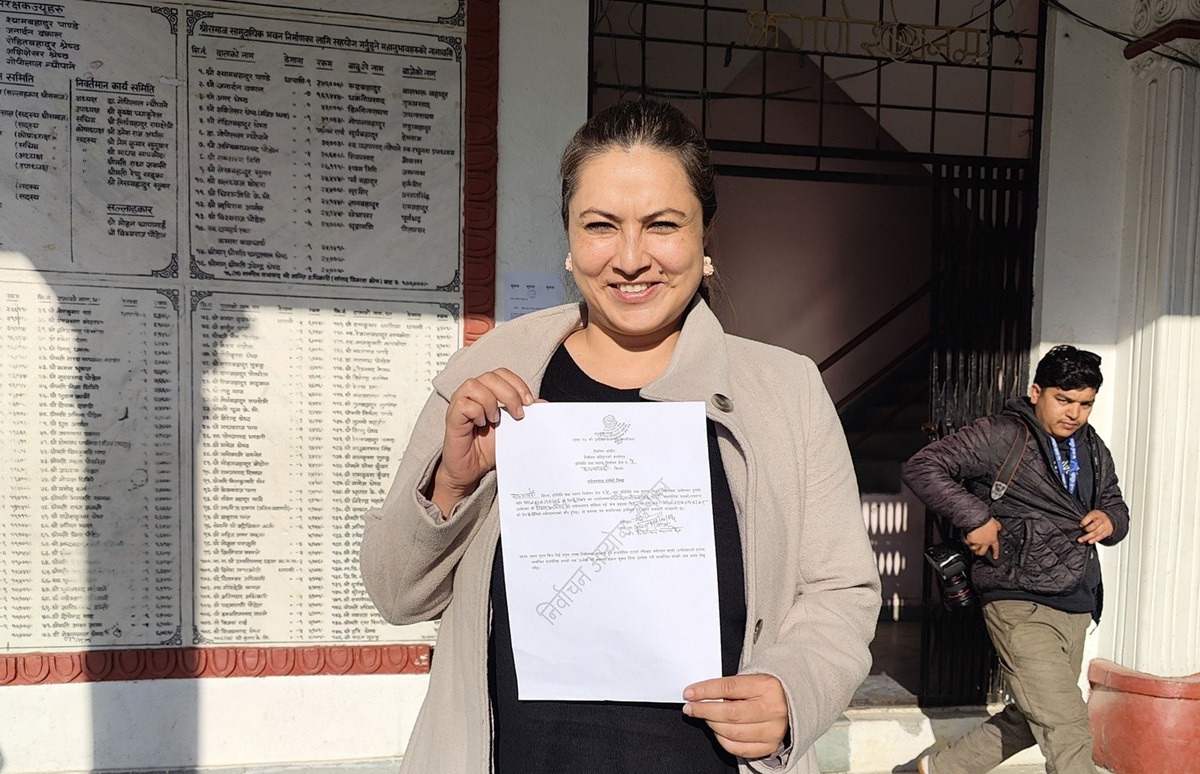
Nisha Adhikari is contesting the upcoming House of Representatives election from Kathmandu-5 representing the Gatisheel Loktantrik Party.
A 39-year-old film actor, mountaineer, and media personality, Adhikari is championing issues such as community health, elderly care, and women's rights. She plans to focus on these areas if elected to the House.
Coming from the arts sector, she faces stiff competition from established leaders of CPN-UML and Nepali Congress (NC). UML has fielded Ishwar Pokharel, NC its General Secretary Pradip Paudel, and Rastriya Prajatantra Party (RPP) has Kamal Thapa. Swatantra Party (RSP) has fielded a Gen-Z candidate in Sasmit Pokharel.
Here are the edited excerpts of the conversation with Adhikari, who is standing her ground against these "heavyweight" candidates:
How is your election campaign going?
From the beginning, we planned a very peaceful campaign. Whenever I meet citizens, I find them curious to see me. They listen to my words attentively. This gives me the opportunity to properly explain my party and the agenda in our manifesto.
After hearing me out, they often say that these are fresh ideas and they like them. They also share their own concerns with me. Since it’s a two-way conversation, I feel very positive about it.
In your constituency, top-tier leaders from NC and UML are competing. RSP has also fielded a Gen-Z candidate. There is a lot of buzz about their parties and candidacies in the media and social media. How do you view this?
Yes, parties with strong organizations are in the fray. RSP is also a party that has been in the government once or twice. I take their wave as a natural phenomenon. We have seen and experienced election waves before. But there is a reason I have stepped into the political arena myself this time.
The reason is: if all of them had done good work while in power or in the opposition, the Gen-Z generation wouldn't have had to protest so much. Such incidents wouldn't be happening in the country. When the people and parties we entrusted with the responsibility to build the nation failed to work properly, people like us had to come forward.
Therefore, I have come with my own agenda. I am not particularly concerned about big organizations, populism, or election waves.
What made you feel you had to enter politics yourself?
Even before the Gen-Z movement, I wasn't satisfied with how politics was functioning in the country. I was meeting many people and discussing this. Thinking the next election would be in 2028, I went to Tribhuvan University to pursue an M Phil.
In the meantime, seeing what happened during the Gen-Z Movement, I felt that much of it could have been prevented. Having to witness and experience such things in our own time made me realize I couldn't just sit back and do nothing. I didn't feel there was any alternative to moving forward and being responsible for the country, the citizens, and our generation.
I entered politics because I felt this is the time for all of us to do what we can. For me, the election wave, the size of the organization, or who is the hero in terms of populist talk doesn't matter. I want to talk about the policies and rules that build a country. In politics, our agenda is the hero. If the agenda had been prioritized, the country wouldn't be in this state.
In the last election, Pradip Paudel of the NC defeated Ishwar Pokharel of UML by a margin of 5,000 votes. This time, they are competing again. RSP has a Gen-Z candidate. Amidst such competition, your party is new, and you are new to politics. How easy or difficult is it for you to contest?
Walking through the election campaign right now, I feel like I am fulfilling a responsibility I've realized toward my constituency and the country. It’s not the number of votes or the probability of winning or losing that gives me satisfaction, but the fact that I am out there advocating for how the country should be run and how these issues should be addressed. If I had remained silent and hadn't raised this voice, that would have been a defeat for me.
Furthermore, regardless of how old an organization or how new a party is, where are the women candidates? I registered my candidacy at the very last moment. Until then, I was waiting to see who would bring forward a woman candidate.
Previously, the question of female participation deeply bothered me. Looking at the candidates fielded in elections, it feels like women are being pushed to the sidelines. Women make up more than half the population—51 percent. Shouldn't their representation reflect that? Even in our constituency, there is no record of a woman candidate winning. Even those nominated are very few. I hope that by my candidacy, this constituency will one day make history by electing a woman.
You must be hearing what your competitors are saying. What is your strongest asset to win against them?
My constituency has big leaders from old parties. Even with them and their parties in government, our country has come to the brink of this crisis. If they had played a good role in the opposition, someone like me wouldn't have had to enter politics today.
Let’s talk about the other new party, RSP. They also went into government. While RSP President Rabi Lamichhane was home minister, he claimed he would solve the Nirmala Panta murder case within 10 days. He did nothing regarding that. That is just one example.
I can go to the House and speak clearly on how to work toward good governance. This is what I have studied. While studying conflict, peace, and development, I realized what is necessary for a country to function peacefully. When it comes to eradicating corruption, my party will not issue a whip to silence me. This is my strength. No matter how good a candidate you send, if the party issues a whip, it’s over. That won't happen in my case.
Another strength is that I can properly represent 51 percent of the population. Regarding children, I can understand many things based on experience. I have included menstruation and women's health in my agenda. When making state policies later, I will have more knowledge than them on how and where to link these issues. Meaningful participation of 51 percent of the population is my agenda, and I can address it best.
The strongest point is that my party carries no burden of corruption so far. We have no burden of violating the code of conduct. Corruption isn't just about money; moral corruption must also be accounted for. In terms of accountability, my party and my candidacy are the cleanest, most responsible, and most transparent in Kathmandu-5.
Your constituency is a part of the capital city and includes a high-budget metropolitan area. What are the physical and social development problems here? What issues are voters sharing with you?
It might sound basic to many, but voters are still talking about roads. Mothers complain that Melamchi water hasn't reached them. We are still dependent on jar water. There are examples where neighbors suffered because seven-story houses were built without a proper design map.
There is also the issue of tourism. I feel we should develop tourism further in Hadigaun and showcase our values and traditions. Regarding physical infrastructure, from drinking water to health services—the general problems found across Nepal also exist in the urban areas of Kathmandu-5.
There are problems not just in physical development, but in social development as well.
How do you plan to solve these problems?
While local issues like inner roads and drinking water may not fall directly under a federal lawmaker's jurisdiction, one can pressure the government. A lawmaker cannot do the direct work, but her/his role is to raise these issues in the House.
Corruption is a problem across all three levels of government. It has spread from top to bottom, hindering our development. If those who do good work are honored and those who do wrong are punished, corruption will decrease.
I have released my agenda, which includes women's health and meaningful participation. We need to bring youth into a single hub to create a networking environment. We need environment-friendly infrastructure. Ring roads and highways should be eco-friendly. When expanding roads, a system for proper testing must be adopted.
Another subject is sports and art. Nepal can be developed into a neutral venue for sports and art. Our traditional arts like painting, handicrafts, and pottery are disappearing. These, along with music, must be integrated.
Kathmandu-5 is also a hub for hospitals; TU Teaching Hospital and Gangalal Hospital are here. I see it as a place where promoting women's health would be easy. If implemented at the policy level, we can do a lot, from hormone packages to awareness. There is very little research on women's health. I want to work on that. The issues I've raised address many such problems.
Additionally, I want to work on ending the trend of MPs disappearing from their constituencies after winning. I have always voted in Kathmandu-5, but I never saw a candidate come back to talk to the people here. Voters are saying the same thing now. After becoming an MP, one must visit their constituency, connect with the people, and hold discussions. Shouldn't we inform the public about the policies we made or the issues we raised for the constituency?
What issues directly affecting common citizens will you raise?
I already mentioned health. It is necessary to work on general health and women's health across the country, just like in my constituency.
In education, many things need improvement. We must prioritize making teachers skilled, trained, and updated.
I have five main agendas, which I have clearly written in the manifesto. Among them, I’ll mention social justice here.
If you look at how common citizens and women are placed and treated in society, you can see the state of the country. That is why it’s said that society is the mirror of the nation.
Let’s talk about young men and women. Employment is said to be their major problem. Just as women have to look after children, young people also have the responsibility of caring for their parents in old age. I believe that if the state took some responsibility for children and the elderly, young people could contribute more to the economy and employment.
You mentioned earlier that corruption is what stops everything and must be eradicated. Others say the same. What is your idea for removing corruption? If you become an MP or one day the prime minister, how will you eradicate it?
Eradicating corruption must start from the top level of the country down to the bottom. The first thing to do at the bottom is to increase political literacy.
Citizens must know their rights. They need to know where and how to raise their voices. We don't have a very strong civil society. We need one.
To eradicate corruption from the top, the first step is to make appointments to various institutions transparent and merit-based.
There are constitutional bodies like the CIAA and the Election Commission. Their appointments are recommended by the Constitutional Council, which includes the speaker, deputy speaker, and the leader of the opposition (apart from PM and Chief Justice). I believe that structure must be neutral.
Furthermore, a mechanism must be created to recommend appointments based on capability. Political parties should not dominate appointments. In our country, even judges are said to be political appointees. That should not happen. Regulatory bodies must be made independent and clean.
Civil servants should be prohibited from participating in partisan politics. If a civil servant takes the side of a party, how can they provide just service to the citizens?
By improving these and many other things, we must strengthen our system. Only then can corruption be controlled.
What policy have you and your party adopted regarding financial transparency? How are you sourcing funds for election expenses?
First, we must understand why a political party is formed. It is formed to build the country based on certain values. People who believe the country can be built that way provide financial resources through donations. I believe in liberal democracy. Naturally, I would donate to a liberal democratic party. I believe those who practice politics based on issues should receive donations to work on those issues.
Since our party is new, we are gradually raising issues. Currently, we don't have a massive public mandate. As we establish our values and issues, people will trust us and provide donations. Right now, whatever we have is transparently available on our website.
As for myself, I am only doing what I can afford. After the campaign, all accounts will be made transparent.
Constitution amendment is a topic of debate right now, ranging from the governance system to the transformation of parties. In your opinion, what are the things that need to be improved starting from the Constitution?
To make the structures for eradicating corruption impartial, improvements are needed starting from the Constitution. Many other areas also require reform.
You are someone with a career in the arts who has entered politics. Regardless of the win or loss after the election, will you continue active politics?
Working on how to create policies, agendas, and strategies can be done from anywhere. I am 39 now. I will continue in active politics for at least another 10 years. This is my prime time. After that, the next generation should come—and they must.
By the time I leave politics, I want to bring youth into leadership roles. Specifically, I want to work on the development of women. Organizations always make women carry flags and placards but don't bring them to the front. We need to make people understand that women are not just for carrying placards; they are for leading.