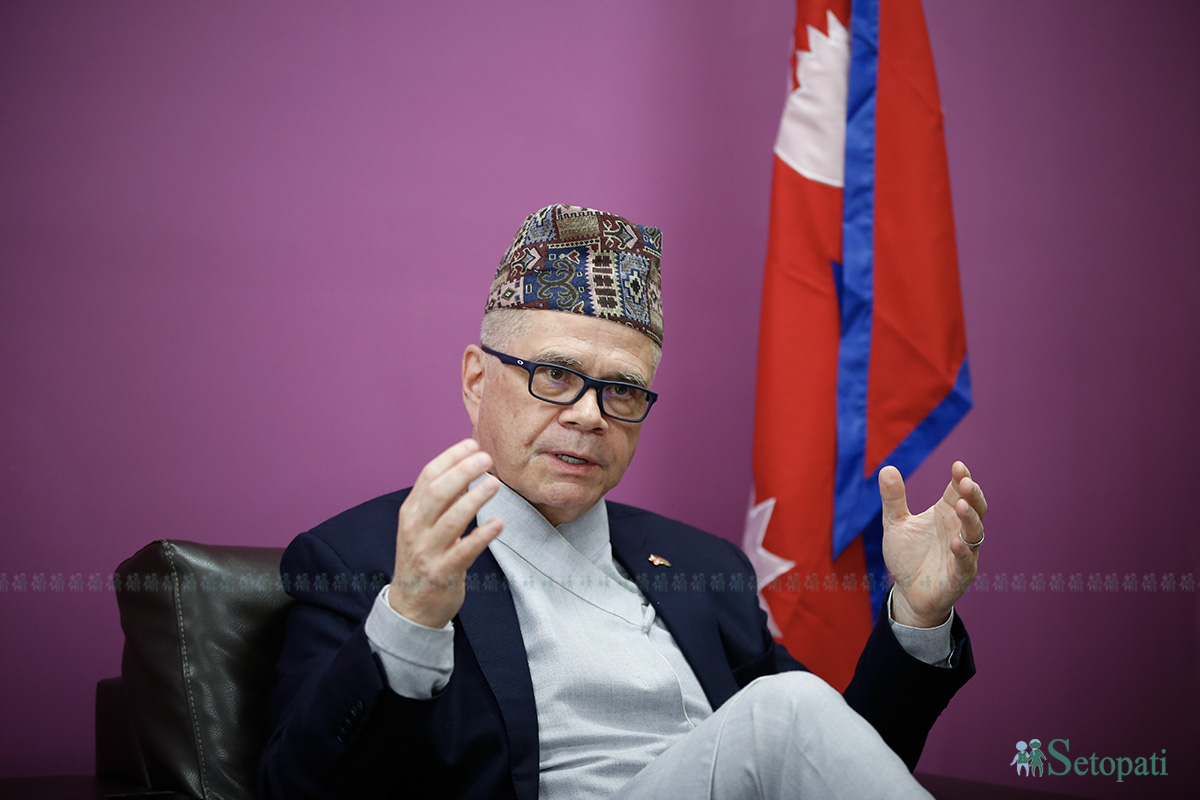
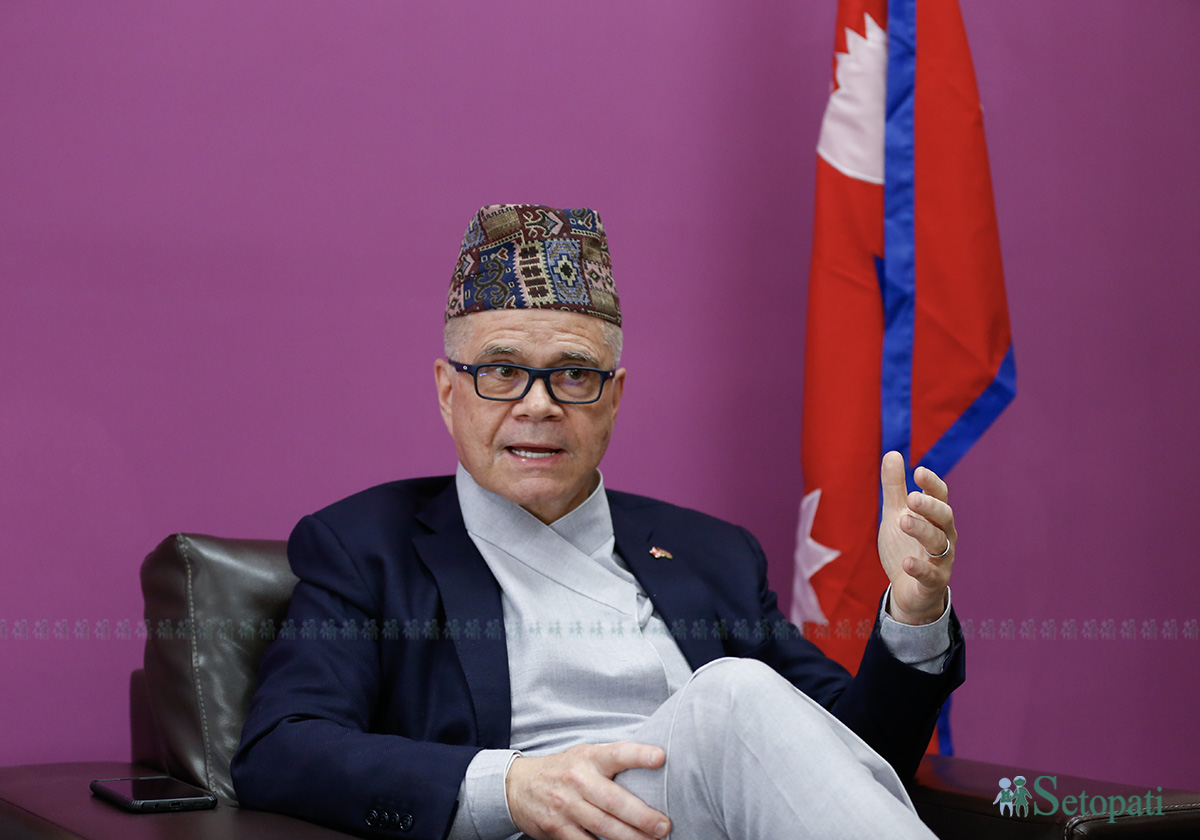
Michael Foley was appointed the Chief Executive Officer (CEO) of Ncell last November. With more than two decades of experience in the telecommunications sector, he has held senior management positions in various countries, working on telecommunications service expansion, digital transformation, and organizational improvement.
According to Michael, Ncell is currently facing uncertainty over license renewal, which is directly affecting the company’s long-term investment. Large-scale investment is not possible in a telecom company without certainty about the future. The lack of clarity on the license post 25 years of operation has also stalled necessary investments in areas such as 5G, gigabit-per-second internet, and data centers.
He said that with clear decisions and policy certainty, Ncell would be able to increase investments aggressively.
Setopati's Business Editor Chetana Guragain spoke with CEO Michael Foley, focusing on topics such as Ncell’s future, the investment market and challenges, and the digital future.
Excerpt of the interview:
Michael, it has been over three months since you arrived in Kathmandu. We hope the city and the people have been treating you well.
Hmm… it has lived up to its reputation for incredible kindness and hospitality.
And you have had a chance to travel outside of Kathmandu and see the country yet?
Birgunj and Pokhara so far. After our democratic exercise in early March, I'm going to take two weeks to go west to east, and I'm going to drive.
Wonderful. You know, in a democracy, when a new prime minister is elected, there is something called a 'honeymoon' period, typically for 100 days. So is there something similar in the corporate world, or specifically in Ncell?
I think a honeymoon period is a bit of a construct developed from the outside, not from the placeholder's position, because there's nothing about a honeymoon about this at all. It's a very intense period of time where you're doing a lot of learning, a lot of listening, mostly assessing.
And when you come into a job like this—and I've been in a lot of these jobs—where you come into a business that has had a challenge and it needs to be kind of assessed and addressed, it's quite intense. It's fun. I enjoy it.
I would say it is more baptism by fire than honeymoon. And in particular, as everybody knows, there are particular challenges around this particular company that need to be addressed, that was really getting into it a lot quicker than normal. Normally, you would come into a job like this and, for the first 60 or 100 days, not really make any decisions.
But that's not been the latitude that I've had in this particular role. So it's tough. It's hard.
You have taken the leadership of this company during a period which is probably one of the most consequential in the company's history. So how are you navigating?
Well, there's nothing you're going to do in the first few days that people will remember when you're done. So you really have to step back and take the larger picture and not be too rushed. Although there's, you know, sometimes when the kitchen's on fire, it's not time to build a new addition on the house, right? I don't say the kitchen's on fire, but the environment, as well as the issues around this company, compound each other.
I arrived here a month and a half or so after the events of the 8th and 9th of September (Gen-Z Protest), and those still have strong echoes today, and they will echo for a long time. What happened was incredibly intense, incredibly consequential, historic, and will have consequences and impacts for a long time.
So my issues with my little company pale in comparison to what Nepali culture and community and society are going through right now in terms of a hinge moment in the life of the country.
So how do we articulate the responsibilities of a mobile operator in the middle of that—a company that plays a very important role in the culture, in the identity, and the sovereignty of a nation? How do you articulate our role in the middle of that was primarily at the top of my mind. The rest of the stuff, you know, fixing licenses, addressing organizational issues, growth issues—those are part of a recipe book. This was unusual for me.
So really putting thought against that was more important than anything else.
After you have taken the leadership of Ncell, you seem to be facing two kinds of challenges. One is industry-specific, and another is company-specific. Maybe we can start with the industry-specific challenges. The telecom industry in Nepal is not doing well, and it faces enormous challenges, right?
I agree with you on that. I would consider that a statement of fact.
How grave is the challenge?
Well, I came into the country in August to start looking around when I was starting my discussions with the owners of this company. It was fairly obvious to me that we had a few things that were not kind of the way they are in other countries.
First of all, our networks being relatively poor in terms of their network quality. And I say that with all humility. We're doing a few things right now to address that quickly. But the networks are not particularly competitive with those in the neighborhood. India and Bangladesh are already kind of looking at 5G. Pakistan is on the way. Their 4G networks operate as 4G networks, with relatively better speeds and better quality.
And I thought that this was a particular issue.
Then there was also the issue about competition—in a country with a population of around 30 million, why are there only two players in the telecommunications sector? Probably you could have a third player in the market.
So there is really one private operator and one government operator in the country, and that is basically a duopoly. That probably is not ideal for competition, for customer satisfaction long term, and may have an impact on FDI (foreign direct investment) and things like that.
So I thought that there were some real operational issues, detail stuff, like distribution and so on, which were not where they should be. But my first impression was that network quality was not where it should be, especially in a big city like Kathmandu that has a lot of tourism.
Probably a very large majority of the tourists that come in have 5G phones. They arrive, they turn on their phones, and they get a pretty relatively below-average 4G service. So that's not a great first impression. So I didn't like that. That was my first impression.
Some people in the telecommunications sector are saying that, in the current environment, there is a challenge about capex and there is no business case for additional investment as things stand now. Is that true?
No, I disagree with that. There is clearly a case for capex in this market. The issues that my competitor has are because the procurement processes in the publicly owned company are extremely difficult. I understand what kinds of systems, checks, controls, challenges, and blocks they have on their side.
On my side, it's a different issue. We are prepared to invest significantly, but for Ncell to invest, we need to ensure continuity beyond 2029.
So there is absolutely room to invest, to increase revenues, to pay out programs, to do really exciting things here. It's an environmental issue, different for both players, that is keeping us from doing what we need to do.
Even on 4G, when it was launched here, there should have been a big bump in spending. That did not happen here because even at that time, the operator did not see a future that would pay that back.
Ncell's license expires in 2029. And probably that is what you're referring to. Is that holding you from making big investment decisions?
Yes. It may hold us back from making even small investment decisions. So it has now become a critical issue for us. It becomes somewhat existential. Just keeping the lights on with the day-to-day capex to keep things working, we have to do. But if we don't invest to increase bandwidth and services, services will continue to degrade.
So the license renewal issue, in that sense, is both a growth and an existential issue, right?
Absolutely. It's a real challenge in the sense that telecom companies are not like building a bridge and turning it over after 20 years in the city, after you've paid tolls, right? A bridge you build is built; you have to keep it clean and so on. In our industry, we have to invest 20% of revenue every year to stay current, and even more when we have changes in technology from 3G to 4G, 4G to 5G.
That is blocked at this point because of a construct created 25 years ago, in a different world, in a different time. That is something that we need to get ourselves over.
I think we will, but we need to get ourselves over that hurdle, or else no sane individual is going to put 60–70 million dollars in for no payback. It just doesn't make any sense.
That means, in the company's life, that's around the corner, right?
It is well within our planning horizon.
Do you think, or are you afraid, that the government plans to take ownership of the company after 2029?
Do I think it is going to happen? I suspect not.
When Ncell's transaction happened in December 2023, that was designed to create a Nepali company out of a foreign company—a company that's critically important for the culture, the sovereignty, and the industry in the country.
Somebody was actually taking a foreign company and making it a local company. Why weren't people putting garlands over that owner's head, saying you're now creating a local company that's critically important for our culture and our society from being a foreign company owned in Malaysia?
But they were blocked in a couple of ways—one is that the Nepal government is not recognizing a transaction, and secondly, we're not going to be allowed to change Ncell's shareholding to become a Nepali company.
The first one, as soon as there was renewal of the license for the last five years and there was money to pay, somehow, de facto, that transaction was recognized and the money came from the company to renew for the last five years.
Unfortunately, not being able to change the ownership structure of the company—which is the second edict, a post facto signing of the original contract, a retroactive change came into effect stating—that you can't change your company structure to make it Nepali.
And that, to me, started to sound a little strange.
I didn't write the past. I'm trying to write the future, and I need to make this a Nepali company in order to have a lifecycle for these investments. That's what we're trying to get done now.
We are talking about a third operator, but where are we going to find a investor to put $200 million into the country from scratch?
That's hard at the best of times. Nobody's going to do it when they have this kind of circumstance around us. Any investment in the country sees what's happening to us right now.
We are having conversations with various stakeholders and business-related officials. They all ask what our plan is. Our answer is simple—we will continue to make our case, and eventually we believe our concerns will be heard, but we're not quite there yet.
But from a legal standpoint, as per the provisions of the Telecommunications Act 1997, the government can take control or ownership of this company.
Yes, but this applies to a company where foreign shareholding holds majority ownership. If the majority ownership is Nepali, we have the right to ask for a license extension.
Ncell's investor, Mr. Satishlal Acharya, is a Singaporean citizen but a businessman of Nepali origin. We want to make changes to the organization, the corporate structure of this company, to make it a Nepali company and do an IPO here. We are being stopped from doing that.
So what you're saying is Ncell is ready to become a public company and be majority-owned by Nepali nationals?
Absolutely. That's the only way for us to have a license going forward—to be a Nepali company. When the license was renewed for the last five years, they added a new condition, which has prevented us from becoming a Nepali company in practice.
So has this negotiation or Ncell's proposal to become a Nepali company been placed on the table of the government, or has that negotiation not begun in earnest?
It is as crystal clear as the purest river in the country. You can see the rocks 20 meters down. It's clear. It's understood. How and when that decision will be made to allow us to continue is a matter for the government, and that does not belong to me.
But are you hopeful there will be an amicable solution that is agreeable to both the government and your stakeholders?
Yes, I think there will be a set of conditions placed upon us at one point. Whenever a license is renewed, conditions are placed, and it's normal. It could be about rolling out new technology, investments in data centers, could be the IPO, or about resolving ownership issues. We'll go with those conditions, whatever is necessary.
If negotiated in earnest, there may be solutions.
But for now, politically speaking, this is an election government. And maybe it's fair that it cannot take big decisions like this.
Yes, we are in an interregnum. But the government is taking decisions. Recently, they made a decision to abrogate the law on social media.
But I'm not a politician here. I don't do politics, and I don't understand politics here. Decisions are not just based upon the facts on the table or the sentiments of the people. But eventually, it gets so painful that things start to find a way. We just have to continue to be constant in our message, respectful in our approach, and persistent in our stubbornness to get this done.
Ncell has given a letter to the prime minister. Have you heard anything from the government like, 'Okay, we are looking into it, we are considering it?'
Yes, we have submitted the letter, and discussions were held. Whether they're prepared or capable of making a decision really belongs to the cabinet and the honorable prime minister.
There's no level of pressure I want to or can put on for this. It's inappropriate. All I can do is put out the facts and the concerns, and then the state will make the decision it makes at the time it makes it. That's where we sit.
But if the discussions do not produce a result, either now or after a new government is in place, and the government decides to take ownership of Ncell, in your opinion, how is that likely to impact the telecom industry in Nepal and the FDI inflows, because you have worked in the region?
I don’t think this will send a positive message.
First of all, there'll be a massive dislocation for three years, where there would be little investment in the company. So that'll create a massive capital deficit at the end of the three-year period and some really serious issues in terms of employment and competitiveness of the networks. So, all those things are not positive.
It is not the right solution for this kind of industry. There needs to be continuity.
Why do you think our current investor was able to buy the company? At that time, the license period was only five years. The Malaysians couldn't find an international buyer. Nobody, in their mind, would come and do FDI in this case. So we found somebody who's a son of the soil, a patriot, somebody who wants to do something well. And they built a deal to make Ncell a Nepali company.
That was the only potential deal. So now we're going to continue to invest. We are enthusiastic. We're respectful. We think there's going to be a solution, but that can't last forever without a sign from the other side.
What you are also saying is if this confusion lingers for the next three years, and if there is no investment, no growth, and Ncell goes into kind of survival mode, that is going to impact the company's future prospects and probably may not attract new investment?
Yeah. And it does impact. Will you be able to find foreign investors wanting to come in a circumstance that looks like this? To buy a company—not going to happen.
This is so Kafkaesque in terms of a situation. Everybody that we speak to sees the value of the argument. Now we need to find somebody who's prepared to decide to give the company in the interests of the state and everybody else and make it a Nepali company.
I don't think of many countries in the world where both operators—one private and one public—are actually national operators. That does not exist in Pakistan. Not at all. One is from Amsterdam, formerly from Russia. One is UAE-based. Then one is Chinese. In Bangladesh, its Malaysian, its Norwegian.
There is also a possibility for us to have another company owned by taxpayers and private shareholders. The potential for a really interesting story.
If Ncell's license is renewed and the ownership structures are changed accordingly, how quickly do you think you can move from now to making investments and bringing new services like 5G and others?
I love this question. If we had a life, we would already be in 5G. If we had a future, we would already be doing 5G tests in this country. Period. We'd have built new data centers. We'd have built more fiber. We'd have invested tens, if not a couple hundred million dollars already.
The company is not leveraged in terms of its debt. We can raise money with a life. We can raise money from local banks, local investors, international banks. We can go very quickly. And I can tell you that we have the ability to change the structure of the company overnight. It's been filed. It simply has not been recognized.
And filing for an IPO, we'll do it properly. It'll take six or eight months to do an IPO, a year maybe to get all the stuff together for that. We can move very quickly—lightning speed.
We don't have the same heaviness as our competitor has. The decisions are made between a board of three or four people and myself. And we have a team that can move extremely quickly, and we're prepared.
Honestly, at the size of our market, we should already be in 5G. We should already have 5G trials going on here. If not, having launched 5G softly in Kathmandu, Pokhara, and a couple of other places.
We are just touching B2B services. We're just a little bit into hosting for banks—banks begging us to build data centers in Terai or some other places where we can actually get out of the seismic zone in order to have a proper data center to support the economy if something bad were to happen again.
Because if another major earthquake or disaster occurs now, the country will be set back a decade in digital capabilities, and there will be problems in the economy.
A data center costs about 8 to 12 million dollars per megawatt of power. We need 5 to 10 megawatts. That's a 100 million dollars that we have to invest to give the proper infrastructure that is needed here.
But I can't do it right now. I want to. I have shareholders who are prepared to do it. I'm standing at the start line. I just need permission.
So, there are two scenarios. One: if your license is renewed, you’re ready to flex your muscles, make investments, start building 5G, and introduce new services. The other: if the government does not decide and this confusion continues, and if the government eventually decides to take ownership, this uncertainty over the next three years will cause delays. Bringing in new investors might be stalled, putting the company into a kind of coma—or at least into survival mode.
Can you imagine what that means for the 13 million subscribers that we have? They can't be taken on by the other guy's business.
My little company is not the biggest issue. If our company is able to do what we think we can do, if, by chance, we succeed, we can become an example of how foreign direct investment can work in Nepal. We can help attract new businesses, improve education, create employment, and develop infrastructure.
I'm not saying we're the savior of the economy. I am not talking only about Ncell. Both Ncell and Nepal Telecom can build the infrastructures on which today’s economy depends and is going to continue to depend.
It has been done it in Pakistan; it has been done it in Bangladesh. It makes a difference. What we can do here would make a real difference for a generation of young people.
Looking at your revenue, compared to 10 years ago, it has gone down by about 50%. And if your license is renewed, beyond the traditional things that you have been doing, do you think that you will have a role in digital payments and building or fostering fintech ecosystems? Or is that too early?
I think there's a couple of things.
First of all, it is a fact that some of the revenues have disappeared. In the last 10 years, international long distance has now become OTT. Voice services domestically have become very much OTT.
But we have not yet become significantly involved in home internet services. But there's a new generation of internet services to the home.
So yes, some of the revenues have gone away because of structural changes in the industry, some of them gone because we haven't invested, and some of it because we haven't played in those areas. So there's room for all that to happen.
Mobile financial services—mobile operators are generally not allowed to participate in that directly—but we can partner with people. We can enable it. We can make it much easier to do.
So, I think we will see changes in revenue for the company. We're going to try to get it to grow a bit, but there's a lot of opportunity. Our consumption of data is lower than the rest of Asia. We don't have 5G here. So, there is massive room for growth in investment.
That's why I say the business cases are solid if we get permission.
I can also say this based on my experience working in various countries: young people everywhere want the same thing—they want to be connected. They want it to be fast. They want it to create opportunities. When they get this, they start to create businesses for themselves. They start to create opportunities for themselves. They're very clever when it comes to using data services. It's become part of their day-to-day life. It's like the oxygen that they breathe.
Through technology and technology-driven infrastructure, China and South Korea have made huge leaps in their economies. We also have this opportunity. We just haven't gotten quite there yet.
So my little company is a small problem compared to the opportunity created for the rest.
Some people argue that Nepal needs a third private telecom company. The argument is that this would create competition, improve quality, and benefit consumers. Do you think there is room for a third company here?
Probably yes. The issue is, is there market space?
The challenge is now we have got 85% 4G handsets in the market. We have penetration well over 100%. So there's double-seeing all over the place here in the market. It's an extremely challenging market to cover because of the geography.
So it is not at the top of the list of foreign investors. At the time when a Finnish company was exploring the market, but seeing that the Nepali market was small and difficult, it decided not to enter.
So, is there space—Yes.
Is there desire for people to come in from the outside, given the current regulatory environment—probably less so.
If you want somebody to build it from the inside, possibly, but it's a couple hundred million dollars. So, that's a lot of money to spend for this market.
I welcome it if it was to come. I think it would be helpful for the market. If I had the right to operate and compete with another commercial enterprise, the penalty would not be paid by me. With two private players in the market, the penalty would be paid by the less agile of the three.
So, I'm a big yes.
How is Ncell carrying out social work under its corporate social responsibility (CSR)? What impact is it having?
First of all, to me it's corporate social investment, and we do it in many different ways.
The Ncell Foundation has been investing for years in education, health, environment, disaster management and response, and digital inclusion. We will continue to do so in the future.
From the very beginning, the company has prioritized CSR and carried out various social initiatives. We have worked to preserve Nepali art and culture as well as to empower youth.
I am glad that our more than 100 social projects have directly or indirectly benefited over 13 million Nepalis. We have already spent more than 2 billion rupees on social initiatives.
There's a lot of it that we do, and there's room to do more.
If you talk about the taxes we have paid, up to the last fiscal year we have paid nearly 360 billion rupees. This has contributed to the nation’s economy. Across the country, we have provided employment—directly and indirectly—to nearly 100,000 people.
But the biggest way that we can make an impact on society is by providing our services better, cheaper, and easier to access. That's the main social investment that we can make.
***