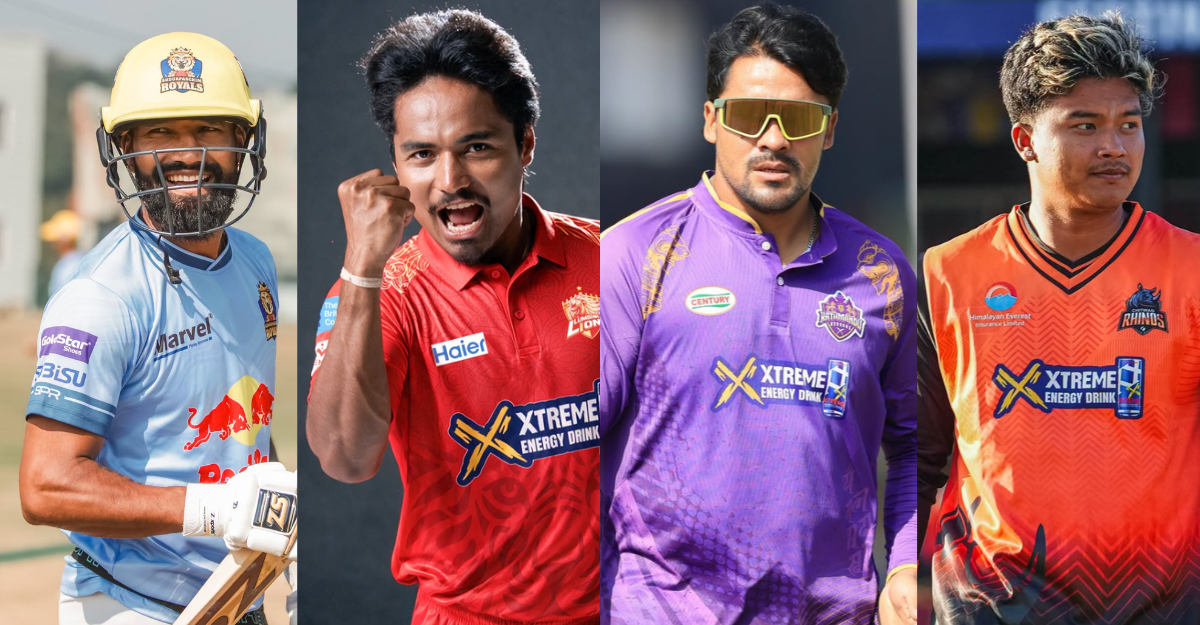
Those who love sports in Nepal should genuinely be proud of the Nepal Premier League (NPL), the franchise cricket tournament whose third edition ran from October 26 to November 21.
Bigger, longer, with better infrastructure and stronger branding that is attracting more high-caliber international players, the NPL is literally turning into a big event.
As a lover of sports in general, I also cherish the fact that the country I call home is putting together such a big show.
I must confess that I am not a huge fan of cricket and barely understand its rules. However, as someone who is passionate about sports, my general rule is that you do not need to know all the rules to enjoy a particular discipline,.
Understand the basics and enjoy the show, including the atmosphere and the overall environment that make sports an incredible, perhaps even unique “unifier,” bringing people from different walks of life together.
When Italy, the country where I was born, played in the Cricket World Cup for the first time last year, I was genuinely excited, even though many of the players representing the country were Australians and South Africans of Italian descent.
The fact that Nepal, which has grown a lot internationally and has become quite a solid team, was playing against Italy increased my interest further.
As I watched the game in a restaurant, I struggled to understand exactly what was going on. In the end, it was a huge surprise that Italy won the match, although it was a big upset for the country that so generously hosts me.
Cricket is growing internationally even in countries where it has traditionally never been played. Thanks to second- and third-generation citizens with migrant backgrounds, the sport is gaining traction is such countries.
The fact that Nepal is able to organize such a big tournament and generate so much excitement around it makes me happy, and I try to follow the NPL as much as possible.
And yet, I cannot help but wonder whether the NPL represents the true essence of sports.
Let me explain.
Nowadays, sports around the world has become a huge business worth billions upon billions of US dollars.
The United States is a paradise for the sports industry, with professional teams competing there in all the major sports, from baseball and basketball to ice hockey and American football (a different kind of football, very different from what Americans call “soccer”), the latter being the king of them all.
In Europe, too, the sports industry is becoming increasingly professionalized and is attracting investors from all over the world.
Yet even the most professionalized sports clubs, despite being capable of generating huge profits, are generally well rooted in their local communities.
They have an organization in place, a structure that works throughout the year, employing people on long-term contracts, offering services through merchandise and exclusive memberships, among other activities. In short, they support their own “supply chains” of business partners.
Thinking about football (the real one, not the American version), all clubs, not only those attracting global attention, such as Real Madrid, Barcelona, Paris Saint-Germain, and the clubs from the English Premier League, have more than just the “first team.”
They also have youth academies, which play a huge role as “pipelines” for talent development. After all, we all know the story of Lionel Messi, how he rose through the youth teams of Barcelona before becoming one of the greatest footballers in history.
Unfortunately the teams participating in the NPL share no similarities with this model.
When the NPL started in 2024 with its franchise model, I immediately realized the limitations of this approach, modeled on the much bigger Indian Premier League, the biggest franchise-based cricket tournament in the world.
I certainly understand that behind every professional sports club there is an entrepreneur or, as is increasingly common in many developed countries, an investment fund putting tons of money into it.
In the case of the NPL, each of the eight franchises is backed by prominent business houses that make considerable investments every year.
According to The Kathmandu Post, each of them is investing around 15 crore rupees. This is a huge investment for a sporting event that lasts approximately one month.
If you think about it, a tournament lasting only one month is quite short, although the IPL does not last much longer either.
It is beyond my very limited understanding of the cricket world why these leagues are so short. But could it be because the franchise model is always centered on short-duration events?
To a casual observer of cricket like me, the franchise model is essentially about providing a big dose of excitement over a very short period.
Each franchise basically invests in attracting some notable players. However, looking at the names of big foreign stars in the NPL, I noticed that some of the players are semi-retired or coming out of retirement just to play a few games.
Frankly, a player coming all the way from Australia or the West Indies just to play three or four games seems quite ridiculous to me.
Is it because having them play the entire NPL season would cost too much for the franchises hiring them? Is it because they have other commitments around the world? Or is it because playing too many games would be too demanding for them?
But let’s set that aside for now.
As has already been discussed in many articles, these famous athletes do leave a mark, and not just on the cricket field.
They have become promotional ambassadors for Nepal, visiting the high mountains and other attractions that the country offers. Through their social media posts, they also create a buzz about the country.
This is a good thing, no doubt.
But the fundamental problem with the franchise model remains.
The organizations behind these franchises are not building local ecosystems that can nurture young talent.
In this sense, they have neither youth academies nor grassroots-level programs that can generate positive outcomes for local communities. After all, let’s not forget that sports can also be a catalyst for social development.
The so- called “Sport for Development and Peace” approach has become an important dimension of the overall sports system worldwide.
Imagine a cricket club with a team of professional or semi-professional players, as well as junior teams for both boys and girls.
The same organization could then organize a series of initiatives at the local level in partnership with youth clubs or NGOs, with local governments also being part of the equation.
You do not need a huge budget to organize small but well-designed and impactful events that can, for example, raise awareness of social cohesion, inclusion, and harmony among different communities.
Think of the communal clashes that marred many localities in Madhesh province just a few months ago.
Cricket is hugely popular in the southern plains, and it could certainly help heal the wounds created by religious and political polarization.
Promoting social cohesion, inclusion, and active citizenship by bringing young people together in localities affected by communal clashes can help instill a renewed sense of oneness among them and make them less vulnerable to manipulation by extremist politics.
Think also about what community cricket could achieve across the country. Working with children through cricket could help them acquire new skills and also raise more awareness of key issues such as gender equality and the importance of education.
Can the NPL franchise model upgrade itself and grow beyond its original premise? Can the business houses investing huge amounts of money in developing the sport through the NPL also start thinking about the longer term?
To begin with, could they organize small community events for girls and boys throughout the year? What about setting up youth academies?
I do understand that, in the franchise model, player auctions are paramount and one of its key features.
When I first heard about the much-talked-about player auctions for the IPL, I was simply amazed.
Yet, the current model for selecting players could be retained while introducing new rules requiring each franchise to run a youth program, from which at least a few players must be selected, to be able to participate in the NPL.
Setting up youth academies could be a goal achieved gradually, together with some Sport for Development and Peace activities.
Reforming the franchise model underpinning the NPL could help Nepal’s cricket reach new heights.
A longer tournament backed by genuine sports business organizations could be a game-changer for the country.
Reinventing the NPL and rethinking its fundamental assumptions might cause some discomfort initially.
Yet transforming the franchises into genuine clubs, with permanent organizations running them and a presence at the local level, could also benefit the business executives investing huge amounts of money to make the NPL a success story.
Certainly, establishing commercial sports entities that operate throughout the year would require a much greater financial commitment. However, this tectonic shift could be planned in a sustainable and gradual manner.
Perhaps, if such a shift in the way the NPL is run were to materialize, even India could learn something from Nepal for once.
Now that the third edition of t he NPL has concluded, there will be one more year to strategize and rethink the model.
Reconsidering some of its underlying assumptions might be the best way to strengthen not only the NPL brand in the long term, but also the entire product behind it.
If that were to happen, the entire economy and society at large would benefit from what is, so far, the biggest sporting event organized in the country.