Discussions have begun on whether local-level and provincial assembly elections should be held separately or simultaneously.
Election Commission officials have already met Home Minister Sudan Gurung and urged the government to clarify its position on the matter soon.
Meanwhile, the Election Commission has called a meeting of nationally recognized political parties for November 20.
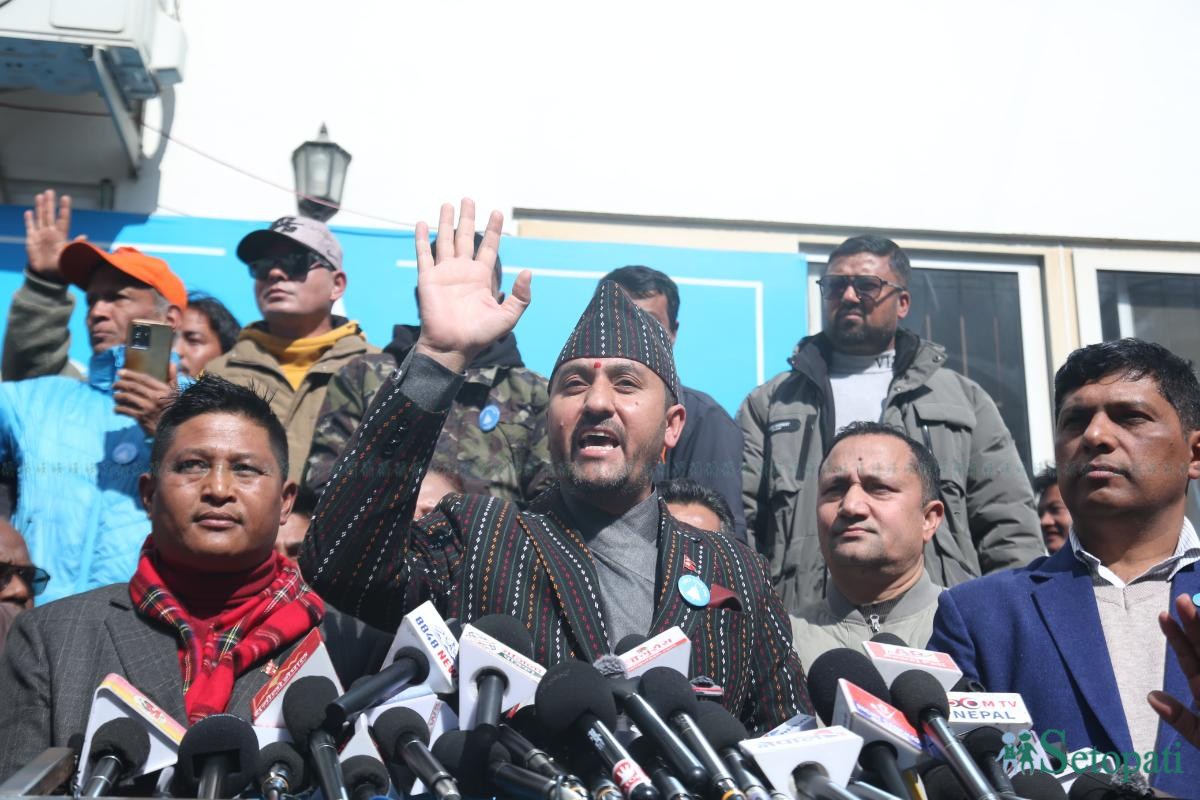
Against this backdrop, Setopati spoke with Jagdish Kharel, spokesperson for the ruling Rastriya Swatantra Party (RSP), about the party's position on holding local-level and provincial assembly elections together and the discussions taking place within the party.
Kharel said that the party had not yet held formal discussions on conducting both elections simultaneously but would now prioritize the issue and intensify deliberations.
He said that the financial burden on the country from holding elections repeatedly should also be taken into consideration before making a decision.
"There is a question of whether the country's economic situation can sustain elections every six months," he told Setopati. "Discussions on this issue will now move forward rapidly, both within the party and at the government level. Preparations for the elections must also begin on a priority basis."
According to Kharel, the possibility of holding both elections simultaneously needs to be examined from three perspectives: legal, political, and technical.
He said that simultaneous elections could be held if they were found feasible from all three perspectives and political parties reached a consensus.
"If it is legally, politically, and technically feasible, and political parties can reach an agreement, local-level and provincial assembly elections can be held simultaneously," Kharel said. "If that is not possible, we will proceed in accordance with the Constitution and the law, holding local-level and provincial assembly elections when their respective five-year terms are due to expire."
He added that the RSP would discuss the possibility of simultaneous elections not only within the party but also with other political parties.
Election Commission officials earlier met Home Minister Gurung and told him that the government needed to clarify its position soon on whether local-level and provincial assembly elections should be held together or separately.
Local-level elections were held on May 13, 2022. The five-year terms of the representatives elected in those polls will end in May 2027.
Similarly, the five-year terms of provincial assembly members will end in November 2027.
There is, therefore, an interval of approximately six months between the expiry of the terms of local-level representatives and provincial assembly members. This gap has prompted the government to examine the possibility of holding both elections simultaneously.
The Home Ministry is primarily discussing two options.
The first option is to hold both local-level and provincial assembly elections together in October 2027, after the terms of local-level representatives expire in May.
Under this option, local governments whose representatives' terms end in May would remain without elected representatives until October. The Constitution stipulates that local governments cannot remain vacant for more than six months. The government therefore believes that holding elections in October would therefore not create a constitutional obstacle.
However, questions remain about how public service delivery and legal administration would be managed while local governments remain without elected representatives for several months.
The second option is to hold both local-level and provincial assembly elections as early as April 2027.
Under this arrangement, newly elected local representatives would assume office in May, while the terms of newly elected provincial assembly members would begin only in November.
However, constitutional and legal questions arising from holding provincial assembly elections before the existing assemblies complete their five-year terms would need to be resolved.
"Let us hold elections for the provincial assemblies as well in April, but arrange for the elected members' terms to begin only in November," a Home Ministry source said. "This would save election expenses. Those elected to the provincial assemblies would also have time to prepare before assuming office."
National Assembly elections are currently held before the terms of sitting members expire. The government believes that adopting a similar arrangement would not create constitutional or political complications.
The government is preparing to amend the Local Level Election Act and the Provincial Assembly Election Act, if necessary, to facilitate either of the two options.
The Local Level Election Act requires elections to be conducted before local-level positions become vacant. Meanwhile, the Constitution stipulates that provincial assembly members serve five-year terms. This has created a constitutional challenge for the government in declaring the existing assemblies' terms prematurely ended.
Previously, House of Representatives and provincial assembly elections were held simultaneously. However, following the Gen Z movement in September 2025, the House of Representatives was dissolved, and a separate election has since been held.
According to the Home Ministry source, holding both elections simultaneously could save approximately Rs 3 billion to Rs 4 billion in security and election management costs.
"Temporary police personnel would have to be recruited twice. Uniforms would have to be purchased for them, and election officials would have to be paid allowances twice," the Home Ministry source told Setopati. "Holding the elections together would save a substantial amount of money. Instead, the elections could be conducted in two phases to ensure proper security arrangements."
The Election Commission, meanwhile, is preparing to hold local-level elections in April 2027.
The commission believes that the end of the academic session in schools in April would also make it easier to manage polling centers.
The commission is also ready to conduct local-level and provincial assembly elections simultaneously. However, it maintains that the government must make a decision in time and provide sufficient time for preparations.
At the all-party meeting scheduled for November 20, the commission also plans to discuss arrangements for voting from abroad and allowing voters to cast ballots outside the districts where they have permanent addresses, alongside the election timetable.
The positions of political parties will now be crucial in determining whether the two elections are held together or separately.
RSP spokesperson Kharel said that the party will base its decision not only on legal and technical feasibility but also on whether political parties can reach a consensus.