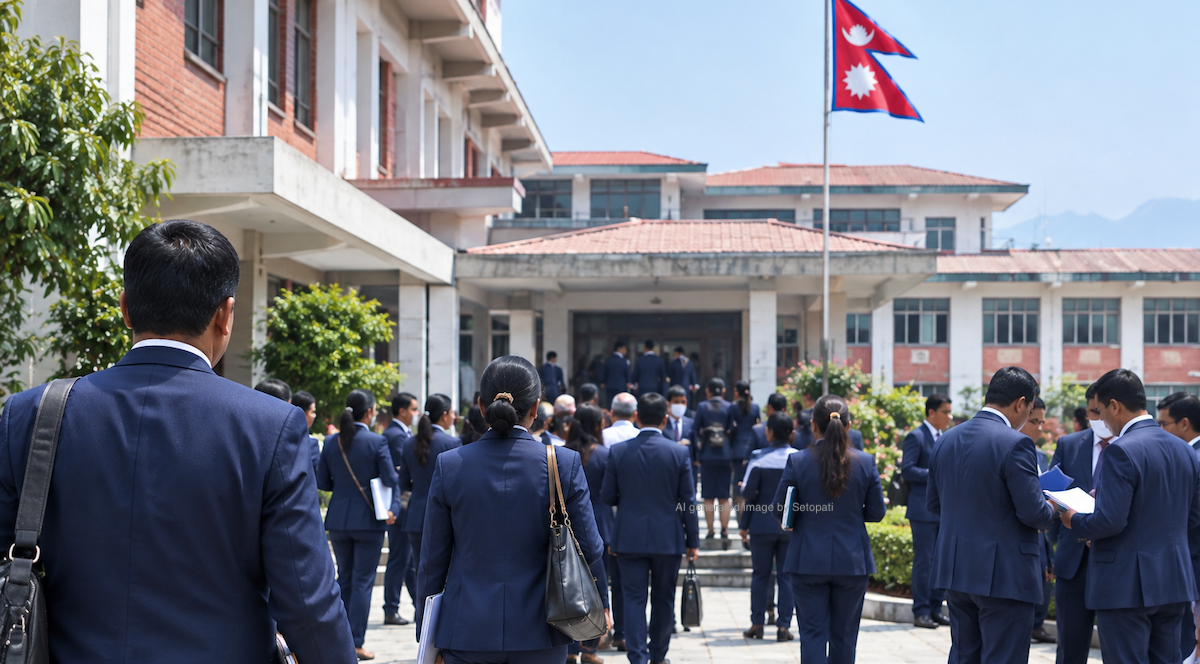
The government’s plan to change provisions related to the retirement age and service period of civil servants through an ordinance have sparked widespread concern among government employees.
According to a high-ranking government source, the government is considering withdrawing the Federal Civil Service Bill currently under consideration in Parliament or introducing an “Ordinance to Amend Certain Nepal Acts” to impose a retirement age of 55 and a maximum service period of 30 years on currently serving civil servants.
The government is also preparing to set the tenure of secretaries at three years through the ordinance.
A source told Setopati that preparations were underway to present the proposal at a Cabinet meeting.
The government had earlier registered the Federal Civil Service Bill in the House of Representatives, proposing mandatory retirement for employees who had reached the age of 55 or completed 30 years of service.
Rather than waiting for Parliament to pass the bill, the government is now preparing to implement these provisions through an ordinance.
According to a source at the Federal Parliament Secretariat, the Civil Service Bill remains in Parliament, and the government has not sent any letter seeking its withdrawal.
This suggests that the government may be seeking to change civil servants’ terms of service through a separate ordinance while leaving the bill already registered in Parliament unchanged.
Neither the draft ordinance nor the provisions it would contain have been made public. The Cabinet has not yet made a decision either. Nevertheless, news of the preparations has already triggered considerable anxiety within the civil service.
Employees approaching the retirement age or nearing the end of the proposed 30-year service limit are particularly concerned that their careers could come to an abrupt end.
A serving joint secretary said that uncertainty over when the government might introduce the ordinance had disrupted the working environment.
“There is talk that the ordinance could come today or tomorrow. There is no environment in which to work. How are we supposed to work?” the joint secretary told Setopati. “We took these jobs under one set of conditions. Forcibly removing us under a different set of conditions is not appropriate in itself.”
The official also argued that once a bill has been registered in Parliament, the law should be made through parliamentary deliberations rather than by changing terms of service through an ordinance.
“The bill is already in Parliament. It should be discussed and decided there. Why take the backdoor route of an ordinance?” the official asked.
The bill registered in Parliament proposes mandatory retirement for employees who, when the law comes into effect, have either reached the age of 55 or completed 30 years of service. Employees would retire as soon as they meet either of these two conditions, whichever comes first.
For employees who remain in service after this transitional arrangement, as well as those newly appointed, the proposed mandatory retirement age would be 60.
The bill also proposes a three-year tenure for secretaries and a two-year tenure for the chief secretary.
If these provisions take effect immediately, a large number of senior officials could be forced to retire at the same time.
An estimate based on the situation as of September 17 indicated that approximately 90 percent of government secretaries could reach the end of their service under the proposed arrangement.
This could trigger a major, simultaneous reshuffle in the leadership of government ministries.
Former chief secretary Baikuntha Aryal said that prolonged uncertainty over civil servants’ terms of service could affect the performance of the administration.
“When employees are uncertain about their status or whether they will keep their jobs, they become reluctant to make decisions. That is only natural,” Aryal said. “Even under normal circumstances, people tend to lose motivation as retirement approaches. This kind of uncertainty creates psychological stress similar to being forced into premature retirement.”
He said that the government should immediately clarify whether it intends to bring an ordinance.
“An atmosphere of uncertainty in the administration should not be allowed to persist. The government should either immediately clarify that no ordinance will be introduced or, if it intends to bring one, do it quickly as possible,” he said.
Former chief secretary Bimal Koirala also warned that simultaneously enforcing a 30-year service limit and a retirement age of 55 could disrupt the administrative structure.
He said that the simultaneous departure of experienced officials could affect government decision-making and continuity in public services.
The potential impact of the ordinance would extend beyond retirement. If long-serving secretaries and other senior officials leave office simultaneously, there could also be major changes in ministry leadership, postings, and promotion processes.
The existing Civil Service Act contains a provision prohibiting changes to employees’ terms of service that adversely affect the conditions in place when they were appointed. Therefore, reducing the retirement age and service period for existing employees through an ordinance could also raise questions about its legal validity.
Meanwhile, civil servants continue to resign from government service. However, there is no evidence that all those resigning are doing so because of the proposed ordinance or the bill.
Officials say that concerns over possible changes to terms of service and uncertainty about the future have weakened morale across the civil service.