Ethical questions have been raised as CPN-UML Senior Leader Bidya Devi Bhandari continues to retain the military security provided to her as a former president, even after returning to party politics.
At its meeting held from September 21 to 24, the CPN-UML central committee assigned Bhandari the role of senior leader. However, she has yet to relinquish the Nepal Army security detail she has been receiving in her capacity as a former president.
Bhandari, who has returned to the responsibility of engaging with party cadres and the public as a political leader, continues to travel under military protection.
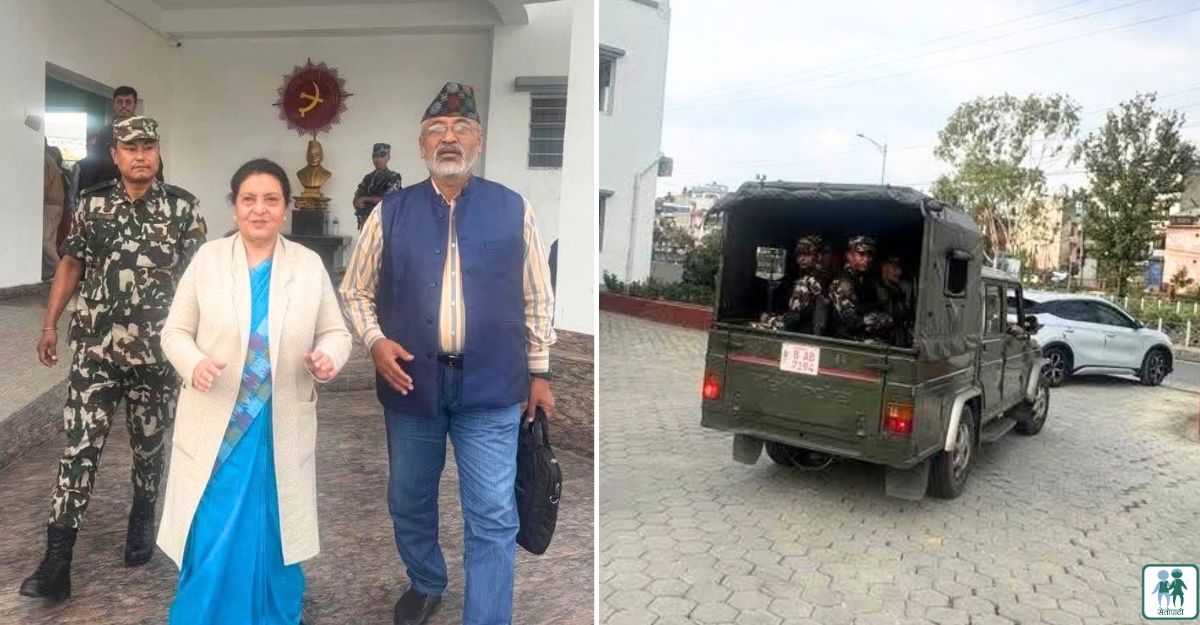
On Friday, she arrived at a UML standing committee meeting surrounded by army security personnel. As she stepped out immediately after the meeting concluded, an Army major was standing beside her. A vehicle carrying a military security team was also on standby to escort her.
When Setopati asked her, “You have returned to party politics. How long will you continue to receive Army security?”
Bhandari replied, “Forever, for as long as I live.”
Her response has raised a broader question: How appropriate is it for someone who has returned to active politics to continue receiving military protection in her capacity as a former president for the rest of their life?
Nepal’s Constitution designates the president as the supreme commander of the Nepal Army. On that basis, legal provisions allow former presidents and vice-presidents to receive military security.
According to Army spokesperson and Brigadier General Raja Ram Basnet, the Army provides security to former presidents and vice-presidents under the Security Management Procedure for Distinguished Persons, 2024.
Such security arrangements are based on the principle that the president serves as a guardian figure for the nation and, even after leaving office, is expected to remain above partisan politics. Former prime ministers, by contrast, generally do not receive Nepal Army security. They often remain active in politics.
However, in Bhandari’s case, the circumstances have changed.
She is no longer simply a former president unaffiliated with any political party. She is now a senior leader of the UML who participates in the party’s decision-making processes and political activities.
Active politicians are expected to attend party meetings, rallies, conferences, gatherings of party cadres, and events involving direct interaction with the public. Depending on circumstances, they may also have to participate in sit-ins, processions, and protests.
This also raises questions about how practical it is for a political leader to be accompanied by a Nepal Army security detail at all times while participating in such activities.
Military affairs experts say security arrangements should be reconsidered when former officeholders return to active politics, as political leaders are required to attend a wide range of public events.
According to these experts, the Army is an institution responsible for national security, not an organization intended to facilitate routine interactions between political parties and the public.
There are also concerns that maintaining a military security cordon around an active political leader could create unnecessary distance between the leader and ordinary citizens. The presence of armed personnel and the security arrangements could make members of the public feel uncomfortable approaching the leader or expressing their concerns.
It is not against the law for Bhandari to continue receiving Army security as a former president. However, an ethical question remains over whether it is appropriate for her to continue using a privilege granted by law even after returning to active politics.
Military affairs expert and former lawmaker Deepak Prakash Bhatta views Bhandari’s continued military protection as an ethical issue.
“Constitutionally and legally, there is nothing to prevent the Army from accompanying her. But now that she has entered active politics, the question is how the public and party cadres will perceive a leader of a communist party receiving such protection,” he told Setopati.
According to Bhatta, a former president returning to active politics while retaining military security is a new practice in Nepal.
“She alone knows what plans she has for returning to politics. But at a time when there is frustration and anger in the general public, these considerations should have been taken into account,” he said.
He added that it is too early to determine what impact this arrangement might have down to the grassroots level.
Retired Nepal Army Major General Purna Silwal also says the government should review security arrangements for former high-ranking public officials who return to political roles.
“The Government of Nepal itself should review and decide whether presidents and vice-presidents who return to politics should receive security from the Armed Police Force or Nepal Police, similar to former prime ministers, or whether their Army security should continue,” Silwal said.
Bhandari has previously decided to give up benefits other than security that she was entitled to as a former president.
While preparing to return to active politics, she wrote to the Home Ministry in June 2025, stating that she would not accept the facilities and benefits available to her as a former president, apart from security.
At that time, however, she wanted to retain her military security.
Her position has not changed since becoming a senior leader of the UML.
UML Secretary Mahesh Basnet, meanwhile, says there is no need to turn the security provided to Bhandari as a former president into a controversy.
“It is a benefit provided to her by the state in her capacity as a former president. I don't think there is any need to exaggerate the issue,” he said.
Basnet argues that a benefit granted by the state to a former president should not be turned into a controversy simply because the recipient has returned to politics. However, the question raised by military affairs experts is not whether she is legally entitled to the benefit, but how much it aligns with her political role.
Bhandari’s return to politics has not been straightforward.
Before becoming president, she served as a vice-chairperson of the UML. She was Nepal’s president from 2015 to 2023. After leaving office, she expressed a desire to return to party politics.
However, the party led by UML Chairman KP Sharma Oli blocked the renewal of her party membership.
Her party membership and political comeback, which had remained on hold for more than a year, were eventually resolved alongside shifts in the party’s internal balance of power.
As calls for a restructuring of the party leadership grew following the March 5 election results, Oli appointed Bhandari as a senior leader.
After the central committee assigned her the role of senior leader in late September, she has begun attending formal party meetings.
Bhandari is not the only former officeholder to return to active politics. Former vice-president Nanda Bahadur Pun has also re-entered the political arena. Pun, who served as vice-president while Bhandari was president, is now a vice-chairman of the Nepali Communist Party (NCP).
His appointment to a party position had prompted dissatisfaction within the NCP. However, the decision gained acceptance within the party after Chairman Pushpa Kamal Dahal assigned him the role.
At the time, some suspected that Dahal had brought Pun back into active politics in anticipation of Bhandari’s possible political comeback.
The law does not prohibit former presidents or vice-presidents from returning to politics. However, a separate debate remains over whether it is appropriate for someone who has held the nation’s highest ceremonial and constitutional office to subsequently become involved in the political activities of a particular party.
Nepal’s first president, Ram Baran Yadav, chose not to return to active party politics after leaving office.
Before becoming president, Yadav was the general secretary of the Nepali Congress. He had served as a minister and member of parliament multiple times and was elected from Dhanusha in the first Constituent Assembly election in 2008. After becoming president, however, he gave up his active partisan role. He has not returned to party politics since leaving office.
In Nepal’s context, there is a significant constitutional and political distinction between someone who has served as prime minister and someone who has served as president returning to active politics.
A person does not have to resign from their party position upon becoming prime minister. They can retain their responsibilities within the party and simultaneously lead both the government and the party. This has long been part of Nepal’s parliamentary practice.
By contrast, once a person is elected president, their party affiliation and all responsibilities within the party automatically cease. After assuming the presidency, they are not permitted to participate in partisan events or activities and are expected to limit their involvement to formal state functions and constitutional duties.
The presidency is considered a special, honored position precisely because it is treated as a shared, impartial, and parental institution of the country above any specific political party.
Before being elected president, Bhandari herself had served two terms as UML vice-chairperson. But all her party responsibilities ceased after she was elected president.