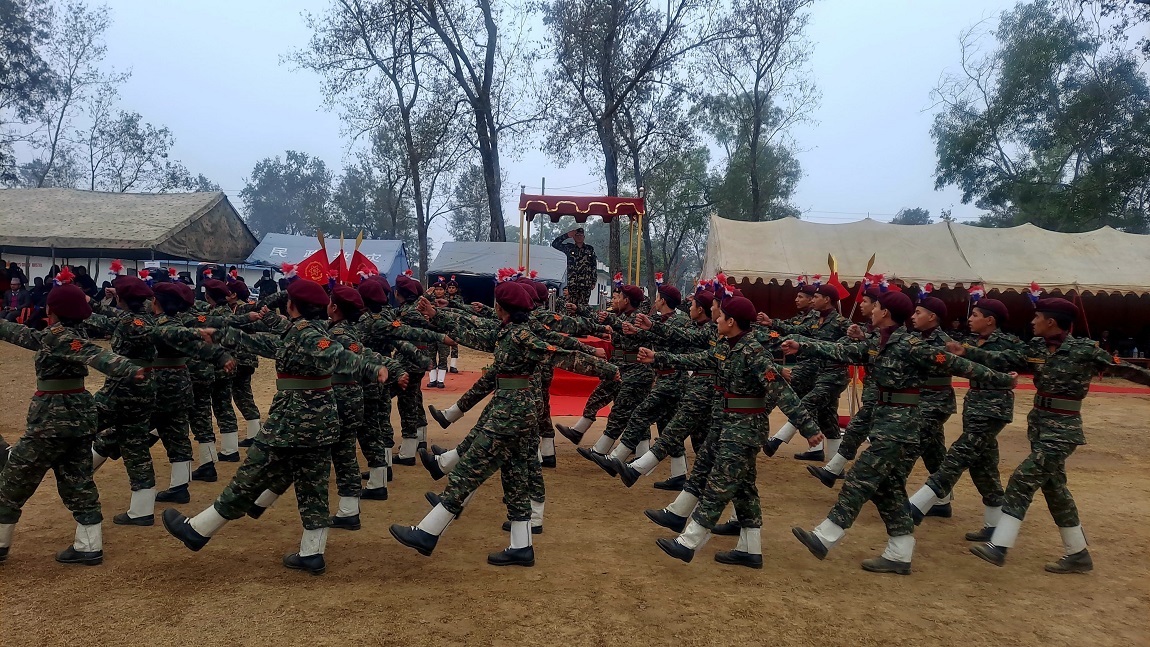
The National Cadet Corps (NCC) is set to be of a civilian and non-military nature.
Operated under the Nepal Army, the NCC has been providing volunteer training to students.
The State Affairs and Good Governance Committee of the House of Representatives has added an interpretation in the National Cadet Corps Bill explicitly defining the NCC as civilian and non-military in nature.
The committee has also reduced the role of the Nepal Army in the corps to some extent.
When the Ministry of Defense registered the bill in the House of Representatives, it had proposed that serving Nepal Army personnel would provide training. The committee has removed the provision allowing serving military personnel to conduct the training. However, the authority to select such trainers has still been given to the army.
During discussions on the bill, lawmakers said that educationists, people with experience working in disaster response, and others should be allowed to provide training. They argued that qualified individuals from outside the military should also be eligible to participate as trainers.
The bill retains the provision that the director general of the NCC will be a retired major general of the Nepal Army.
The provision that the chief of the army staff will recommend the director general has also been retained. However, the bill requires the chief of the army staff to recommend three candidates, giving the government the option to select one of them for appointment.
The committee has removed the chief of the general staff of the Nepal Army from the NCC’s steering committee.
In place of that position, the committee has added a provision for a female civil servant of gazetted special class or equivalent rank designated by the Government of Nepal. The defense minister will chair the steering committee. The chief of the army staff and the secretaries of the Ministry of Defense and Ministry of Education will be members. The director general of the NCC will serve as its member-secretary.
The bill gives the NCC academy the authority to establish criteria for selecting students for training. However, the committee has added a provision requiring selection to be made on the basis of inclusive principles.
The provision deputing staff from the Nepal Army and the civil service for the operation of the NCC academy and offices remains unchanged.
The bill also retains the provision allowing people other than students to receive NCC training. In other words, other individuals will also be able to receive NCC training conducted under the Nepal Army based on necessity.
The Cabinet may mobilize people who have received such training based on national necessity. Under the amendment, the Cabinet will have the authority to determine what constitutes a national necessity. Any circumstance or situation designated by the Cabinet will be considered a “national necessity.”
The bill adds a provision requiring the government to inform Parliament after NCC volunteers are mobilized on the basis of national necessity.
The bill requires both houses of the Federal Parliament to be informed when trained students or other individuals are mobilized as volunteers.
The bill also stipulates that a person who has received NCC training cannot be compelled to serve in the military merely because they have undergone the training. A similar provision was also included in the 1970 bill.
When the government registered the bill in Parliament, it had removed the provision stating that military service would not be compulsory. The State Affairs and Good Governance Committee has now restored that provision.
Committee Chairman Hari Dhakal has submitted the committee’s report on the bill to the House of Representatives. The House will now pass the bill and send it to the National Assembly. It will acquire legal status only after being passed by the National Assembly and authenticated by the president.