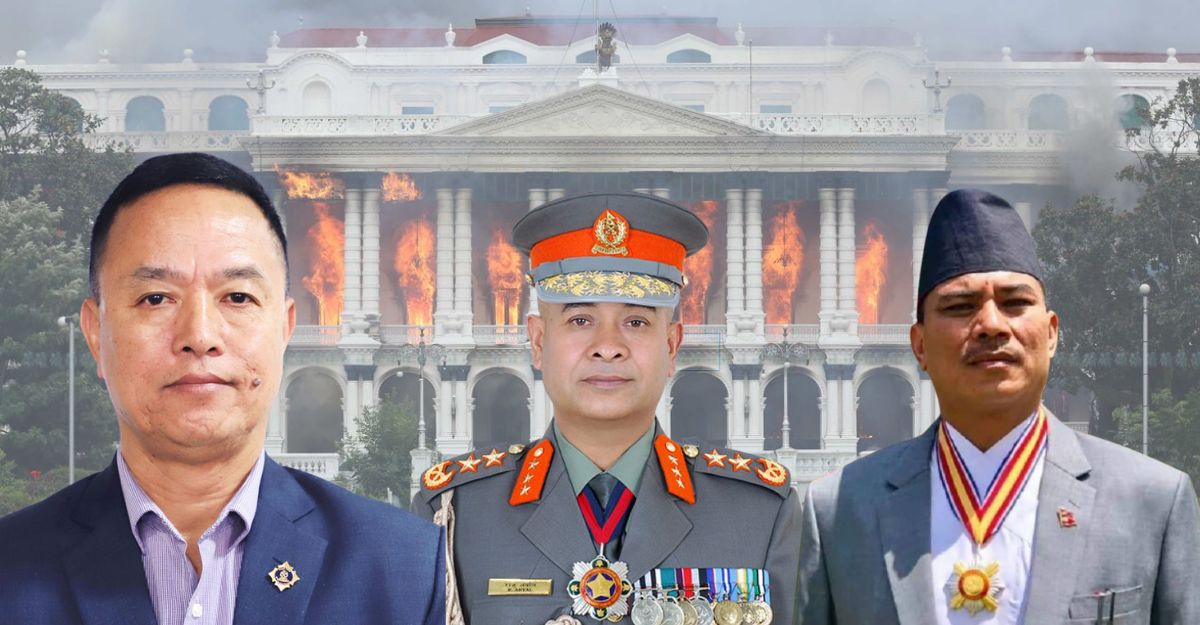
A government-appointed committee is currently reviewing recommendations for action against former chiefs of security agencies made by the inquiry commission formed to investigate the events that took place during the Gen Z movement on September 8 and 9 last year.
The three-member committee, led by former judge Prem Raj Karki, is preparing to submit its report to the government next week.
"The study is almost complete. We are now discussing the conclusions," committee coordinator Karki told Setopati. "We will submit the report to the government by July 6."
The committee has been studying international precedents from similar incidents and relevant laws in various countries. Its report is considered important for future crowd control and the legal boundaries of command responsibility.
The report is drawing attention for three main reasons.
First, the inquiry commission led by former judge Gauri Bahadur Karki recommended action against policy-level and security leadership (including the home secretary, inspector generals of police, and chief district officer) without identifying the security personnel who actually fired shots during crowd control, resulting in deaths. It recommended filing criminal cases against them under Sections 181 and 182 of the National Penal Code.
If this recommendation is implemented as is, or if the Karki-led study committee upholds it, criminal liability for human casualties during any protest in future could fall directly on senior officials in command centers. Therefore, officials say, the committee’s legal interpretation on this will significantly influence the working style of the civil administration and security agencies.
Second, the report could define the relationship between officers issuing orders and personnel deployed in the field.
There is concern in security circles that if the leadership faces increased risk of prosecution on charges of attempt to murder or negligence during crowd control, commanders may hesitate to take decisions during crises, which could weaken the state’s established mechanism for maintaining peace and security.
According to sources, the committee has studied some international precedents similar to Nepal’s incident to address this issue.
For example, it has examined the US Capitol Hill attack on January 6, 2021, when supporters of Donald Trump stormed the Capitol in Washington, DC, over the results of the presidential election, resulting in several deaths.
It has also studied violent incidents in some European countries and the more recent unrest in Bangladesh.
A committee member said that these international precedents are being used to distinguish between the responsibility of security personnel deployed in the field and the accountability of commanding officers.
Third, the report is expected to help define the boundaries of legal jurisdiction for inquiry commissions in Nepal.
It is an established practice in Nepal to form inquiry commissions to investigate various incidents, followed by recommendations from such commissions. However, the since commissions are neither courts nor public prosecutors, questions have been raised over whether they have the authority order prosecution by explicitly specifying sections of criminal law.
According to sources, the committee’s review is focused on whether the Karki-led commission’s recommendations for action against the then chiefs of security agencies and others were appropriate.
“In our law, only government attorneys under the Office of the Attorney General have the authority to specify sections. We have examined whether an inquiry commission can recommend action by specifying sections,” said a member of the committee.
“The commission’s report does not identify who actually fired the shots during the incidents of September 8 and 9. Since it implicates only the leadership, the report appears incomplete,” the member added. “People died during the protests, but nowhere does the report identify who fired the fatal shots. Someone fired, but it is not clear who fired.”
The commission recommended criminal action against then-inspector general of Nepal Police Chandra Kuber Khapung, former inspector general of Armed Police Force Raju Aryal, and then-chief of National Investigation Department Hutaraj Thapa.
It also recommended action against former home secretary Gokarna Mani Duwadi, and then-chief district officer of Kathmandu Chhabi Raj Rijal.
They were recommended for prosecution under Sections 181 (causing death through negligence) and 182 (causing death through recklessness) of the National Penal Code, 2017.
Section 181 carries a prison sentence of three to 10 years and a fine ranging from Rs 3,000 to Rs 100,000, while Section 182 provides for six months to two years' imprisonment, a fine of up to Rs 20,000, or both.
Sources say the committee has examined foreign laws and comparable international cases to determine whether it was legally appropriate for the inquiry commission to recommend action by specifying criminal charges and punishment.
The study committee also includes former additional inspector general of Armed Police Force Subodh Adhikari and former Nepal Police AIG Tek Prasad Rai.
During its study, the committee consulted former government secretaries, former IGPs, the current attorney general, the National Judicial Academy, Nepal Police, the Armed Police Force, and others.
Immediately after taking oath on March 27, the first Cabinet meeting chaired by Prime Minister Balen Shah decided to implement the report submitted by the inquiry commission on the Gen Z movement. However, a separate committee was formed to study the recommendations against security agencies, citing the need for further examination.
The committee was initially given 15 days to complete its work, but the Cabinet later extended its deadline by 45 days on June 2.