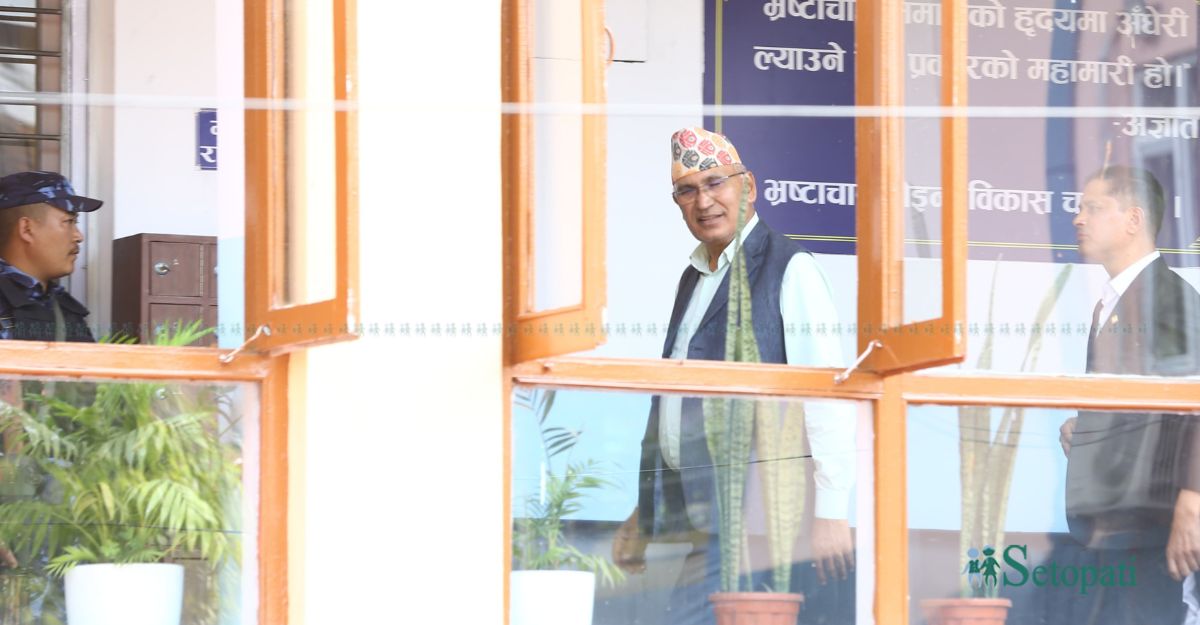
The Supreme Court has ordered the submission of files related to the cases registered by the Department of Money Laundering Investigation against businessman Deepak Bhatta and others.
On Tuesday, a bench of Justices Tek Prasad Dhungana and Meghraj Pokharel ordered that the case files involving money laundering, banking offenses, and securities-related charges currently pending in the Special Court against businessman Bhatta and Sulav Agrawal be produced before the Supreme Court for examination.
The next hearing on the habeas corpus petition filed on behalf of UML Vice-chairman Bishnu Paudel has been scheduled for Friday.
Previously, on June 25, a bench led by Justice Shreekanta Paudel had issued a show-cause order to the defendants and set a hearing on the petition for Tuesday.
Meanwhile, the DMLI has been securing remand extensions from the Special Court to continue its investigation.
On Monday, the department presented Paudel before the court, where a bench comprising Judges Narayan Prasad Paudel, Hemanta Rawal, and Umesh Koirala granted a second remand, authorizing three additional days in custody.
Prior to this, the Special Court had initially granted a seven-day remand for Paudel on June 23.
The following day, Paudel’s wife, Domaya, filed a habeas corpus petition at the Supreme Court, claiming that her husband was being held illegally.
Why was Paudel arrested?
Paudel was arrested on June 22 over his alleged connection with businessman Bhatta, who is already in custody pending trial on money laundering charges. He was brought to Kathmandu in a public van the same night.
Investigators have linked Paudel to a transaction involving the sale of a 20 percent stake in Shree Ram Tobacco Industries Pvt Ltd, purchased by Himalayan Assets Management Pvt Ltd, a company under Bhatta's sole control.
Prosecutors told the court that the 20 percent shares had a book value of approximately Rs 300 million but were sold for only Rs 37.5 million.
During court proceedings seeking Paudel's detention, the prosecution argued that while serving as finance minister, he abused his political influence to facilitate the transaction and helped Bhatta launder more than Rs 262.5 million.
Prosecutors also alleged that after the discounted share transaction, Paudel facilitated the import of areca nuts for Shree Ram Tobacco Industries while serving as finance minister.
Other allegations raised during the hearing were that Paudel helped facilitate a license for Himalayan Reinsurance, assisted seven insurance companies in obtaining operating licenses, and initiated plans to secure a license for the Janakpur Cigarette Factory.
They mentioned that the Department of Money Laundering Investigation had also cited statements from Chunnu Prasad Sharma and Kamal Kishor Malpani as part of the basis for Paudel's arrest.
Sharma, a businessman who contested the last general election from Rupandehi-2 as a candidate of the Nepali Congress, reportedly told investigators that when Bhatta was brought in as a partner, then-finance minister Paudel had agreed to facilitate approvals from government agencies, support business expansion, and, in return, receive a beneficial interest through the allocation of a 20 percent stake in Shree Ram Tobacco Industries.
Prosecutors argued that this statement formed a key basis for Paudel's arrest.
The investigation also alleges that although the book value of Shree Ram Tobacco's shares was Rs 816.71 per share, 375,000 shares were sold at Rs 100 per share.
Lawyers representing Paudel have denied the allegations, arguing that he was arrested without evidence and solely on the basis of statements.