We had an interesting experience while reporting on the elections in Madhesh.
As we entered the inner villages of Madhesh and began discussing the elections with the elderly and middle-aged youth, the village children would gather around us. As soon as we introduced ourselves and mentioned we were there to talk about the election, those children were the first to shout, "It’s all bell here, nothing but the bell!"
The same thing happened when we met 67-year-old Guddar Thakur of Rupani Rural Municipality–2 in Saptari. When we asked him, "Who do you want to vote for this time?" his 10-year-old grandson, who was sitting nearby listening to the conversation, immediately chimed in, "Baba, give it to bell, bell!" The grandfather said nothing. He just kept smiling gently.
We asked the child to stay quiet for a moment. But why would he stay quiet? Snuggling into his grandfather’s lap and playing with the snowy white beard on his cheeks, he said lovingly, "Baba, put the stamp on bell, okay!"
Stroking his grandson's hair, Guddar said, "You heard him, everyone here says the same thing."
"Children say anything, but what do you say?" we asked. "Mine is the same," Guddar replied. "I’ll put the stamp wherever my son and grandson tell me to this time."
"My son works as a barber in Qatar. He calls every day and tells me to vote for Balen Shah. The grandsons say the same. The villagers are also saying let’s have a look at Balen Shah. Therefore, this time, I’m voting for Balen," he shared his conclusion.
The grandson looked satisfied with the grandfather's answer. Looking toward us, he said, "See uncle, it's all bell here. Bell!"
Even though Balen Shah—the senior leader of Rastriya Swatantra Party (RSP) and the party’s prime ministerial candidate—is not a candidate in this constituency, there are voters here who will vote for RSP because of him.
Saptari is the same district from where Gajendra Narayan Singh started pro-Madheshi politics. Singh formed the Nepal Sadbhawana Party and contested the 1991 elections. He won from Saptari-2, and his party secured six seats in the parliament in the first election after the restoration of democracy. The Madheshi politics he started has grown and branched out to reach this point.
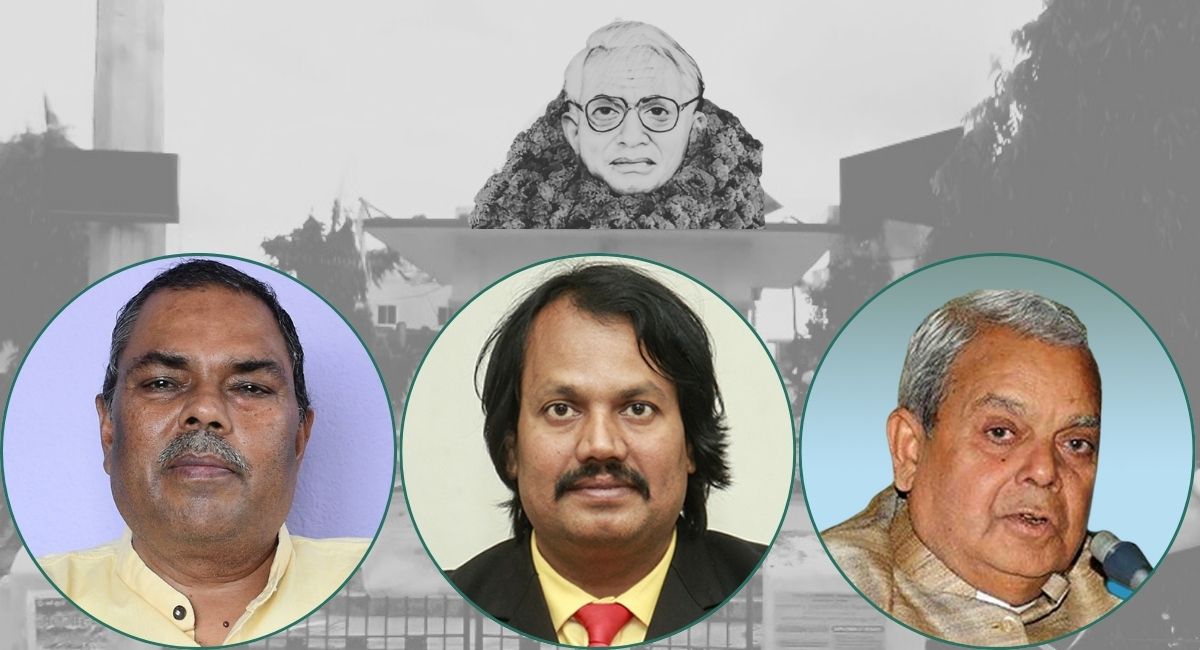
The statue of Singh standing tall at the center of Rajbiraj city is a witness to the growth and expansion of Madheshi politics. This part of the city where his statue stands was once called 'Tribhuvan Chowk' after King Tribhuvan. Now it is called Gajendra Narayan Singh Chowk, or Gajendra Chowk in short.
Singh’s political roots are tied to Nepali Congress (NC). He was involved in the struggle against the Rana regime as a young man. BP Koirala had appointed him as the party president of Saptari district at the young age of 30. Saptari district was not as small as it is today. Today's Siraha and Udayapur were also part of Saptari. When the first general election in Nepal was held in 1959, there were only 109 seats in the parliament. Even then, Saptari had 4 seats.
Singh was the NC president of Saptari during that election. In that election, NC won a two-third majority, and BP Koirala became the first democratically elected prime minister of the country.
After King Mahendra seized power through a military coup on December 15, 1960, he imprisoned BP Koirala. Like many Congress leaders and cadres, Singh also went into exile. He spent his life in exile mainly in Darbhanga, India. After BP Koirala returned to Nepal in 1976 with the policy of national reconciliation, Singh also returned in 1977. In the 1980 referendum, he campaigned vigorously in favor of multi-party democracy.
The year 1983 saw the turning point in Singh’s political life. In 1982, the Population Commission tasked Dr Harka Gurung with preparing a report on 'Internal and International Migration in Nepal.' The chairman of the commission was the then prime minister Surya Bahadur Thapa. Gurung submitted the report in July 1983.
Due to the sensitivity of the recommendations included in that report, it was not made public immediately. Later, the recommendations slowly started to leak. This created a huge wave in Madhesh. The report primarily recommended five tasks.
First, border regulation: registering the names of people crossing the border in the first phase, implementing visas in the second phase, and fully implementing a passport system for crossing the Nepal-India border in the third phase. The second important recommendation was to implement 'work permits'—making work permits mandatory for non-Nepalis (mainly workers of Indian origin) working in Nepal. Third, tightening citizenship: amending the Citizenship Act to include strict provisions for obtaining citizenship. Fourth, controlling migration: stopping migration from India to the Tarai immediately as it could disrupt Nepal's demographic balance. And fifth, trading between Nepal and India only through limited border points.
Gajendra Narayan Singh opposed Harka Gurung's report, claiming it spread ill-will against Madhesh, sought to further discriminate against and wrong Madheshis, and aimed to devastate the economic life of Madhesh. He led demonstrations in districts including Saptari and showed black flags. He issued the 'Saptari Manifesto' against the report.
The manifesto had five main demands—Nepal should adopt a federal system of government, citizenship rights should be given to everyone born or living in the Tarai, Hindi should be recognized as the second national language while accepting it as the lingua franca of the Tarai, there should be proportional recruitment of Madheshis in the Nepal Army and Nepal Police, and constituencies should be determined based on population.
After issuing the 'Saptari Manifesto,' the government arrested Singh and charged him with treason. He was released from custody after spending 9-10 months in jail. After that, he contested from Saptari-2 in the 1986 Rastriya Panchayat election and won.
There was a rule that members had to wear Daura-Suruwal in the Rastriya Panchayat. One had to speak in Nepali in the House. Singh, however, would go to the House wearing a Dhoti and speak in Hindi. He would raise issues of discrimination against Madheshis and demand federalism. Panchayat leaders vehemently opposed him wearing Dhoti-Kurta and speaking Hindi in the Rastriya Panchayat. But he did not yield. In this way, he brought the voice of Madhesh to the parliament during the Panchayat era. And after the restoration of democracy in 1990, he registered the Nepal Sadbhawana Party and brought that party to the parliament.
The politics Singh started for the Madheshis has grown, spread, and faced ups and downs to reach the present day. And standing in the middle of Rajbiraj city, the statue of Gajendra Narayan Singh has been watching all these highs and lows.
The rebellion Singh started 42 years ago, which gave birth to Madhesh politics or Madheshi-led politics, is facing its most critical situation to date in this election. Madheshi parties are fighting for their existence in this election. Setting aside other leaders, the politics of two major figures of today’s Madheshi politics, Upendra Yadav and CK Raut, is faltering in front of Singh's statue.
Janamat Party Chairman Raut is a candidate from Saptari-2. We have already written a story about how he is trailing far behind his opponent. While traveling through Saptari-3, we saw that Janata Samajbadi Party (JSP) Chairman Upendra Yadav is also far behind his competitor, Amar Kanta Chaudhary of RSP. We see little chance of him improving his position and winning the election in the next two days. We will discuss this in detail shortly.
Before that, let's talk about the rise of Upendra Yadav in Madheshi politics and his contributions. After Singh, Upendra is the leader who fought most effectively for Madheshi rights and interests. Opposing the interim Constitution written after the 2006 People's Movement, Upendra Yadav tore up that Constitution at Maitighar in Kathmandu. The Madhesh uprising he thus started then laid the foundation for federalism in Nepal. Several demands raised by Singh, including the entry of Madheshis into the army, were addressed. And that established Upendra Yadav as an influential leader of Madhesh.
Upendra Yadav became so popular among the Madheshi people that in the 2008 Constituent Assembly elections, the Madheshi Janaadhikar Forum led by him won 30 out of 48 seats in Madhesh. With 22 seats from the proportional representation (PR) electoral system, the Forum became the fourth-largest party in the First Constituent Assembly with 52 seats.
The 2007/08 Madhesh movement gave birth to another Madheshi party—the Tarai Madhesh Loktantrik Party (TMLP) led by Mahantha Thakur. This party also won 20 seats through direct and PR systems in the First Constituent Assembly and became the fifth-largest party. This party, after various splits and mergers, has merged into JSP this time. Its veteran leader Mahantha Thakur is a PR candidate from JSP this time.
A few years after the rise of these two Madheshi parties, another Madheshi party emerged in Madhesh—the Janamat Party led by Raut. With the objective of making Madhesh a 'separate country,' Raut returned to Nepal from America in 2011. After running this secessionist campaign for a few years, he also joined parliamentary politics in 2022.
His intention was to push aside other Madheshi parties and become the sole pillar of Madheshi politics. For that, he chose the path of directly challenging Upendra Yadav. He filed his candidacy against JSP Chairman Upendra Yadav in Saptari-2. At that time, Raut won by securing more than double the votes Yadav received. While Raut secured 35,042 votes, Yadav could muster just 16,979 votes. In his very first election, Raut made Janamat a national party. Janamat also showed a strong presence in the provincial election in Madhesh securing 13 seats.
In the 2022 election, only two parties from Madhesh, JSP and Janamat, became national parties by securing 3.99% and 3.74% of the votes respectively. Loktantrik Samajbadi Party (LSP) led by Mahantha Thakur received just 1.5% of the votes and failed to become a national party by crossing the threshold of 3%.
Given the public wave we found in Madhesh during this election and the trend of Madheshi voters, it will be difficult for any Madheshi party to become a national party this time.
Balen Shah is the reason why the politics of Madheshi parties has suddenly reached such a fragile state. Shah is not a proponent of Madheshi politics. He does not seem to have much interest in the struggle and martyrdom of Madhesh for its identity and rights. Until some time ago, he was also against federalism and had refused to cast a vote for the provincial assembly.
The comment made by political analyst CK Lal about Shah is striking. He says, "Balen Shah, born in Kathmandu, is not a son of Madhesh, he is a son of Kathmandu. But he is indeed a Madheshi son."
Due to this 'Madheshi son' who does not practice Madheshi politics, the politics of Madheshi parties is on the verge of being ruined this time. It is too early to say what the long-term impact of this will be. Everything does not end in one election, nor is everything built in one.
However, a statement by Rabi Lamichhane, chairman of Shah’s party, is relevant here—we are trying to end the era of politics that divides and isolates the entire country and Madhesh. Is the era of Madheshi politics really coming to an end, as Lamichhane claims?
Now, let's talk about the election atmosphere seen in Saptari-3, where JSP Chairman Yadav is a candidate. After traveling through this constituency for three days and talking to as many voters as possible, we saw no wave in his favor. In fact, he is not even in the race for victory here. Voters have criticized him, saying he came to Saptari-3 because he could not go to Saptari-2 after suffering a humiliating defeat last time. Many also complained that Yadav only gave slogans for the benefit of Madheshi people but could not deliver results.
The voters here are moving away from Yadav and are attracted to new candidates. Voters are leaning toward RSP candidate Amar Kanta Chaudhary this time. We found that Chaudary is significantly ahead of Yadav and other competitors. The reason for the wave in favor of him is the voters' desire to give a majority to RSP and make Balen Shah the prime minister.
Besides JSP's Yadav and RSP's Chaudhary, 27 candidates are competing in this region, including Dinesh Kumar Yadav from NC, Tara Kanta Chaudhary from CPN-UML, Arun Kumar Sah from the Nepali Communist Party (NCP), and Surendra Prasad Sharma from the Janamat Party.
This constituency includes 41 wards of Rupani Rural Municipality, Shambhunath Municipality, Bishnupur Rural Municipality, Rajgadh Rural Municipality, and Dakneshwari Municipality. Among them, NC had won the most with 12 wards, while JSP won 10, UML seven, and the then CPN (Unified Socialist), now part of NCP, five wards in the last local election.
To understand the changed political map of this constituency, one must look at the status of the parties in the previous election. In the 2022 general election, RSP was not even in the race here. In the first-past-the-post (FPTP) system, Dinesh Kumar Yadav of NC, who was a candidate supported by the then ruling coalition, emerged victorious. While Dinesh received 26,166 votes, Tara Kanta Chaudhary of UML, who was supported by JSP, received 22,300 votes. Anish Ansari of the Janamat Party, who was third, received 15,114 votes. At that time, RSP candidate Pramod Kumar Sah received just 237 votes.
Janamat Party received the most PR votes with 18,340. Congress was second with 18,249 votes, while JSP received 10,153 and UML got 9,594 votes. The PR votes received by RSP was a meager 298.
In our analysis, there will be a massive upheaval in the balance of power in this constituency this time. There will be many changes in both FPTP and PR systems. This time in Saptari-3, we found no other candidates besides those of RSP and JSP in the competition. NC’s Dinesh and Tara Kanta of UML will compete for the third position. But they are far behind RSP and JSP.
Among those we talked to in this region, 12% have not yet decided who to vote for. Most of these undecided voters are those who voted for NC’s Dinesh last time. After that are those who voted for JSP and Tara Kanta of UML. By the time of the election, they will certainly decide who to give their vote to.
Our analysis is that whatever they decide, it won't make much difference to the election result. In our past experience, these undecided votes are also divided in the end. Some of them might vote for RSP, while others might vote for NC, UML, JSP, Janamat, or other parties they voted for before. Therefore, Amar Kanta of RSP, who is currently ahead in the competition, is likely to receive the most votes.
Based on our analysis of conversations with voters, many who voted for NC’s Dinesh, Tara Kanta of UML, and Anish of Janamat last time are seen moving toward RSP this time. Similarly, a large number of old voters of JSP, LSP, and NCP are also attracted toward RSP. Furthermore, almost all the first-time voters we met said they would vote for RSP.
As a large portion of new voters and those who voted for the once-popular Madheshi parties as well as Congress, UML, and Maoists go toward RSP, RSP looks set to win comfortably. The three parties in the competition—JSP, Congress, and UML—have a low chance of saving old voters or pulling in new voters or those from other parties. We also saw a slim chance of these three parties pulling in any new voters. Most of those who said they would vote for them this time are those who have voted for these same parties before.
We found that RSP will benefit directly from the former winner Congress and its then competitor UML shedding their votes to RSP, and simultaneously Madheshi parties like JSP, Janamat, and LSP also losing theirs to RSP. This will increase the size of RSP while the size of other parties will decline.
If CK Raut loses in Saptari-2 and Upendra Yadav loses in Saptari-3 this time, and their parties fail to secure 3% of the total valid votes cast across the country to become a national party, it will also prevent another prominent leader of Madhesh from reaching the parliament. That leader is 82-year-old Mahantha Thakur. Thakur is on JSP's PR list. If JSP fails to become a national party, he will not become an MP.
In this way, there will be no major leaders of Madhesh in the federal parliament, nor will Madheshi parties be in the federal parliament as national parties. If that happens, for the first time since Gajendra Narayan Singh's victory in the 1986 National Panchayat, a major Madheshi party or leader practicing Madheshi politics will not be in the country’s parliament.