Editorial Note
As our esteemed readers are already aware, we have approached the Supreme Court (SC) after Press Council Nepal sent us a letter to remove or correct the election analyses published by Setopati. We moved the SC seeking an interim order against the Election Commission and the Press Council, requesting them not to interfere with our work or proceed with any action against us. The SC has summoned the Commission and the Council on Tuesday to discuss about the interim order.
A hearing was also held today regarding a writ petition filed at the Supreme Court demanding a prohibitory order to stop Setopati from publishing 'Election Analyses,' claiming that our analyses misled voters and affected the fairness of the election. The SC refused to issue the order against Setopati and has scheduled a discussion on this petition for Tuesday as well.
Respected readers, our contention has always remained—no institution can interfere, in the name of a code of conduct, with the citizens' right to information regarding elections and the constitutionally granted right of the media to deliver such information to the public. Therefore, with the objective that this matter be finally resolved by the SC—the interpreter of the Constitution—we have knocked on the doors of the judiciary. The court's decision will be acceptable to us.
Setopati respects the law and also strives for improvements where necessary. This is exactly how it should be in a democratic society—advancing improvements and seeking solutions through debate, discussion, advocacy, and constitutional and judicial processes.
Setopati’s loyalty lies solely with our readers. We cannot even imagine unnaturally showing a leader of any particular party ahead or behind in an election analysis. That would be against our principles and our interests. Our duty is to deliver the most accurate information we know to our readers. Our interest is that the news we write proves to be correct, that our election analyses turn out to be accurate, and that our credibility increases further.
Almost all the analyses we have written since 2017 have been accurate. Our past election analyses have also established our impartiality and credibility among readers.
This time too, we have performed our analyses with the same professionalism and caution as before. We have also made further improvements this time. Despite best efforts, media outlets occasionally make mistakes. We learn from such mistakes and further refine ourselves. This will continue consistently. Here is our eighth election analysis:
Bhaktapur–2 Election Analysis
At a small tea stall on the edge of the road leading toward Banepa, at the lower end of Katunje in Bhaktapur, four people, including the owner, were engaged in conversation. After we ex-pressed our interest in talking, they gestured for us to take a seat. "Alright, tell us, what is there to say?" asked one of the men sipping tea.
We explained that we had come to understand the issues and grievances in the neighborhoods of Bhaktapur-2, and to learn which party or candidate the voters prefer this time and why. We asked if they would be willing to share their perspectives. Once everyone agreed, we began our questions.
Among those at the shop was a young man named Sushil Dhungel. He is a member of the Rastriya Swatantra Party (RSP). He revealed that he had previously been a Nepali Congress (NC) supporter, but shifted allegiance to RSP after 2022. "The old parties did nothing for 35 years. Now, there is hope that RSP and its leaders will actually achieve something for the country," he said. "The leaders are educated. I hope they will do more than the old guard and create an environment where people can actually stay in the country."
Lekhnath Bhattarai, sitting nearby, stated that he has always voted for CPN-UML and will continue to do so. He explained that he would vote for Mahesh Basnet, the UML candidate in this constituency, because of his work in development and construction. "I have given my vote to UML from the start, and I will give it to UML now as well," Bhattarai said.
Binod Dhungel, also present there, said he would not be changing his allegiance either. Having voted for NC in the past, he will again vote for the grand old party this time. "I won't go anywhere else," Dhungel remarked.
We then asked the woman running the tea stall for her thoughts. She preferred to keep her identity private. (We only record voter details after asking whether they wish to be named or remain anonymous). She shared that she has voted for NC her entire life, but has not yet decided who to support this time. "Everyone says the old parties did nothing and that the new ones will. But you can't say the old ones did absolutely nothing," she said. "The point is, they should have done much more than they actually did."
Over the course of three days, we traveled through all 19 wards of Bhaktapur-2—comprising 10 wards from Suryabinayak Municipality and 9 from Madhyapur Thimi Municipality—speaking with as many of the 98,356 voters as possible.
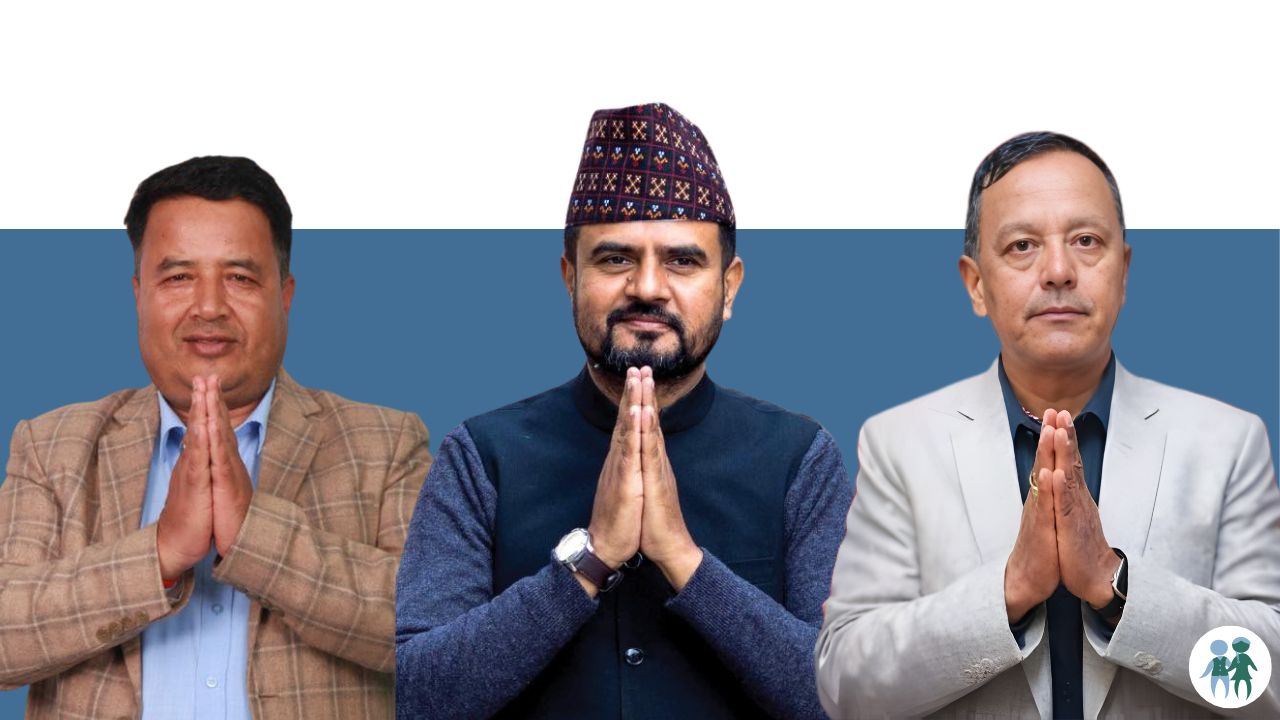
The contenders in the constituency include Kabir Rana (NC), Mahesh Basnet (UML), Rajeev Khatri (RSP), Ram Prasad Sap-kota (Nepali Communist Party), Ramesh Baidya (Nepal Workers Peasants Party), Jitram Lama (Ujyaalo Nepal), Bikram Thapa (RPP), and independent candidate Shobha Pathak, among others.
In the 2022 election, NC candidate Durlav Thapa won with 24,239 votes, narrowly defeating UML’s Mahesh Basnet who se-cured 23,282. At that time, the RSP—competing for the first time—received 4,098 votes. After three days of field research, our analysis indicates that RSP candidate Khatri is currently leading well ahead of the other competitors.
Khatri is a former journalist who entered politics only recently. We found that those intending to vote for him are influenced less by his individual personality or specific agenda and more by the party's senior figures, Balen Shah and Rabi Lamichhane. Some voters also noted that their minds changed following the Gen Z Movement, leading them to move away from traditional parties.
While many voters credited UML candidate Basnet for local development, several stated they would not vote for him this time due to his rude tone. A woman from Suryabinayak-1 said, "Even though UML’s Basnet brought development, he should not win. His mouth is far too rude. But it isn't easy for us to speak out about it. If someone finds out, it becomes difficult to live in this community."
She had previously taken turns to vote for NC and UML, opting for UML in the last cycle. However, since the Gen Z Movement, she has decided to not vote for UML. "Only I know what I went through when my son returned home late on September 8. Imagine how the parents who lost children must feel? Oli’s (UML Chairman KP Oli) arrogance has peaked. It won't be fixed until he is knocked down once," she said.
Dislike for Basnet’s "rude tone" was a common theme. A male voter from Suryabinayak-5, who supported UML last time, said, "After the Gen Z Movement, I couldn't feel positive toward UML leaders. I also dislike Basnet's style of speaking. The old parties just form coalitions to engage in corruption. That is why I am thinking of voting for RSP this time."
In the last election, a five-party alliance including NC, CPN (Maoist Center) and CPN (Unified Socialist) helped Durlav Thapa win. This time, the parties are running independently. Our analysis suggests that, like UML, NC will also struggle to retain its previous vote share. Many former NC voters indicated a shift toward RSP.
Two main factors appear to be driving this decline for NC. First, many voters expressed anger over the "burnt money" allegedly found at the then NC president Sher Bahadur Deuba’s house on September 9. Deuba’s claim that the video was AI-generated further alienated voters.
Babukaji Prajapati of Madhyapur Thimi-3, an NC voter since 1991, said he is switching to RSP. "I voted for NC until now, but my heart changed after the Gen Z Movement. This time, I’m going for the bell," he said, adding, "They say the money at Sher Bahadur’s house was AI-generated. We cannot call what is black, white."
Another voter in Suryabinayak-5 expressed deep disillusionment with all three major parties (NC, UML, NCP). Having voted Congress previously, he now leans toward RSP. "The big three failed to understand the youth. The result was the historic Gen Z Movement. When money burns like paper at a leader's house and they just dismiss it as AI-generated without a clear answer, it’s over," he said.
Furthermore, there is a widespread grievance that the incumbent, Durlav Thapa, has been inactive. A voter in Balkot remarked, "We sent him to the Parliament, but I haven't heard him speak once. We sent him there to work; if he doesn't do that, why vote for him? This time, it’s for the bell! Let’s see what the new ones can do."
However, most new voters warned that if the RSP fails to make progress in the next five years, they will change their votes again. Our analysis places UML and NC in a battle for second place, followed by the NWPP in fourth. Other parties have failed to gain significant traction.
Among first-time voters, RSP is the dominant choice. Anish Sil-wal, 29, of Balkot, registered to vote for the first time specifically for this election. "I didn't even make an ID when my own grandfather ran for office. I made one this time for RSP," he said, citing Balen Shah as his inspiration. "If Balen hadn't run, I probably wouldn't have registered. Seeing his work in Kathmandu—improving schools, stopping floods in Kapan, and fixing parking—gives me hope. I believe if he had the time and opportunity, he would get things done."
Conversely, those still supporting UML fall into two categories: traditional party loyalists and those prioritizing Mahesh Basnet's developmental track record. Basnet, now UML secretary, is widely praised for road construction in the area despite his 2022 loss.
Govinda Krishna Shrestha, 68, of Madhyapur Thimi-4, credits Basnet with saving his neighborhood from flooding by building proper drainage. "He worked for our society even when he wasn't in office, so we choose him," he said. "The new ones don't have a vision. Those who know the land are the ones who work for it."
Some voters also appreciated Basnet for being vocal during the Gen Z Movement when other leaders remained silent. Niraj Shrestha noted, "After the Gen Z Movement, no one spoke. Mahesh Basnet’s speaking up gave other leaders courage. He says what he thinks and has developed this area. That’s why he gets my vote."
Even so, many supporters urged him to be less abrasive in his speech. One UML cadre even claimed Basnet’s previous loss was due entirely to his "foul mouth."
For those sticking with NC, the reasons were twofold: lifelong loyalty or trust in the new NC President, Gagan Thapa. Bimala Kandel of Sano Thimi said, "I can't bring myself to vote else-where; it’s Congress for me. We've stayed through the old days, and now we look to a changed Congress under Gagan Thapa. He took leadership through rebellion, so he cannot afford to fail."
Finally, a significant portion of the electorate—roughly 21 per-cent—remains undecided. Many are disillusioned with the old parties but not yet fully convinced by the new ones, leaving them in a dilemma as the election approaches. Some, however, are still deciding which of the old ones to choose.