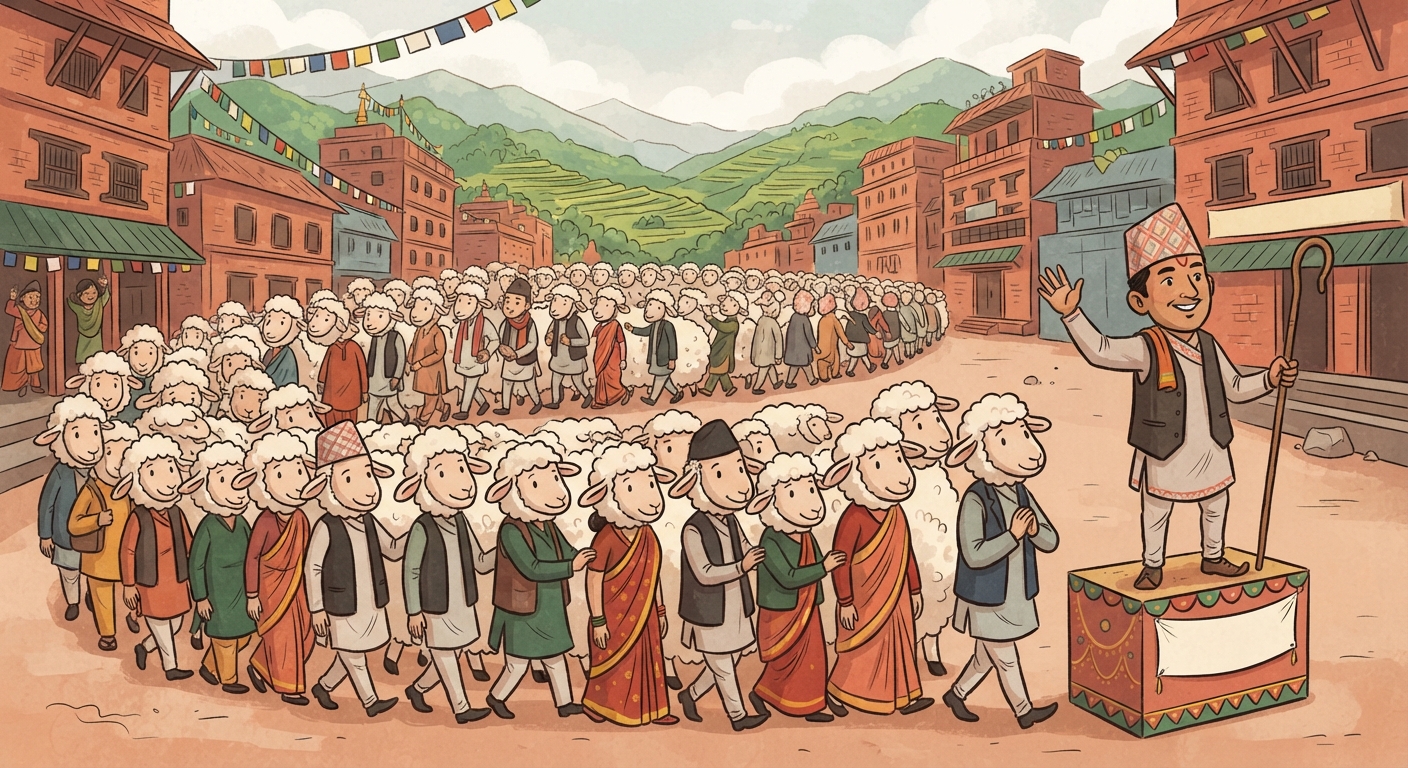
Philosopher Karl Popper, in his seminal work The Open Society and Its Enemies, argues that in an open society, citizens think for themselves, question authority, and criticize beliefs without fear. Such a society rests on the pillars of critical rationalism, individual freedom, pluralism, and institutional accountability. Although we like to blame geopolitical conspiracy theories for everything in Nepal, we must recognize that the enemies of an open society also reside within our own closed-minded habits. And in Nepal, the crowd, the uncritical mass itself, has become the most pertinent enemy of open society.
Just look at the way the crowd explains its failures. Whatever or whenever some socio-political upheaval happens, the assumption of the crowd is too obvious: it’s a foreign conspiracy. Each and every socio-political failure has been externalized, and our political leader is merely a puppet, and their variations depend on which foreign agency the crowd imagines is pulling the strings. Irony there is that for us Nepalis, there is nothing much to prove, as nothing happens from within. Politics in Nepal only shifts from one foreign agent to another. That's all. After all, in this age of fake news, online prejudices, and post-truths, there are fragments of rumor, conspiracy theories, outrageous expert analysis, or some viral post floating somewhere that confirms their ignorance.
The crowd never questions its criteria for evaluation. That is why the cowards of conformity become everything every other day: a communist, a royalist, a nationalist, an internationalist, a religious, a secular, and a liberal. The loyalties of the crowd can change, but its method remains the same. It follows the loudest voice, repeats what others say, shares what the group believes, and never really asks for anything logical. As a result, politics in Nepal has been reduced to just about leaders, either cults of personality or clashes of personality. After all, our political leaders also know that for anything that happens against their will, there is always an angle to twist and turn their political failure into a geopolitical sabotage.
Perhaps the most fundamental obstacle to an open society in Nepal is the education system that rewards memorization, obedience, and conformity over independent reasoning. From an early age, students learn to seek the correct answer rather than ask difficult questions. Universities carry this problem forward when they become extensions of the high school system. A university that teaches students what to think, not how to think, only reproduces a closed society when students can’t separate the difference between a conspiracy and common sense.
Our public intellectuals and social commentators also feed on public prejudices and provoke the uncritical thinking habits of the masses for their media presence and virality. Unverified allegations, fabricated histories, social prejudices, and emotionally charged stories are constantly used to construct imaginary enemies and breed distrust of democratic institutions.
Freedom of expression must protect unpopular opinions. However, it does not erase the duty of journalists, media houses, and commentators to distinguish fact from fabrication and to support their arguments with evidence. Influencers also have their set of tactics to deceive the uncritical public. Hence, we never know how a social media influencer becomes a foreign relations expert when our prime minister is on an international visit, and after he returns, the same person becomes a viral influenza specialist for the crowd during the winter season.
The uncritical crowd without ethical commitments also knows how to apply religious conservatism, social customs, phony idealism, and selective interpretations of scripture to evaluate a wide range of topics, including art, film, humor, literature, journalism, and even natural disasters. This selection of the crowd has learned the art of invoking the outsider as the corrupting influence, such as foreign values, Western INGOs, geopolitics, and non-native religious traditions, to cover up its illogical orthodoxies, structural inequality, and perpetuation of social discrimination.
Moreover, religious organizations can’t arbitrarily assume the right to dictate how people need to dress, behave, eat, express themselves, form relationships, or live privately when our constitution already promises equal citizenship, freedom of conscience, pluralism, and the right to disagree. What matters is the legal framework, not moral policing or mob pressure.
The uncritical mass in Nepal is always in search of a political savior to rescue it from its own ruins. At least after the Gen-Z protests, I hope our political leaders have realized how cruel that mass can be. It can easily tear down the idols it once worshipped. Burning down institutions is not the same as building better ones. This happens when a society has no shared standard of rationality, no civic sense, and no integrity to live up to. People wait for the next propaganda to fall into place, the next hoax to burn down their own house.
I am sure some political entrepreneur in the future will bring out yet another weird narrative to fool a public that is already ready to be fooled. However, politicians in Nepal need to understand that they can exploit the crowd but it cannot be trusted. The same gullible populace that they have deceived with false promises is also prepared to serve as a guinea pig for the next political experiment.
Knowledge in a society advances through questioning, testing, criticism, and the willingness among its members to examine their assumptions and admit mistakes. A society that blames always politicians, geopolitics, and foreign powers for every failure but never questions the criteria by which it judges others and evaluates itself remains intellectually stagnant. And that’s what we have become as a nation: where, despite so much of political change, nothing ever happens, and that’s not awful; it’s just what it is.
(Gaurav Ojha is a writer, researcher, and educator)