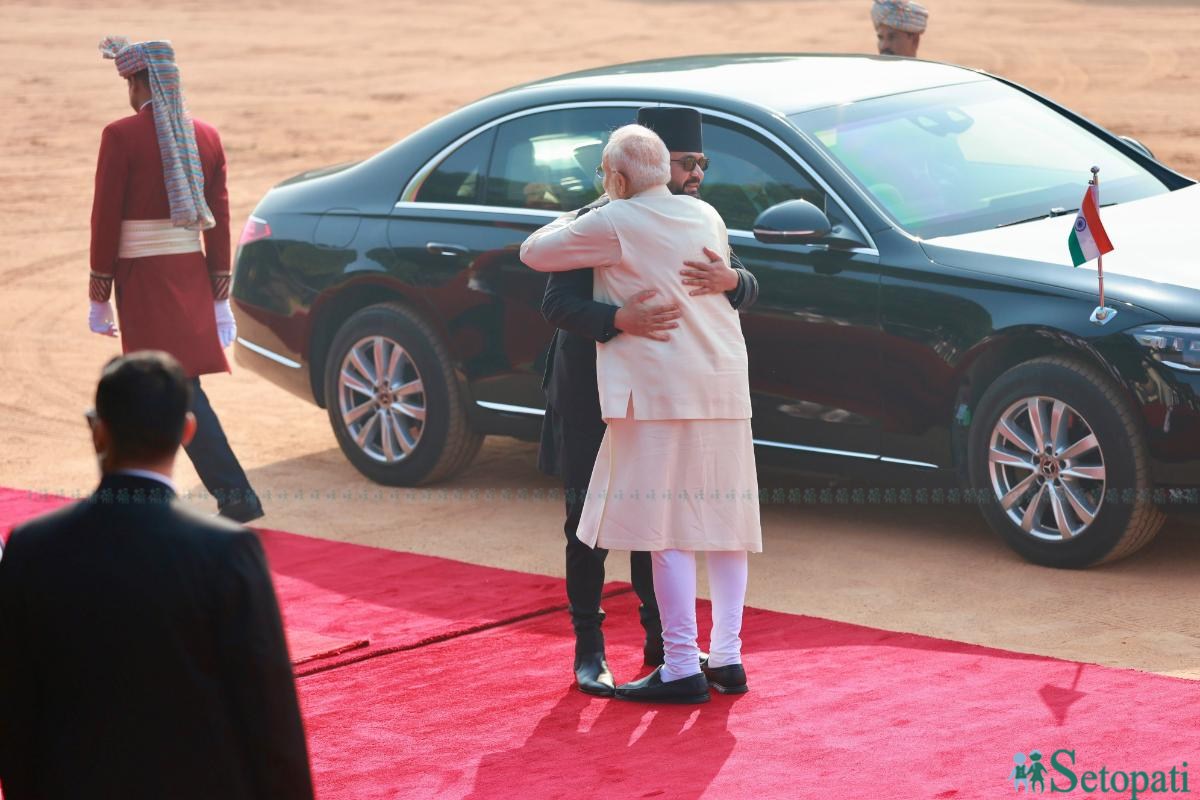
It has come to light that Prime Minister Balendra Shah (Balen) failed to raise the Kalapani and Lipulekh border dispute with India during bilateral talks, despite his repeated public statements on the issue.
Indian Foreign Secretary Vikram Misri said that the Lipulekh issue was not discussed during PM Shah's visit to India.
Speaking at a press conference following Monday's talks between PM Shah and Indian PM Narendra Modi, Foreign Secretary Misri clarified that the issue of Lipulekh did not come up during the bilateral talks.
A journalist had asked whether PM Shah had conveyed Nepal's objection to India and China's plans to conduct trade through Lipulekh.
In response, Misri said, "The issue of Lipulekh did not come up today. There was no discussion between the two sides on this matter. As you know, Lipulekh is a border point between India and China. It has been used for trade and other activities between the two countries for a long time. That is the current situation."
Misri's remarks have exposed a clear contrast between the position PM Shah had publicly maintained on the border dispute before his visit to India and what transpired during the talks in New Delhi.
When he was mayor of Kathmandu Metropolitan City, Shah had displayed a map of “Greater Nepal” in his office. Even after becoming prime minister, he had told Parliament that the United Kingdom should also have an interest in the Kalapani, Lipulekh, and Limpiyadhura dispute.
Informing Parliament that an official diplomatic note had been sent to the Indian government, Shah had also said that Nepal was holding discussions with China and the United Kingdom to resolve the border dispute.
"We have spoken not only with India and China but also with the British government," PM Shah had told lawmakers in response to questions about Kalapani and Lipulekh in Parliament. "Our position is that the British government should also have an interest in this matter because the problems arising from the time of British India's departure continue to affect us. We would like to inform you that all these issues will be resolved through dialogue and diplomatic channels," he had said.
Following Shah's remarks, reports emerged that some officials at the Prime Minister's Office had approached the British Embassy to seek information about the historical background of the border dispute, as well as old maps and documents held by the British government.
However, although Shah had said that Nepal sent a diplomatic note to India regarding Kalapani and Lipulekh and was engaging with the British government, he failed to raise the issue with the very country with which Nepal has the border dispute.
Neither Shah nor Modi mentioned the border dispute in their public statements following Monday's talks.
Even though the issue was absent from their public remarks, questions remained over whether Shah had presented Nepal's position on Lipulekh during the closed-door bilateral meeting.
However, Indian Foreign Secretary Misri made it clear that the issue was not discussed even during the bilateral talks.
The 24-point joint press statement issued by the two countries also gives only limited attention to the border dispute. It directs the foreign secretaries of both countries to continue working toward resolving outstanding boundary issues.
This, however, is not a new agreement.
In 2014, Nepal and India had already assigned their foreign secretaries the responsibility of resolving the Kalapani and Susta border disputes.
A joint statement issued after talks between then-prime minister Sushil Koirala and Indian Prime Minister Narendra Modi had instructed the foreign secretaries of both countries to work toward resolving outstanding boundary issues, including Kalapani and Susta.
Twelve years later, PM Shah and Modi have reiterated the same responsibility.
In fact, the 2014 joint statement explicitly mentioned Kalapani and Susta. This time, the statement does not even name any disputed territories. Nor does it set out any new roadmap or deadline for resolving border disputes.
Nepal and India have long-standing border disputes. Among the disputed areas, Kalapani, Lipulekh, and Limpiyadhura remain the most sensitive.
Nepal claims the territory east of the Kali River as its own under the 1816 Treaty of Sugauli. Nepal considers the river originating from Limpiyadhura to be the main source of the Kali River. India, however, does not accept Nepal's claim.
In November 2019, Nepal protested after India published a new political map showing Kalapani, Lipulekh, and Limpiyadhura within Indian territory.
The following year, the government led by then-prime minister KP Sharma Oli published a revised map of Nepal incorporating these territories. Parliament subsequently amended the Constitution to include the new map in its schedule.
India has not accepted Nepal's new map.
During then-prime minister Pushpa Kamal Dahal's visit to India in June 2023, the border dispute was also raised publicly.
At a joint press conference, Dahal said that he had discussed the border dispute with Modi. The Indian prime minister also expressed commitment to resolving all outstanding issues between the two countries, including the boundary dispute.
Although the bilateral statement issued at the time did not contain any new agreement on resolving the border dispute, both prime ministers addressed the issue in their public remarks.
This time, it was just the opposite.
Shah and Modi did not mention the border dispute in their public statements. The joint statement, however, expressed satisfaction over progress in the maintenance of boundary pillars and instructed the foreign secretaries to continue working on unresolved boundary issues.
This instruction, too, is a continuation of the arrangement made in 2014.
Thus, a dispute that the two countries had explicitly agreed to resolve by naming the affected territories 12 years ago has once again been handed to the same existing mechanism, this time without even identifying the disputed areas.
At Monday's press conference, Indian Foreign Secretary Misri said that various mechanisms had already been established at different levels to resolve border disputes.
He said that considerable progress had been made in recent years on technical matters in undisputed border areas, including the maintenance of boundary pillars and the investigation of complaints regarding encroachment.
Regarding unresolved boundary issues, he said that a meeting of the foreign secretary-level mechanism could take place in the near future. However, he did not disclose when such a meeting would be held.
Based on the outcome of PM Shah's visit to India so far, Nepal's achievement on the border dispute appears limited to renewing an understanding reached 12 years ago.