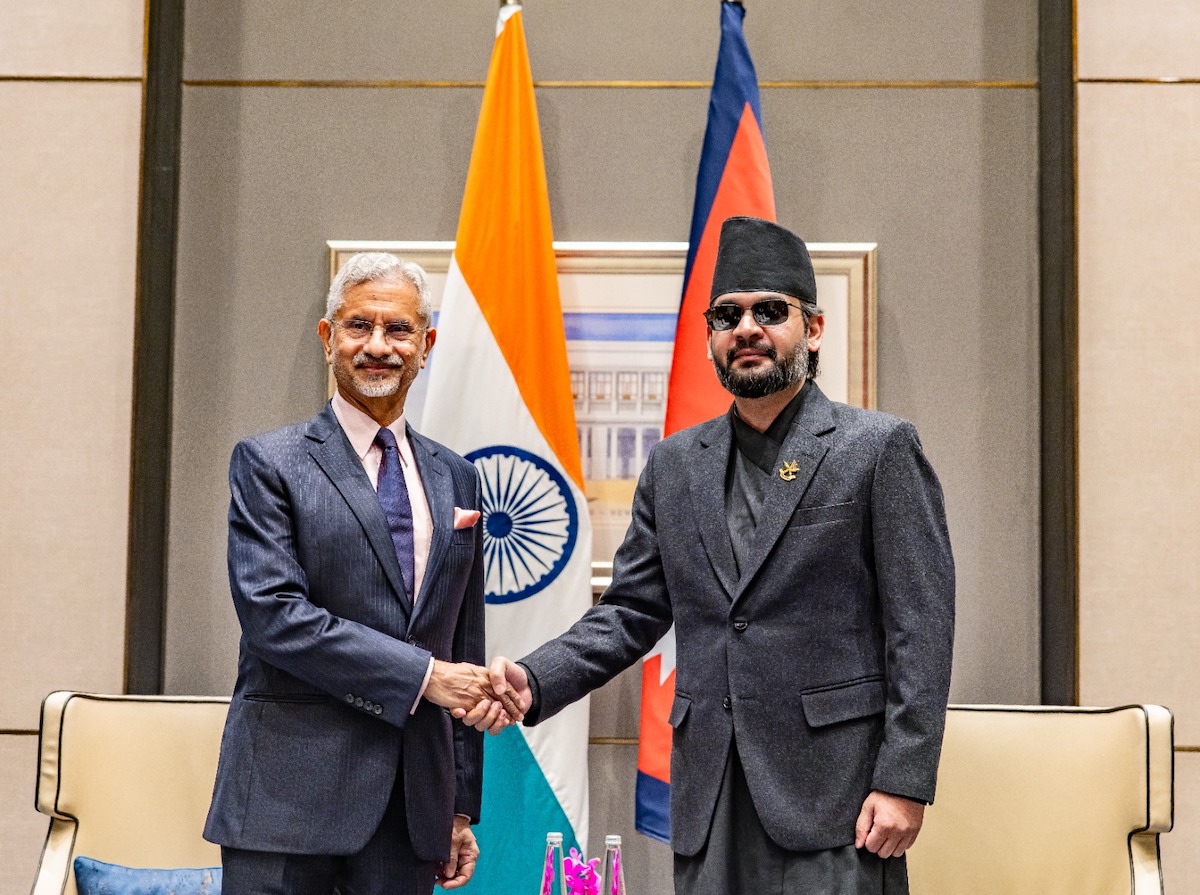
Prime Minister Balen Shah returned to Kathmandu from Delhi on Monday evening, concluding his first bilateral visit abroad. Shah had wanted the air route issue to be settled during his trip.
However, no agreement had been reached on the matter even by the time he departed Nepal for Delhi.
After Shah landed in Delhi, Indian External Affairs Minister S Jaishankar arrived at Hotel Taj to meet him.
The issue of air routes came up during their discussion. Jaishankar, however, began explaining the technical work that needed to be completed before India could provide additional air routes.
Shah interrupted him, saying, “Leaders should work on ideas; process should be followed by bureaucracy.”
Following this exchange, PM Shah did not want to hear further details about the technical aspects of the air route issue.
During the meeting, Shah also said that Nepali cricketers should be able to play in India more easily and Indian cricketers should likewise be able to play in Nepal. Jaishankar, however, pointed to procedural hurdles in this area as well.
According to a member of the Nepali delegation, PM Shah raised the issue of cricket with his Indian counterpart Narendra Modi as well.
Modi responded positively. He recounted an incident in which he had asked India's women's blind cricket team which country they found it difficult to play against, and the players had named Nepal.
Praising Nepal's progress in cricket, Modi said that the two countries could cooperate in the field of sports.
During the meeting, football cooperation was also discussed alongside cricket. On that subject, Modi suggested moving forward by involving Bhutan as well.
At the very beginning of the meeting, Modi praised Shah's address to the United Nations General Assembly.
“India is ready to help realize the dreams that Balen Shah and the young people of Nepal have envisioned,” Modi said. “I would be happy to see Balen's dreams come true.”
Modi also proposed joint film production and cooperation among content creators.
Following the bilateral talks, the two prime ministers held a one-on-one meeting, after which they addressed a joint press conference.
Modi then hosted a luncheon for the Nepali delegation. The two prime ministers sat at the same table. India's External Affairs Minister Jaishankar sat with Nepal's finance minister and foreign minister.
India's National Security Adviser Ajit Doval sat with Kumar Ben, PM Shah’s chief adviser. Doval spoke with Ben about the history of the Newar community in Kathmandu.
It was only after arriving at the venue that the Nepali delegation realized how thoroughly the Indian side had researched the members of the visiting team and their backgrounds.
Modi even presented Shah with a photograph of his father, Ram Narayan Shah, taken during the latter's postgraduate studies at Gujarat Ayurved University.
During the luncheon, a musical rendition of Ani Choying Drolma's song “Phoolko Aankhama Phoolai Sansara” was played. The Nepali delegation was busy eating and the music was playing softly, so they paid little attention to it. Modi gestured to Shah, drawing his attention to the song being played.
Modi spoke in Hindi during the meeting, while PM Shah spoke in English. However, Shah addressed the media in Nepali at the joint press conference.
At the press conference, Modi did not mention any agreement to provide Nepal with additional air routes. Shah, meanwhile, said that cities in the two countries should be connected through air links.
The joint statement issued at the conclusion of the visit, however, included an agreement to make the B345 air route via Bhairahawa, which Nepal currently uses to exit Kathmandu, bidirectional.
According to a member of the Nepali delegation, Foreign Minister Shishir Khanal played a key role in convincing the Indian side on the air route issue.
India had wanted a package agreement covering both the air route issue and the use of Nepali airspace for Bagdogra Airport. Nepal, too, had proposed making three air routes – Janakpur, Mahendranagar, and Bhairahawa – bidirectional.
However, the joint statement included only the provision to allow two-way use of the B345 air route over Bhairahawa.
The Nepali side has expressed happiness that India agreed to make the Bhairahawa route two-way without mentioning the Bagdogra issue.
A member of the visiting delegation said that the two sides had nevertheless agreed to resolve the issues concerning the use of designated airspace in eastern Nepal for Bagdogra Airport and the Bhairahawa air route within one month.
The Nepali side had told India that it was prepared to allow the use of its airspace for Bagdogra, but that a technical study would be necessary first.
“The joint statement includes a provision for a technical study. A decision on this issue will be made within a month,” the delegation member said. “We have already instructed the Civil Aviation Authority of Nepal to complete the technical work quickly.”