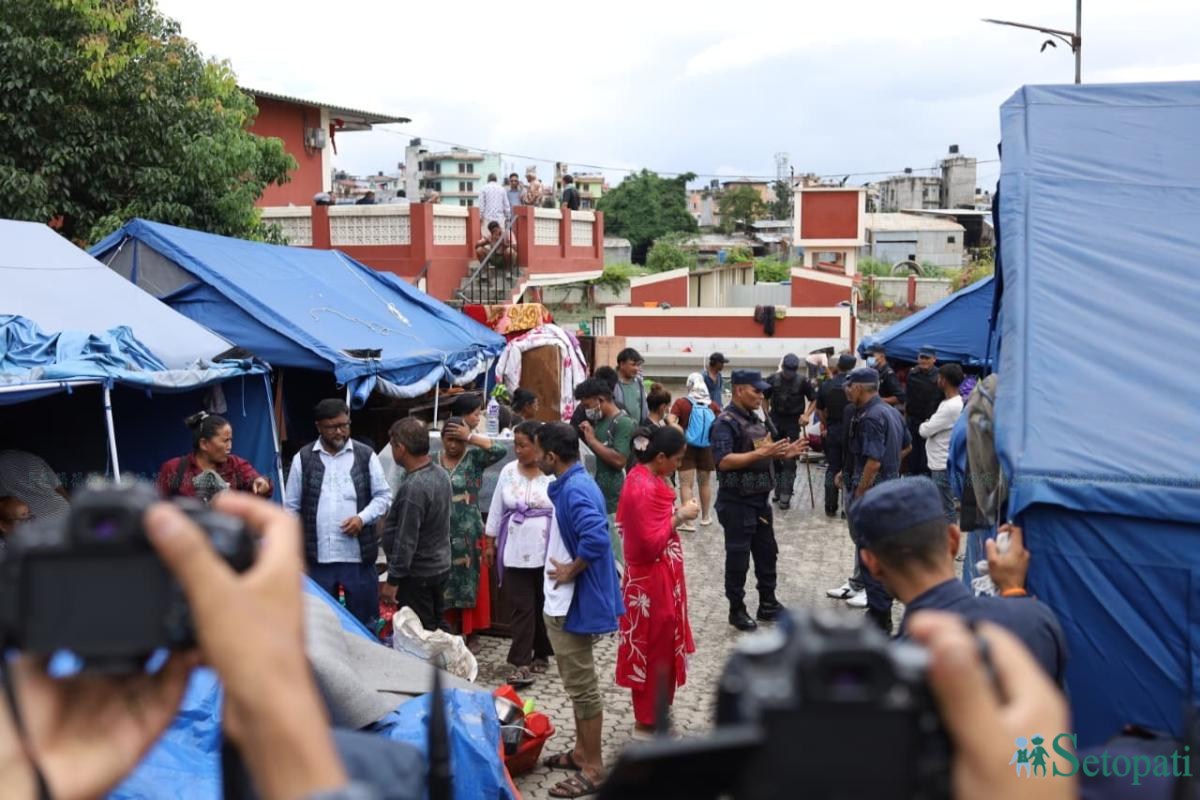
The Land Problem Resolution Committee has begun the process of relocating displaced landless squatters living along riverbanks in the Kathmandu Valley back to their respective home districts (local levels), where they have permanent addresses.
The committee, recently formed by the government led by Prime Minister Balen Shah, issued a 35-day notice on Monday, urging Dalit and landless squatters to submit applications in the prescribed format.
According to the notice, squatters living in Kathmandu must submit their applications to the High Powered Committee for Integrated Development of the Bagmati Civilization (HPCIDBC), while those from other districts must apply to their respective local governments.
Sanjeev Kumar Sah, the committee’s information officer and chief survey officer, said that since applications have been collected multiple times previously, this third notice has been issued to include genuine squatters who might have been left out.
“This notice is not only for those staying in holding centers but for squatters across the country,” Sah told Setopati. “The process of managing those who have already submitted applications in their home districts has already begun.”
According to Sah, the committee is currently forwarding the details of squatters collected by the HPCIDBC in the Kathmandu Valley to their local levels and districts of permanent residence.
The committee said that applications from 26 people have so far been forwarded to the respective local governments.
According to the committee, around 300,000 landless squatters and 950,000 informal settlers have submitted applications across the country. More than 2,600 squatters have been registered in Kathmandu alone.
"Even if we take those figures as a basis, we would need to provide them with suitable land for settlement in Kathmandu itself. However, there is no vacant land in Kathmandu," Sah said. "If we start providing land in Kathmandu to everyone simply because they reside here, it would be unfair to squatters living in other districts. Every citizen, regardless of where they live in the country, must be treated equally. Therefore, everyone is being managed in their home districts."
There is no legal provision under the Land Act that completely prevents the government from providing land to squatters in Kathmandu or other urban areas.
Under the law, up to 130 square meters of land may be provided for housing, or collective/integrated housing such as apartments may be constructed instead of distributing individual plots. However, land cannot be provided in urban areas for agricultural or farming purposes.
Sah said that the committee adopted the policy of managing squatters in their home districts due to the lack of sufficient land in the Kathmandu Valley.
The process of distributing land to squatters has been ongoing since 2020. Of the country's 753 local levels, most have already collected details of squatters by issuing notices up to three times.
The committee said that the current notice is for genuine squatters who were previously left out in 63 municipalities, and that no further applications will be accepted after this round.
“Once a squatter submits an application, the committee conducts a preliminary investigation and forwards it to the municipality concerned,” Sah explained the process. “The respective local government and district land committee will then publish a notice inviting claims in accordance with the procedure. The local government itself will verify whether the applicant is a genuine squatter.”
Once the local level verifies an applicant as a genuine squatter, the land will be surveyed and mapped, and land or housing will be arranged before a land ownership certificate is issued.