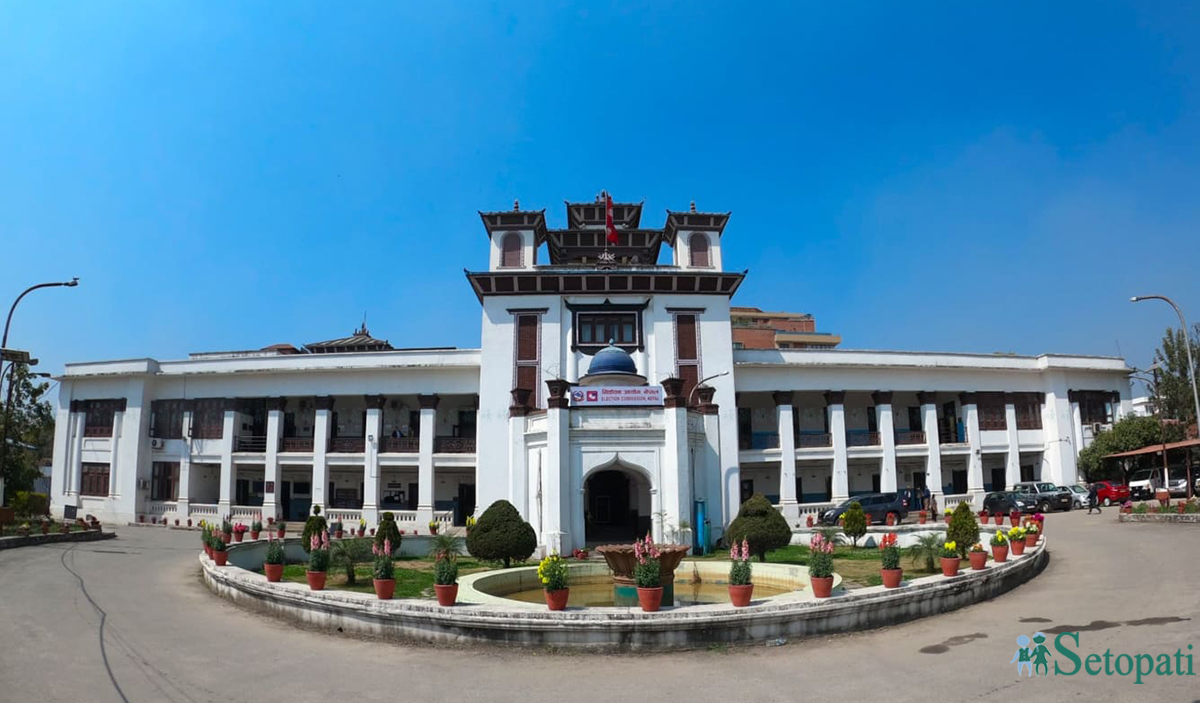
The Election Commission has begun consultations on whether local-level and provincial assembly elections should be held simultaneously or separately.
The commission has invited nationally recognized political parties for discussions on November 20.
The last local-level elections were held on May 13, 2022. The terms of the local governments formed after the election will expire on May 12, 2027.
Election commissioners have already met Home Minister Sudan Gurung and urged the government to clarify whether the local-level and provincial assembly elections will be held together or separately. The current terms of the provincial assemblies are due to expire on November 19, 2027.
A source at the Home Ministry said that the government is currently studying options for holding both elections simultaneously.
The first option is to hold both elections in October 2027.
The government is discussing a proposal to leave local governments vacant until October, even though their term ends in May, and hold both elections in October.
Under the Constitution, local governments cannot remain vacant for more than six months. The government's understanding is that holding elections in October would not create a constitutional problem.
According to the Home Ministry source, the Rastriya Swatantra Party (RSP) may have considered the potential political benefits of this proposal. The party reportedly believes that the influence of established political parties could weaken once the positions of mayors, deputy mayors, rural municipality chairpersons and vice-chairpersons, and ward chairpersons become vacant. Holding elections afterward could, in its assessment, give the RSP an advantage at the local level.
The second option is to hold local and provincial elections in April.
As local government positions are set to become vacant in May 2027, the Home Ministry is also discussing the option of holding both elections in April.
The government's plan is to hold the elections together rather than separately in May and November, as simultaneous elections could save Rs 3 billion to Rs 4 billion in security and election-related expenses.
“The temporary police personnel would otherwise have to be recruited twice. Uniforms would have to be purchased for them, and election staff would have to be paid allowances twice,” the Home Ministry source said. “A substantial amount of money could be saved by holding the elections at the same time. Instead, voting could be conducted in two phases to manage security arrangements.”
The government believes that holding elections in the Tarai and the hills on separate dates, with an interval of one to two weeks, could reduce costs.
Similarly, holding two separate elections would mean issuing the election code of conduct twice. During such periods, the government cannot award new contracts or make certain budget payments. The government believes this could also disrupt budget implementation.
“Let's hold the provincial assembly elections in April as well, but arrange for the terms of the newly elected provincial assemblies to begin only in November,” the Home Ministry source said. “This would save election expenses and also give those elected to the provincial assemblies time to prepare.”
National Assembly elections are currently held before the terms of sitting members expire. The government believes that adopting a similar arrangement would not create constitutional or political complications.
The government is preparing to amend the Local Level Election Act and the Provincial Assembly Election Act if necessary to facilitate either option.
The Local Level Election Act requires elections to be completed before local-level positions become vacant. The government is therefore preparing to remove such obstacles.
The Constitution stipulates that provincial assemblies have five-year terms. This has made it constitutionally difficult for the government to abruptly declare their terms over.
Previously, elections to the House of Representatives and provincial assemblies were held simultaneously. However, following the dissolution of the House of Representatives after the Gen Z movement in September 2025, a separate election for the House has already been held.
What does the Election Commission say?
The Election Commission, meanwhile, wants local-level elections to be held in April.
Schools close in April, when the academic year ends. The commission says holding elections during this period would not disrupt classes and school buildings could be used as polling stations.
The commission is also prepared to hold local-level and provincial assembly elections simultaneously, but says it would need sufficient time to make the necessary preparations.
For local-level elections, separate ballot papers must be printed for each ward based on the candidates contesting there. Vote counting must also be conducted at 753 locations. This requires extensive arrangements, including security and logistical preparations.
Local-level candidates have been urging the commission to shorten the election campaign period, arguing that a longer campaign increases their expenses. As a result, ballot papers would need to be printed within a short timeframe and transported to every ward, making time management a major challenge.
To shorten the election preparation period, the commission has begun discussions on printing ballot papers at the provincial level as well, using the presses of Gorkhapatra or other printing facilities. It believes this could reduce the time required for printing.
So far, ballot papers have been printed only by the Janak Education Materials Center Limited. However, March is also a busy period for the Center, as it is responsible for printing school textbooks.
The commission has also begun preparations for out-of-district voting in the upcoming local-level elections. It wants the government's commitment and the necessary procurement processes to be completed on time for that purpose.
For provincial assembly elections, the commission aims to introduce overseas voting as a pilot project.
The commission has already submitted a draft bill incorporating all these provisions to the Home Ministry.
During the meeting on November 20, the commission wants political parties to clarify their positions on overseas voting, out-of-district voting, and whether local-level and provincial assembly elections should be held simultaneously or separately.