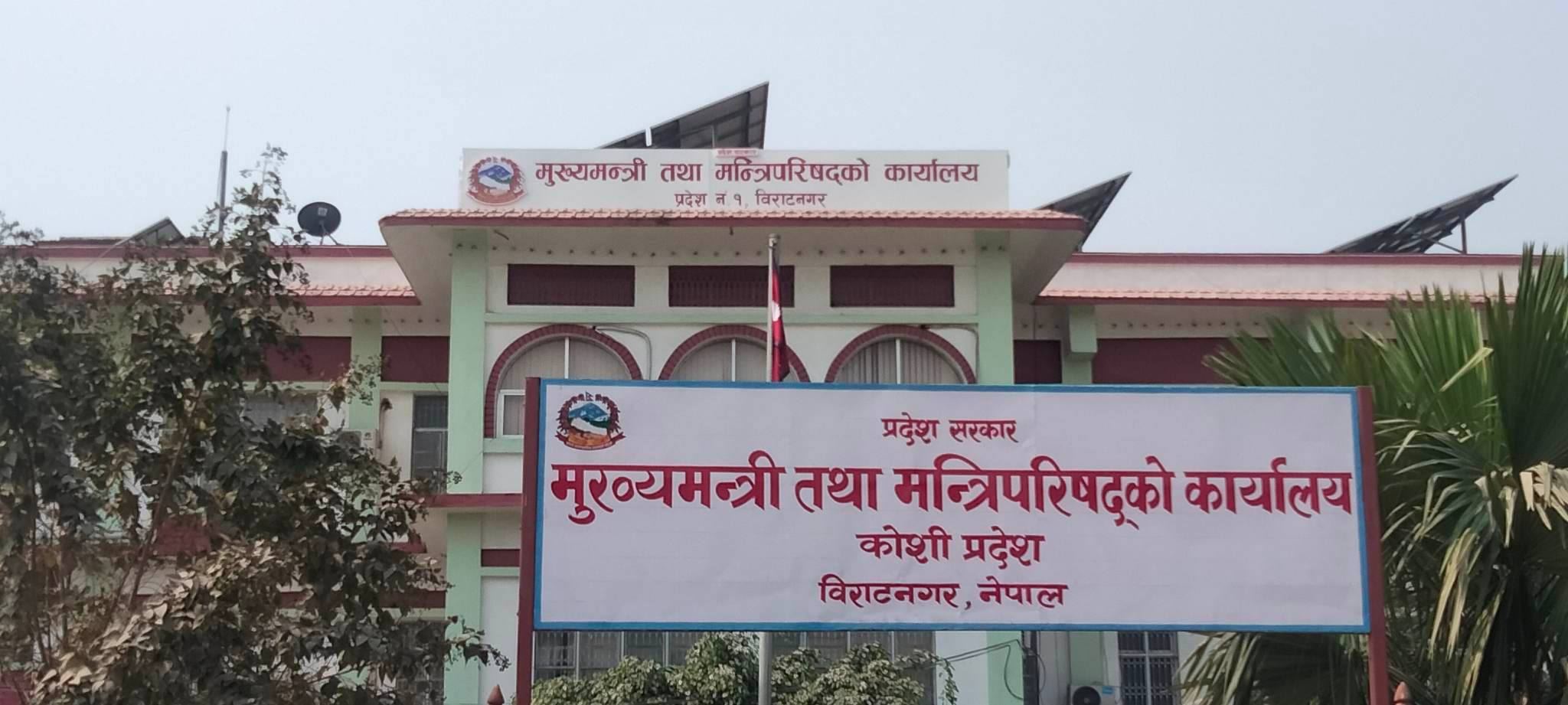
Koshi province has been left without a province chief following the departure of Parshuram Khapung upon completion of his five-year term.
No new province chief has been appointed to replace him.
Although the usual practice when a province chief's position becomes vacant is to assign the province chief of another province additional responsibility for overseeing the vacant province, no such arrangement has been made this time.
According to Sampurna Thapa, a section officer at the Office of the Province Chief in Koshi, Khapung's tenure lasted until November 9, after which he left office.
"His tenure was until November 9. It has ended. Previously, the province chief of a neighboring province would be assigned the responsibility. That has not happened this time either. Maybe something will be decided once the office reopens tomorrow," Thapa said.
Kiran Pokharel, press adviser to the president, also said that he currently had no information regarding the matter.
"This is new. There was also a holiday. Information will be available regarding this after the office opens tomorrow," he said.
Thus, with neither a new appointment being made nor responsibilities being delegated to another province's chief after the expiration of the term, the Office of the Province Chief in Koshi has been left without leadership.
The Office of the President has not made any formal decision regarding the matter.
The Constitution of Nepal has made provisions regarding the vacancy of the post of province chief and how to conduct operations in such situations.
According to Article 163 (3) of the Constitution, the tenure of a province chief is five years.
Similarly, Article 165 (1) (b) stipulates that the position of province chief becomes vacant upon completion of the term.
However, the Constitution also provides an alternative to ensure that constitutional functions in a province do not come to a halt simply because the position is vacant.
Article 165 (2) states that if the position of province chief in any province becomes vacant, the president may designate the province chief of another province to discharge the duties of the vacant province until a new appointment is made.
This means that the constitutional functions in Koshi can continue by assigning the responsibility to the province chief of another province until a new province chief is appointed. However, the president must make a formal designation for this purpose. The Constitution does not provide for the automatic transfer of such responsibilities.
Previously, when Khapung traveled abroad, the province chief of another province was assigned additional responsibility for Koshi during his absence.
When Khapung visited Malaysia in July 2025, the then province chief of Madhesh province was assigned responsibility for Koshi. At the time, the Office of the President made a formal decision.
This time, however, Khapung's tenure itself has expired. Despite the constitutional provision allowing the province chief of another province to be assigned responsibility until a new appointment is made, the Office of the Province Chief says it has received no information about any such decision.
The role of a province chief is linked to various constitutional processes involving the provincial government and provincial assembly.
Article 166 of the Constitution defines the functions, duties, and powers of province chiefs.
The province chief plays a role in constitutional procedures such as summoning and proroguing provincial assembly sessions, authenticating bills, and appointing the chief minister.
The position of province chief is not merely ceremonial; it is also a constitutional office representing the Government of Nepal at the provincial level within the federal governance system. Article 163 (1) of the Constitution provides for a province chief in each province as the representative of the Government of Nepal.
Khapung was appointed province chief of Koshi province in November 2021. He departed after completing his five-year tenure.
The president must now decide whether to appoint a new province chief on the recommendation of the government or assign the responsibility of Koshi to the province chief of another province until a new appointment is made.