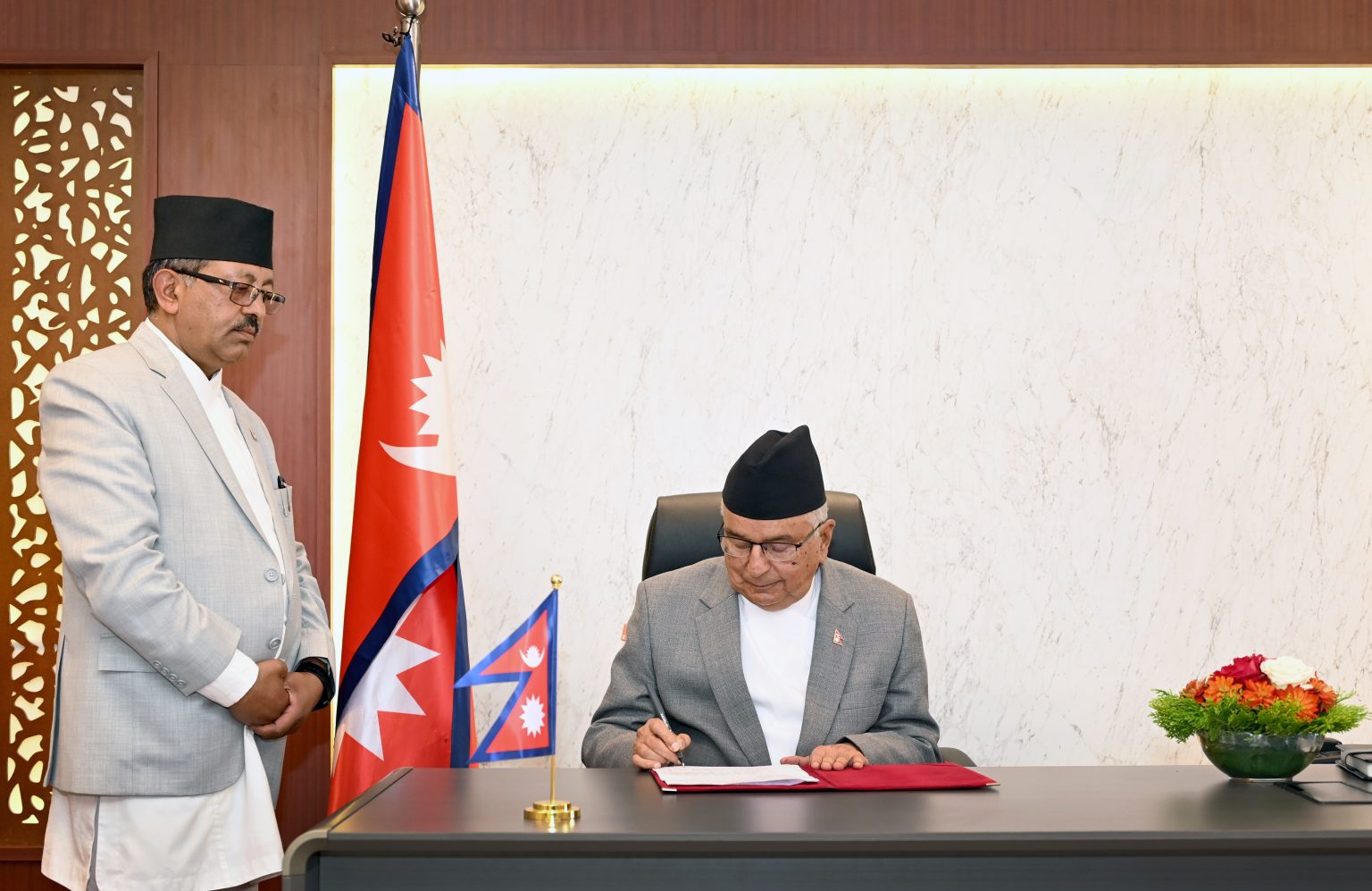
President Ram Chandra Paudel on Friday issued the Ordinance to Amend Some Nepal Acts Relating to Disaster, 2026, on the recommendation of the government.
The ordinance was recommended to the president to enable the Government of Nepal to collectively declare missing disaster victims dead. The Cabinet brought this ordinance to simplify the death registration process for individuals who went missing in the Bhotekoshi-Trishuli flood.
The ordinance stipulates that before the Government of Nepal declares a death, the executive committee of the National Disaster Risk Reduction and Management Authority (NDRRMA) must recommend it.
The home minister chairs the executive committee, with the infrastructure minister and federal affairs minister serving as members, alongside secretaries from all government ministries.
Additional members include the secretary of the Prime Minister’s Office, a lieutenant general of the Nepal Army, the chiefs of the Armed Police Force and Nepal Police, the executive director of Nepal Rastra Bank, the chairperson of the Nepal Telecommunications Authority, and representatives from various other institutions.
To make a decision, the local level of the missing person's permanent address must recommend and forward a decision from the respective District Disaster Risk Reduction and Management Committee to the NDRRMA.
For instance, Uttargaya Rural Municipality in Rasuwa must send the list of missing persons within its area to the NDRRMA's office at Singha Durbar.
Upon receiving the information, the NDRRMA will first publish the list in a national-level newspaper. If any person on the list is found alive or located, the individual or their immediate family will have seven days to file a claim.
If no individual or family makes a claim or objection within seven days, the executive committee chaired by the home minister will recommend the Government of Nepal to declare the person dead. For individuals declared dead under this process, a separate judicial declaration of death under prevailing laws will not be required.
However, if a person declared dead returns alive, the individual or their family must submit an application to revoke the death declaration. If the family of a person declared dead due to a disaster has received any relief or compensation, the government will not reclaim such compensation. Furthermore, if the wife of a person declared dead has remarried after the declaration, her marital relationship with the person declared deceased cannot be re-established.
Through the ordinance, the government has also amended the National Identity Card and Registration Act.
The amendment ordinance grants ward chairpersons and heads of local level the authority to report deaths.
If a family has no guardian or responsible relative to report a death, the head of the local level or the ward chairperson can report it. Under current laws, death reports must be filed by a father, mother, husband, wife, son, or daughter, and in their absence, by a family member who is at least 18 years old.
The government has ensured that no late fees will be charged when registering the death of a person killed by a disaster or declared dead by the NDRRMA executive committee.
The family, guardian, ward chairperson, or head of the local must report the death of such a person declared dead in a disaster to the local level of their permanent or temporary residence. The person filing the report must submit a photocopy of their citizenship certificate along with the name and other details of the person declared dead by the Government of Nepal.