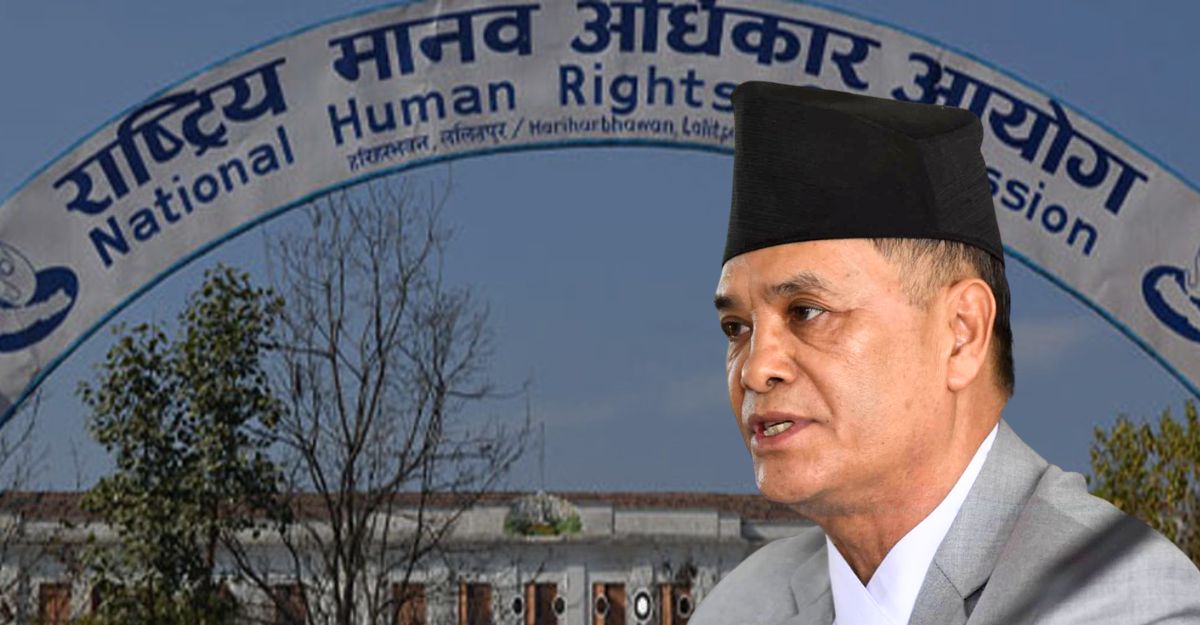
It has been found that police violated the Constitution and the law by refusing to allow a team from the National Human Rights Commission (NHRC) to even enter its office after the team went there to inquire about the detention of former chief justice Cholendra Shumsher Rana.
The Kathmandu Valley Crime Investigation Office arrested Rana at around 3 a.m. on Sunday, citing a “security threat.”
After receiving information about the arrest, an NHRC team led by Commissioner Manoj Duwadi visited the Crime Investigation Office in Teku. However, police did not allow the NHRC team to enter through the office gate.
NHRC Secretary Murari Prasad Kharel said that the police had disregarded the commission’s constitutional authority to visit and inquire into matters at any time and any place.
“The Constitution and law give us the right to visit and inquire at any detention facility at any time, in accordance with the law. But contrary to that, we were not allowed to enter the Crime Investigation Office in Teku today. We were not even told why we were denied entry,” he told Setopati.
Kharel said that this was the first time the commission had encountered a situation in which its team was prevented from entering while attempting to inquire about a person in custody.
The commission has the authority to investigate at any time whether the government has violated an individual’s human rights. Article 249 of the Constitution gives it the right to visit and inspect police offices, detention centers, prisons, and other such facilities, and to issue recommendations or directives where improvements are necessary.
Article 249(3) grants the commission four powers in the course of fulfilling its duty to promote and protect human rights.
Among them, clauses (b) and (c) give the commission the authority to enter any place without prior notice.
Article 249(3)(b) states that the commission may exercise its power “on receipt of information by the commission in any manner that a serious violation of human rights has already been committed or is going to be committed, to search any person or his or her residence or office, enter such residence or office without notice, and, in the course of making such search, take possession of any document, evidence or proof related with the violation of human rights.”
Similarly, Article 249(3)(c) allows the commission “in the event of necessity to take action immediately on receipt of information that the human rights of any person are being violated, to enter any government office or any other place without notice and rescue such person.”
Section 4 of the National Human Rights Commission Act also defines the commission’s functions, duties and powers.
Section 4(1)(a) of the Act allows the commission “to conduct or to cause to conduct inspections and monitoring of prisons, other agencies of the Government of Nepal, public institutions or private institutions or any other place for the protection of human rights, and to provide necessary suggestions or directives to the agency concerned with regard to the improvement to be made in such agency, institution or place for the protection of human rights.”
Similarly, under section Section 4(1)(g), the human rights body may carry out or cause to be carried out other activities as may be deemed necessary and appropriate for the protection and promotion of human rights.
Rights activists say that taking any person into custody without an arrest warrant is not only contrary to the Constitution and law, but also constitutes a human rights violation. They say that when a human rights violation occurs, the commission has the authority to conduct an unhindered inspection and order issue directives to prevent it.
Senior Advocate Raju Chapagain said that after learning that Rana had been taken into custody while he was asleep on the grounds that he was being provided security, the commission had both a constitutional right and a duty to look into the matter.
“When police, as an institution exercising state power, do not act according to law, the fundamental and other rights of individuals are violated. It is the Human Rights Commission’s responsibility to investigate and monitor whether police actions and conduct have resulted in human rights violations,” he said. “Blocking the commission, denying it entry into their offices is a violation of the Constitution by the police.”
According to NHRC Secretary Kharel, it is not unusual for the commission’s team to be asked to wait for 10-15 minutes under normal circumstances. However, he said, it was objectionable that the team was not allowed to enter even after half an hour and was not given any explanation for it.
“When we asked for the reason, the security personnel at the gate said nothing other than, ‘There are orders from above.’ The assistant sub-inspector stationed there did not even have a nameplate. We have also objected to that,” Kharel said.
The NHRC team also contacted SSP Santosh Khadka, who was at the office, by telephone to inquire about the incident. Khadka reportedly said that he had just woken up because he had not slept the previous night. Kharel said that they were unable to reach him by phone afterward.
The team also attempted to contact Inspector General of Police Dan Bahadur Karki, but he did not answer the phone, according to Kharel.
“Later, when we sent a message, the response was, ‘Oh sir, that should not have happened,’” Kharel said. “But we still could not speak by phone afterward.”
Kharel emphasized that the NHRC team had gone to the office not for any political purpose but simply to find out why Rana had been arrested and what his human rights situation was.
“We have no need to engage in politics over any issue. We had gone only to find out whether the arrest was in accordance with the law and what investigation he had been arrested for,” he said.
He added: “We have not been able to understand why this was done. We will have to look into it later. The commission will also issue a statement. We will ask the agency concerned why the commission was not allowed to enter.”