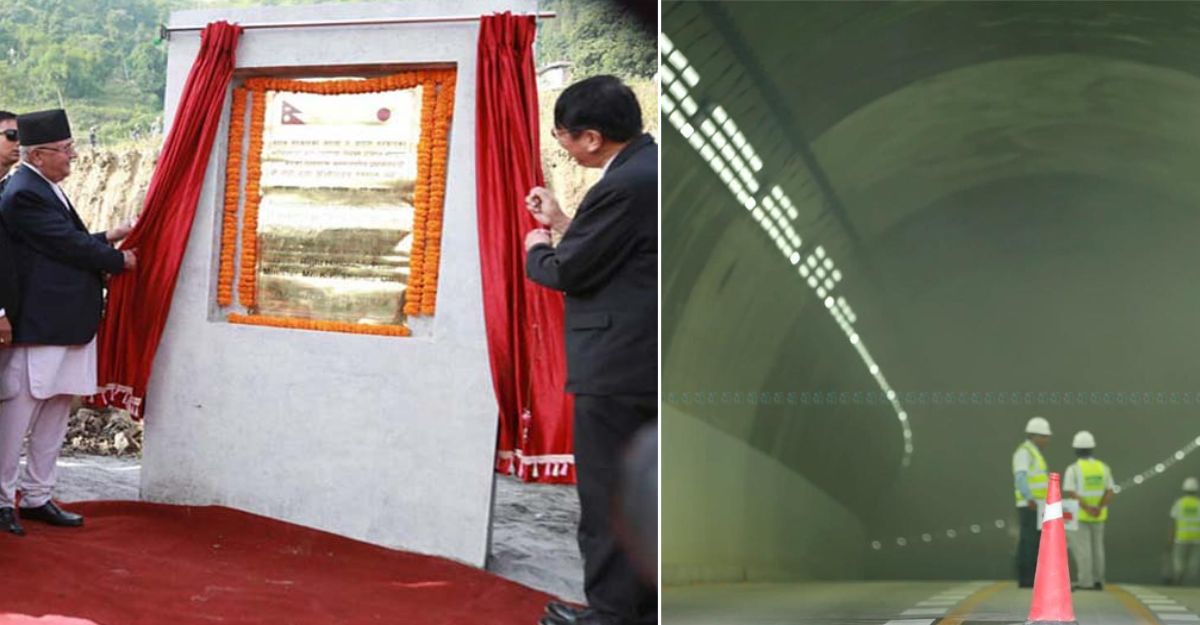
Nagdhunga Tunnel, Nepal’s first modern tunnel which is set to be inaugurated by allowing emergency vehicles to pass through it, is currently making headlines over the removal of a plaque from the project site.
The tunnel is scheduled to be inaugurated on Monday, by initially allowing ambulances, fire engines, and vehicles belonging to security agencies to enter.
The issue has sparked various comments after it became public on the eve of the inauguration that a plaque bearing the name of then prime minister KP Sharma Oli had been removed from the project site.
The Nagdhunga Tunnel was inaugurated for construction by then prime minister Oli on October 21, 2019. The plaque unveiled by Oli during the groundbreaking ceremony has since been removed from the project site. Project officials say it appears unlikely that the plaque will be reinstalled at its original location during Monday’s inauguration ceremony.
We asked the project’s deputy director, Sanjay Panthi, why and when the plaque bearing Oli’s name was removed from the tunnel project.
Panthi explained that the plaque had previously been removed from the project site and stored at the Department of Roads because it would hinder construction work.
“Plaques are usually removed during construction of such large projects and kept in a safe place because they can obstruct the work. We had also kept it safely at the Department of Roads,” he told Setopati. “But when the department was set on fire, the plaque was also there. We searched for it to bring it back to the project, but could not find it.”
He claimed that the plaque could not be located because the Department of Roads’ structures were damaged when they were set on fire during the Gen Z movement.
Rejecting claims of pressure from higher authorities to remove the plaque, Panthi said, “We have not received any such instruction from higher authorities. We searched for the plaque we had kept safely at the Department of Roads because we wanted to bring it back to the project site for the inauguration ceremony. But since we could not find it, we have not been able to put it back.”
He said that the plaque would be brought to the inauguration ceremony and reinstalled if it is found.
The Department of Roads and Japanese construction company Hazama Ando Corporation had signed an agreement to complete the project by April 2023. However, the project is set to come into operation only now as the construction was delayed due to the COVID-19 pandemic, various technical problems, and local obstruction, among other reasons.
A Chinese joint-venture company, Yuxin-ART JV, has been assigned responsibility for operating the tunnel.
According to the project, only emergency vehicles, including ambulances, fire engines, and vehicles belonging to Nepal Police and other security agencies, will initially be allowed to enter from Monday.
Motorcycles, three-wheelers, and vehicles carrying highly flammable or explosive substances, including petrol, diesel and LPG, will not be allowed to enter. Pedestrians will also not be allowed to use the tunnel.
Panthi said that other eligible vehicles will be allowed to enter in phases. According to him, no toll will be charged for approximately 15 days. The toll system will be discussed thereafter.
Cars, vans, pickups, tractors, microbuses, and other light vehicles will be charged Rs 65 when entering Kathmandu and Rs 60 when exiting.
Similarly, the toll for minibuses and mini-tippers/trucks has been set at Rs 115 when entering and Rs 80 when exiting. Buses and trucks with a single rear axle will be charged Rs 260 when entering and Rs 200 when exiting.
Multi-axle trucks and vehicles, as well as heavy equipment, will be charged Rs 600 when entering and Rs 250 when exiting.
The tunnel connects Balambu on the Kathmandu side with the Prithvi Highway at Sisnekhola in Dhading. The current road distance from Sisnekhola to Balambu is 8 kilometers. After the tunnel comes into operation, the distance between Sisnekhola and Balambu will be 5 kilometers. The tunnel will reduce the distance by 2.8 kilometers.
Although the difference between the tunnel and the existing road may not appear significant in terms of distance, the tunnel is expected to save a substantial amount of fuel.
Traffic jams are a daily problem on the route from Sisnekhola to Nagdhunga. The tunnel is expected to eliminate this problem. Traveling to Kathmandu through the tunnel is expected to save 33 minutes, while traveling out of Kathmandu is expected to save 23 minutes.
The project consists of two tunnels: a main tunnel and an emergency rescue tunnel. The rescue tunnel is 2,557 meters long. Vehicles will travel in both directions through the main tunnel. In the event of an accident, rescue operations can be carried out immediately.
The rescue tunnel is located 30 meters from the main tunnel. Its roadway will be 4.5 meters wide. The tunnel will be equipped with ventilation systems and jet fans. Vehicles such as fire engines and ambulances will be allowed to use this tunnel during emergencies.
Seven cross-passages have been constructed between the main and rescue tunnels. In the event of an accident or other emergency inside the tunnel, ambulances, fire engines, and other vehicles can move through these cross-passages.
The project was financed through approximately Rs 22 billion in concessional loans from Japan and Rs 6 billion invested by the Government of Nepal.