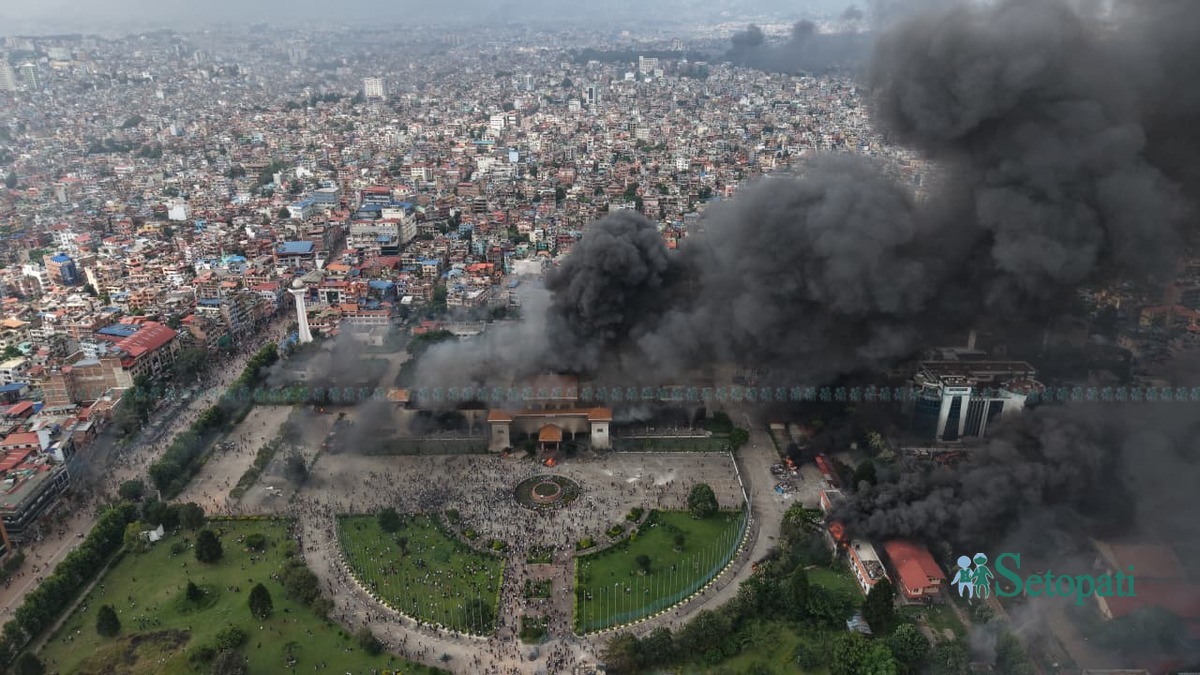
As the government, political parties, and Gen-Z leaders gear up for the upcoming elections on March 5, the arrest of individuals involved in the vandalism and arson of public and private property on September 9, 2025 has noticeably cooled down.
This shift has raised questions about whether the pursuit of justice has been sidelined by election fever. Recently, former chief justice Kalyan Shrestha pointed out in a viral video that there is a fundamental difference between the events of September 8 and 9, arguing that the latter involved criminal acts that remain unaddressed. Shrestha suggested that the current administration might be fostering a culture of impunity to smooth the way for the elections, asserting that no commission of inquiry should legally suspend the operation of criminal law.
In response to these concerns, Nepal Police Spokesperson DIG Abi Narayan Kafle clarified that the process of filing complaints, making arrests, and conducting investigations has not stopped. While he admitted the number of arrests has decreased, he attributed this to the fact that most primary suspects were taken into custody in the initial phase. DIG Kafle emphasized that if there is concrete evidence or identification of individuals involved in criminal offenses, law enforcement continues to act regardless of the political climate.
A significant factor in this dynamic is the 10-point agreement reached between the government and Gen-Z leaders on December 10, 2025. At that time, activists complained that youth were being arrested simply for participating in protests based on photos and videos. The government subsequently agreed not to arrest individuals solely for exercising their right to protest.
According to the agreement, a commission of inquiry was tasked with screening cases within 15 days to distinguish between peaceful protesters and those involved in serious criminal activities or organized gangs. DIG Kafle clarified that the police have never prosecuted anyone merely for protesting, but rather for documented acts of vandalism, murder, and arson.
Data from the Police Headquarters reveals that 510 cases related to the September 9 incidents have been registered nationwide, with 331 already resolved. Out of 935 individuals arrested across the country, 177 were sent to judicial custody, while 13 were released.
Currently, 19 individuals remain in police custody for ongoing investigations, including 17 the Kathmandu Valley and two in Koshi Province.
Kathmandu has seen the highest volume of legal action, with 226 cases and 410 arrests, including those related to the high-profile murders of three police officers in Maharajgunj and Koteshwor.
Geographically, the legal response varies across provinces. Koshi saw 112 arrests across 61 cases, while Madhesh Province has 20 pending cases out of 26 registered. Bagmati and Gandaki provinces both saw 124 arrests each, with Gandaki reporting that ten absconding suspects eventually surrendered to the court. Lumbini recorded 111 arrests, while Karnali and Far West saw minimal cases and arrests.
The charges being pursued range from criminal mischief and theft to more severe crimes like attempted murder, drug offenses, and homicide, highlighting the serious nature of the incidents that the authorities insist are still being actively prosecuted despite the slowing pace.