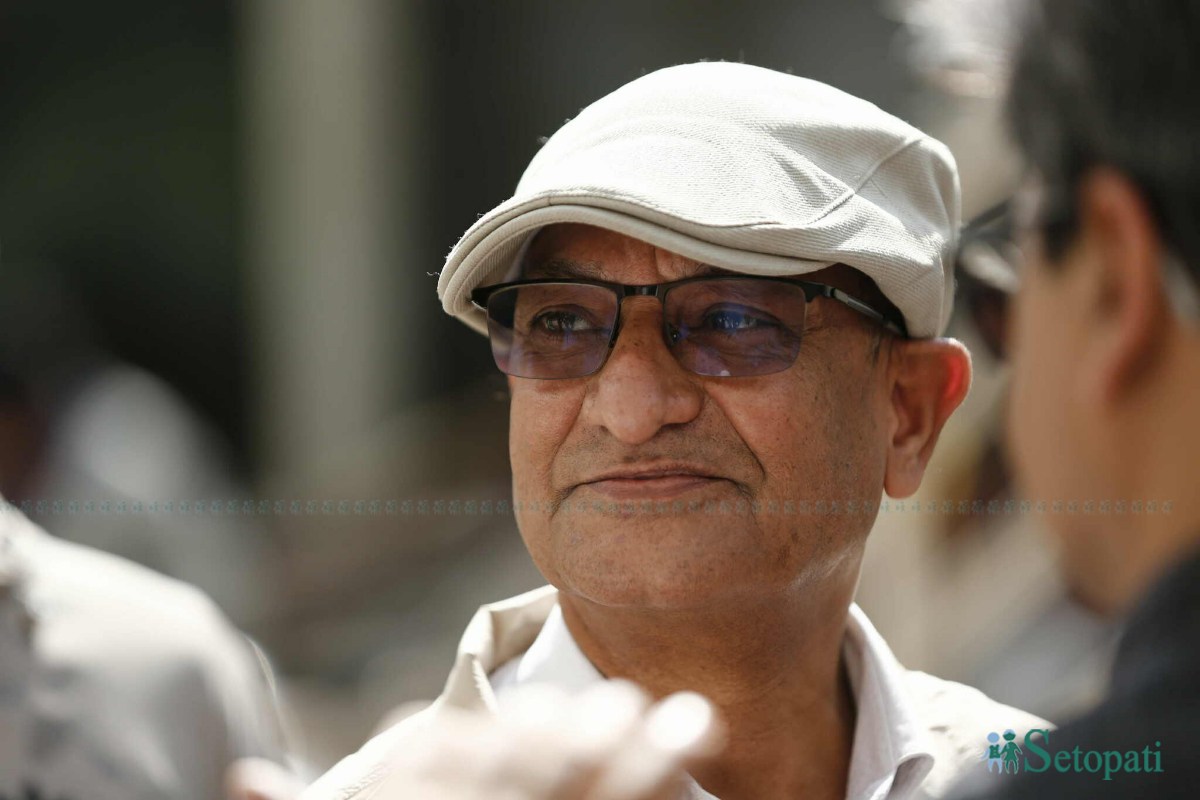
Former home minister and Nepali Congress leader Ramesh Lekhak has revealed that he was never officially informed about the restrictions placed on his movement or the withholding of his passport.
Providing a written statement on Monday to the inquiry commission investigating the incidents of September 8 and 9, Lekhak emphasized his unwavering commitment to the rule of law.
"I have an unwavering belief that in a democracy, the country must function in accordance with the rule of law as provided by the Constitution and other prevailing laws," he stated. "It is with great sadness that I must say, I only learned through the media that the government, upon the commission's recommendation three months ago, had restricted my movement to within the Kathmandu Valley and withheld my passport. I have not been given any written or verbal information whatsoever as to under which provision of the country's Constitution or other prevailing laws, for what purpose, with what justification, and for what duration the movement restriction and passport withholding were imposed."
He also stated that he was not given any opportunity to inquire or respond about this matter.
"I believed that being informed before and after a decision on this matter falls within the principles of rule of law and fair hearing, but that did not happen. Making such decisions or actions without reason and without information is also against the Constitution and legal provisions. Therefore, I wish to draw the special attention of all bodies including the commission and the government to this matter," Lekhak said.
The former home minister also clarified that he never ordered the use of force during the Gen Z movement, noting that there is no law authorizing a home minister to give such an order.
Lekhak said that his own home and private property were set on fire during the unrest.
"The house in Kathmandu was built from earnings, including ancestral property. The pain of seeing your ancestral property turned to ashes is something only the sufferer can truly understand,'" he said. "To protect my elderly and critically ill mother, who constantly required oxygen, from the protestors' attack on September 9, we had to rush her to hospital after keeping her without oxygen for a long period. That’s why she passed away a few days later. Nearly five thousand books and historical documents, including important documents collected and notes made by myself during formal and informal talks, dialogues, discussions, or agreements on the peace talks between the then government (seven parties) and the Maoists after the ten-year armed conflict, and during the drafting of the interim constitution and the current constitution, were destroyed by fire. Nevertheless, at a time when the entire country was reduced to ashes, I have considered my personal pain as negligible."