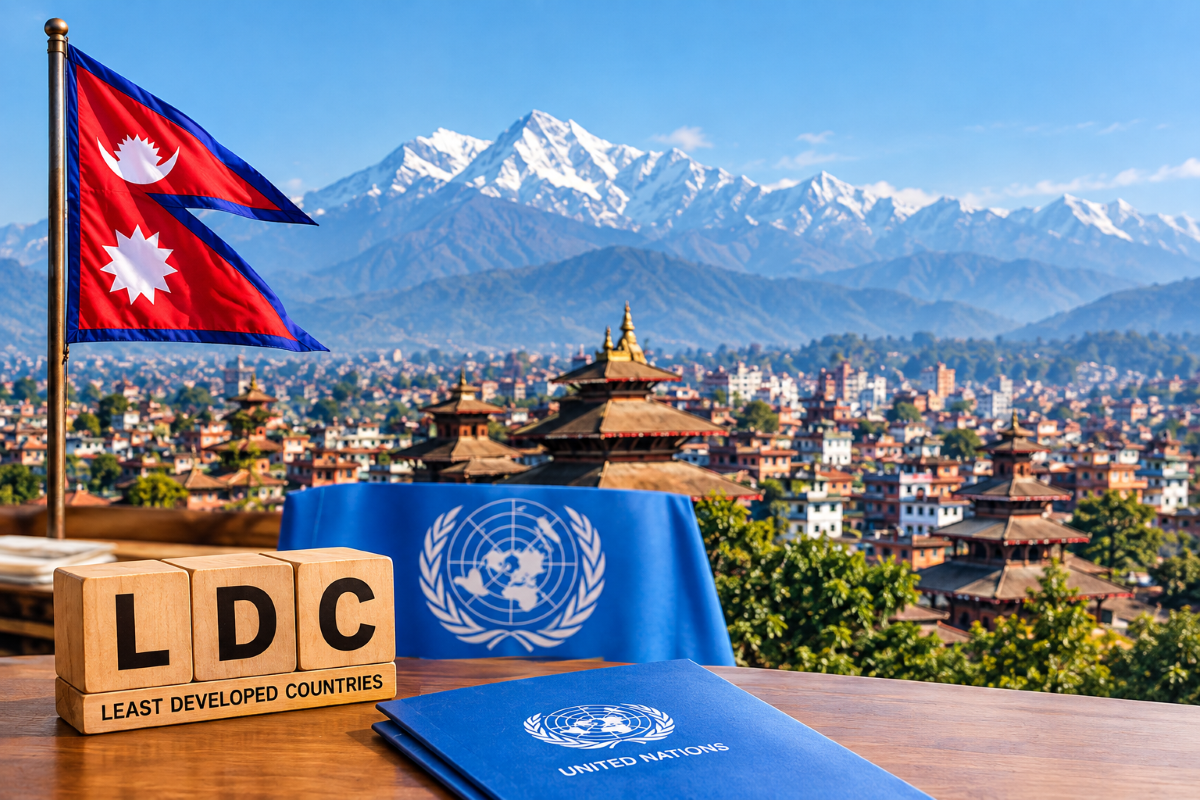
Nepal has yet to graduate from the list of Least Developed Countries (LDCs), even 11 years after meeting the criteria required for graduation. The country has received a second extension, citing inadequate preparations for the transition.
The United Nations General Assembly has granted Nepal an additional three years to graduate from the LDC category.
Nepal will now graduate from the list on November 24, 2029. The country had previously been scheduled to graduate on November 24, 2026.
Nepal met two of the three graduation criteria as early as 2015. After meeting the same criteria again in 2018, the UN Committee for Development Policy was in a position to advance the graduation process.
However, citing the impact of the 2015 earthquake and subsequent natural disasters on the economy, the government requested that the graduation process not proceed immediately. The Committee for Development Policy postponed its recommendation, raising concerns about the sustainability of Nepal’s economic and development achievements.
In 2021, the committee recommended Nepal for graduation once again. By then, Nepal had met two of the criteria in three consecutive reviews. However, the government requested additional preparation time because of the impact of the COVID-19 pandemic on the economy and social sectors.
Normally, countries are given a three-year preparatory period before graduation. However, considering the effects of the COVID-19 pandemic, the UN General Assembly decided on November 24, 2021, to grant Nepal, Bangladesh, and Laos a five-year preparatory period. Nepal’s graduation date was subsequently set for November 24, 2026.
Now, the country has been granted another three years.
This time, too, Nepal did not request an extension because it had failed to meet the graduation criteria. Instead, the government sought additional time, arguing that the country was not adequately prepared to cope with the loss of international benefits and the potential economic consequences of graduation.
Nepal formally requested an extension of the preparatory period from the UN Committee for Development Policy in May 2026.
The government cited tensions in the Middle East, disruptions to international supply chains, potential impacts on remittances, and climate-related disasters as key risks.
The government also expressed concern that Nepali goods could lose the duty-free and quota-free market access they currently enjoy after graduation. It noted that this could weaken export competitiveness and threaten employment in the manufacturing sector.
Nepal has also been unable to fully implement its Smooth Transition Strategy, designed to mitigate the effects of graduation. The government argued that additional time was necessary because of weaknesses in productive capacity, export diversification, and institutional preparedness.
On July 21, the UN Economic and Social Council accepted the Committee for Development Policy’s assessment of Nepal’s situation and recommended that the General Assembly grant the country additional time.
The United Nations has established three criteria for graduation from the LDC category: gross national income per capita, the Human Assets Index, and the Economic and Environmental Vulnerability Index.
The first criterion is gross national income (GNI) per capita, which reflects a country’s average income and available economic resources. In the 2024 review, the graduation threshold was US$1,306.
The second is the Human Assets Index (HAI), which measures the health and education status of a country’s population. It includes indicators such as child and maternal health, nutrition, school enrollment, and literacy. The graduation threshold is 66 points, with a higher score indicating better performance.
The third is the Economic and Environmental Vulnerability Index (EVI), which measures a country’s vulnerability to external economic shocks, natural disasters, and environmental risks. The graduation threshold is 32 points, with a lower score indicating better performance.
A country must meet at least two of these three criteria in two consecutive triennial reviews. In such cases, the UN Committee for Development Policy may recommend the country for graduation.
Nepal currently meets all three criteria. According to the UN’s assessment of the country’s graduation preparedness, Nepal’s GNI per capita reached US$1,404 in 2025, above the graduation threshold of US$1,306.
Similarly, Nepal’s Human Assets Index stands at 77.58 points, exceeding the required threshold of 66. Its Economic and Environmental Vulnerability Index is 28.96, below the threshold of 32.
However, meeting all three criteria for graduation and being capable of managing the economic challenges that follow are two different things. Nepal has therefore sought additional time to prepare for the transition.
Nepal has been on the UN’s list of Least Developed Countries since 1971.