Just a day after the government claimed that diplomatic efforts were underway to remove obstacles to tea exports, another 30 tea factories and hundreds of tea gardens have shut down.
Processed tea products from Nepal that reached the Indian market have been stranded in warehouses for over a month under the pretext of laboratory testing. As exports have come to a standstill because of this issue, tea factories and plantations have been forced to close.
Since June 15, more than 73 factories and hundreds of tea gardens in Ilam have remained shut. From Thursday, factories and tea gardens in Jhapa have also closed, effectively bringing Nepal’s tea sector to a complete halt.
While the government claims it is making efforts to remove these obstacles, stakeholders say they are completely unaware of any such efforts.
Speaking in the House of Representatives on Wednesday, Minister for Industry, Commerce, and Supplies Gauri Kumari Yadav claimed that the government was engaged in diplomatic efforts to remove barriers affecting Nepali tea exports to India.
She further claimed that initiatives were also being taken to address market access problems affecting other agricultural products.
However, the very next day after the minister made these claims in Parliament, tea factories and plantations in Jhapa also shut down. This has put the livelihoods of approximately 65,000 workers at risk.
“With more than 30 factories and hundreds of tea gardens in Jhapa also closing from Thursday, Nepal’s tea sector has now come to a complete standstill,” said Aditya Parajuli, president of the Nepal Tea Producers Association. "Jhapa and Ilam are the main hubs of Nepal's tea industry. All activities, from plucking green leaves to processing and packaging, have stopped."
While Minister Yadav claimed in Parliament that diplomatic efforts are underway to resolve the issue, government bodies associated with the tea sector appear unaware of it.
Netra Prasad Subedi, spokesperson for the Ministry of Industry, Commerce, and Supplies, said he had been informed that special discussions on the issue were taking place at the Office of the Prime Minister and Council of Ministers. However, he admitted that he was not aware of the details.
"It initially seemed to be moving toward a resolution, but with the situation forcing closure of factories, the issue has received greater priority," he told Setopati. "I have been informed that the Prime Minister's Office is taking it seriously."
However, he could not provide clear information regarding the dialogue with India, the status of diplomatic efforts, or potential solutions.
Deepak Khanal, director of the National Tea and Coffee Development Board, also said that the Prime Minister’s Office, the Industry Ministry, the Agriculture Ministry, and the Tea and Coffee Development Board were actively working to resolve the issue. He, however, admitted that no concrete achievements had been made yet.
"The government is fully aware. Discussions have also been held with business people at the Prime Minister's Office," he said. "Currently, discussions are taking place on two levels: how to reopen factories immediately and how to find a long-term solution. Since I am not participating in the discussions myself, I do not have further information."
While government bodies claim to be seeking solutions, industrialists complain that they see no results.
According to them, the obstruction in Nepali tea exports is caused by new procedural arrangements implemented by the Indian Tea Board. Under the new system, tea arriving in India is stored in warehouses, samples are tested, and sales are prohibited until laboratory reports are issued. Producers say this has disrupted the entire trade cycle.
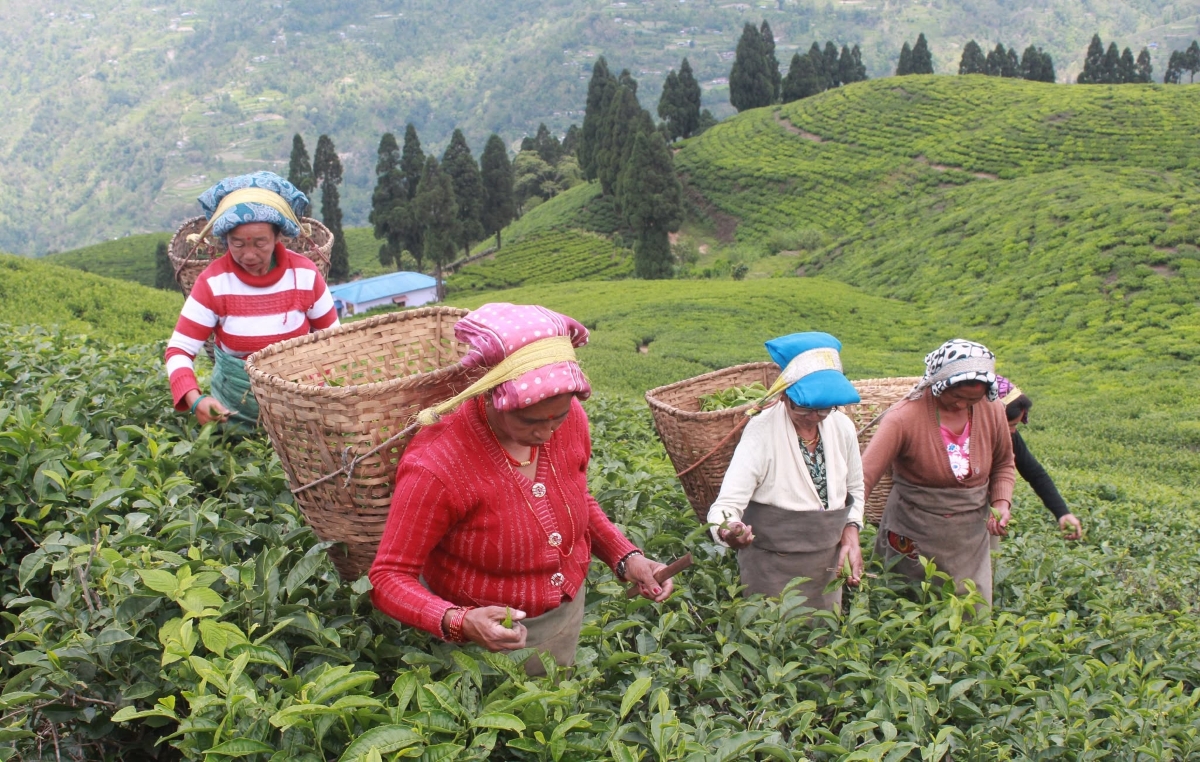
The impact is no longer limited to factories – it has spread to tea gardens as well. With factories closed during the peak season, farmers have stopped plucking green tea leaves. Thousands of farmers in Ilam and Jhapa now face the risk of seeing their crops go to waste in the fields. Daily wage laborers have also lost their source of income.
According to Gyani Limbu, vice-president of the Suryodaya Tea Producers Association, the shutdown of Jhapa’s tea sector has paralyzed the entire industry. "We have not received any assurance or information about initiatives from the government so far," he said.
Currently, around 250,000 kilograms of orthodox tea exported from Ilam is stranded in warehouses across the Indian border. Including CTC tea, the volume exceeds 300,000 kilograms. An additional 1 to 1.5 million kilograms of processed tea is sitting unsold in factories across Nepal.
Tea cultivation in Nepal currently covers 20,602 hectares. The sector generates more than Rs 4.5 billion in foreign currency earnings annually, but it is now facing a severe crisis due to the export blockade.
Industrialists say that while the crisis deepens, the only response they continue to hear from the government is that discussions are ongoing and efforts are being made.
“Factories have already shut down. Farmers’ tea leaves are over-maturing in the fields. Workers’ livelihoods are in jeopardy,” said Aditya Parajuli. “The government keeps saying that efforts are ongoing. But the question of when a solution will emerge remains unanswered.”