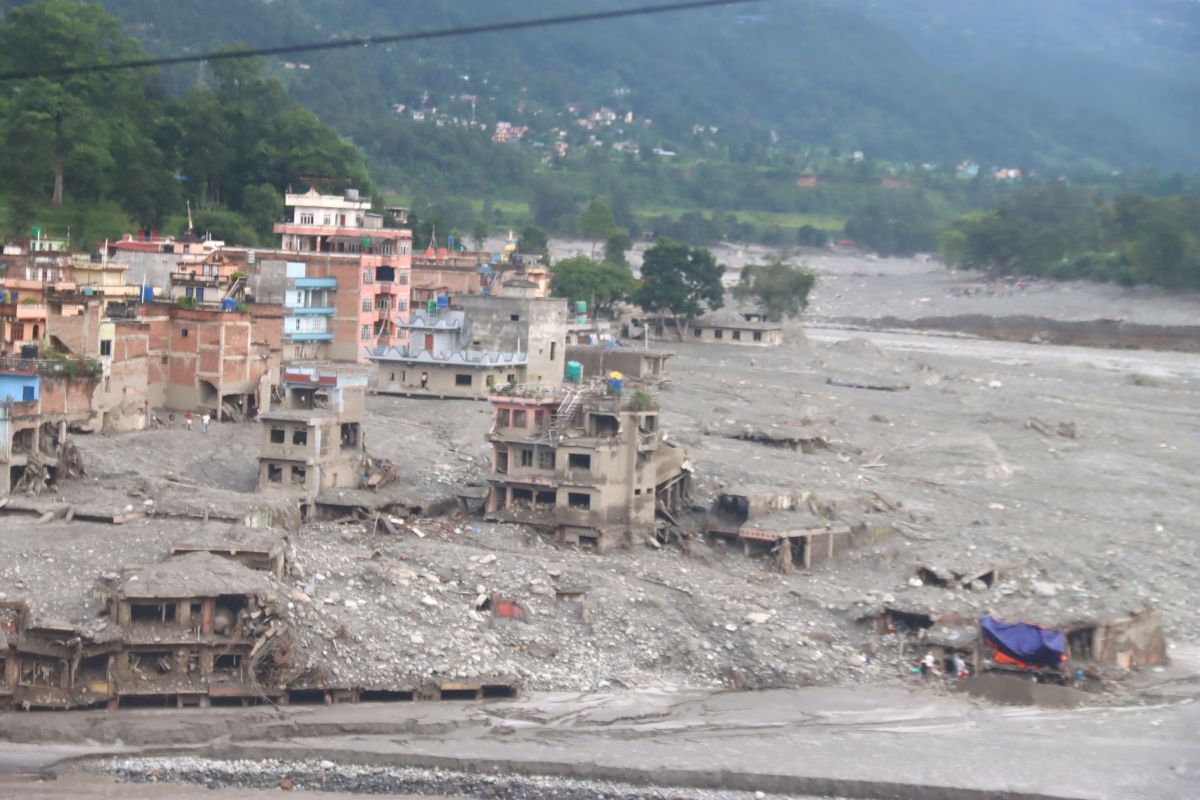
Preliminary details have been made public showing that property belonging to households and business establishments suffered damages worth Rs 79.17 billion due to the devastating flood in the Bhotekoshi River in Rasuwa on August 26.
The figure comes from a household survey conducted under the Post-Disaster Needs Assessment (PDNA) prepared by the National Planning Commission.
According to the commission’s preliminary findings, the flood caused losses worth Rs 69.57 billion to household property and Rs 9.60 billion to business property.
The assessment covers damage to houses, land, crops, livestock, vehicles, and household belongings. However, damage to roads, hydropower projects, public infrastructure, productive sectors, and the environment are not included in these figures.
Among household assets, land accounted for the largest share of losses.
The flood buried 507.97 hectares of land belonging to 3,610 families, causing estimated losses of Rs 35.44 billion. In addition, losses were estimated at Rs 13.26 billion based on the value of residential plots and Rs 11.95 billion based on the construction costs of houses.
The flood also damaged valuables, cultural objects, and archaeological items belonging to 2,330 families, causing losses estimated at Rs 5.02 billion.
According to the commission’s report, household goods belonging to 3,187 families suffered losses worth Rs 1.45 billion, while vehicles belonging to 1,115 families sustained damage worth Rs 1.24 billion.
Similarly, losses were estimated at Rs 663.5 million for temporary household items, Rs 232.1 million for crops, Rs 214.2 million for livestock and fish farming, and Rs 104.1 million for stored food grains.
The commission conducted the survey across 15 local levels in Rasuwa, Nuwakot, Dhading, and Gorkha districts. A total of 58 teams comprising 156 personnel were mobilized for the survey.
Information on 7,316 households and businesses was collected using digital tablets and an online application. Of these, 6,817 households and 1,638 business establishments were identified as having been affected by the flood.
The disaster affected 32,872 people across the four districts. Nuwakot recorded the highest number of affected people at 17,954, followed by Rasuwa with 9,676, Dhading with 4,584, and Gorkha with 658.
The flood damaged 4,151 building structures belonging to 3,967 property owners. Of these, 2,989 structures were completely washed away or destroyed, while 508 were filled with mud and silt. A total of 3,194 structures were rendered unusable.
Among business establishments, 774 wholesale and retail businesses, 337 hotels and restaurants, and 166 agricultural enterprises were affected. A total of 403 vehicles belonging to businesses sustained damage worth Rs 940 million.
Among families who lost their homes, 30.62 percent said that they would be willing to relocate if the government provided them with land. Similarly, 25.99 percent wanted to return to their previous locations, while 19.24 percent were willing to live in collective housing, according to the survey.
Earlier, a preliminary assessment by the National Disaster Risk Reduction and Management Authority had estimated the flood’s physical damage at approximately Rs 700 billion. Finance Minister Swarnim Wagle had also said, based on the preliminary assessment, that around Rs 700 billion would be required for reconstruction.
Subsequently, a Rapid Damage and Needs Assessment (RDNA) report prepared by a joint technical team from the National Planning Commission and the National Disaster Risk Reduction and Management Authority estimated that Rs 723.31 billion would be required for reconstruction and recovery.
This figure represents the estimated funding needed for reconstruction and recovery, not the total value of damage caused by the flood.
The Rs 79.17 billion figure released by the National Planning Commission is a preliminary estimate specifically covering losses to household and business property. The commission said that it is preparing a comprehensive PDNA report that will also account for damage to public infrastructure, hydropower projects, productive sectors, and the environment.